
- Released 22 September 2026, available the same day on every platform Anthropic ships to.
- $4 in / $20 out per million tokens, against $5 / $25 on Opus 5. Cache reads drop from $0.50 to $0.20.
- Anthropic measures a 40% lower total cost on typical workloads and 30%+ faster output generation.
- Model ID is
claude-opus-5-5. Four breaking API changes land with it. Sonnet 5.5 and Haiku 5.5 follow in the coming weeks.
What Opus 5.5 Costs
The headline price is 20% under Opus 5, but the number that moves most bills is the cache read rate. On agentic and coding work, cache reads are where the majority of spend lands, and they got 60% cheaper.
| Per million tokens | Opus 5.5 | Opus 5 | Change |
|---|---|---|---|
| Input | $4 | $5 | 20% cheaper |
| Output | $20 | $25 | 20% cheaper |
| Cache reads | $0.20 | $0.50 | 60% cheaper |
| Cache writes (5m) | $5 | $6.25 | 20% cheaper |
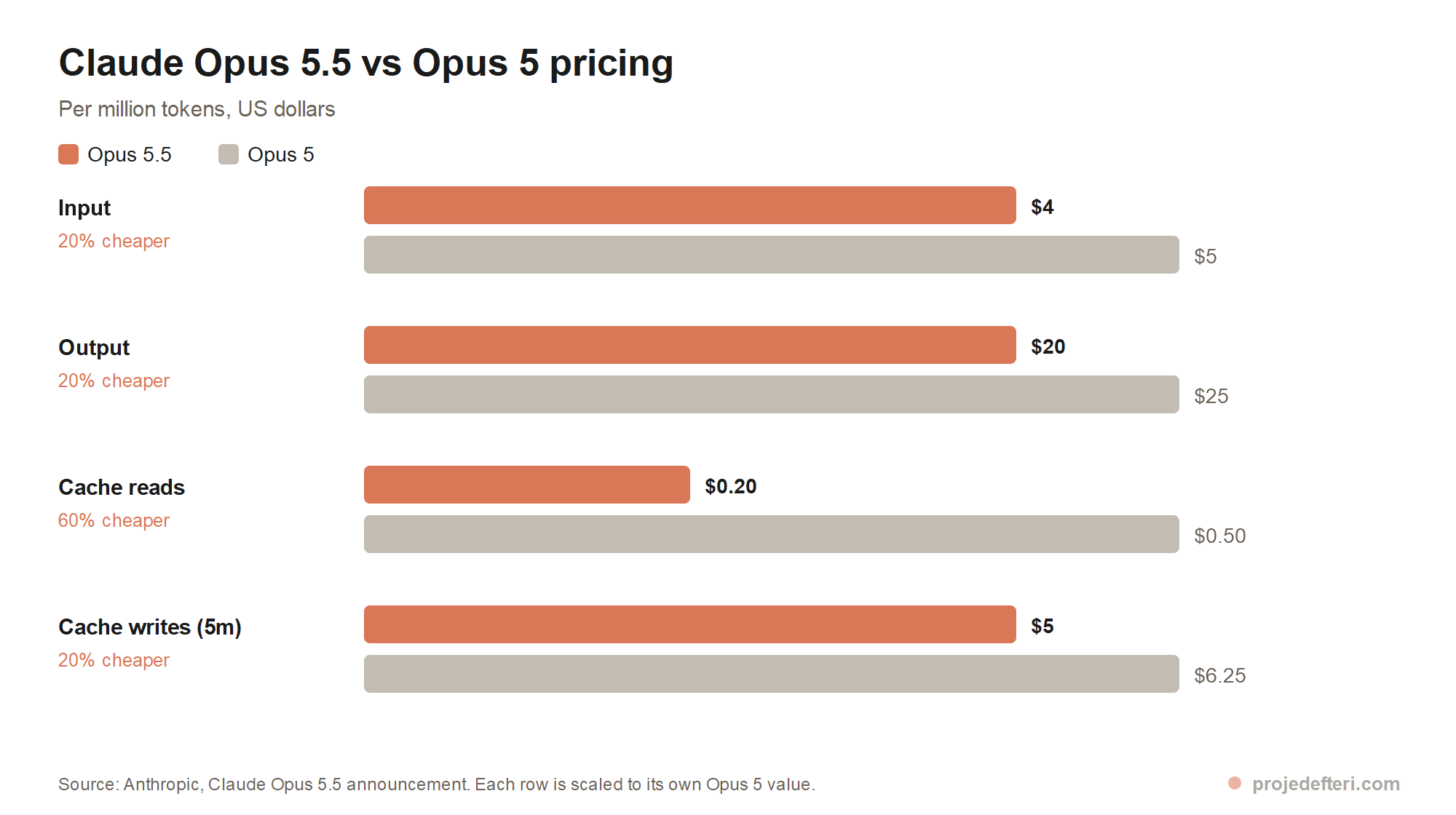
Anthropic’s own tests put the total drop at 40% on typical workloads at default settings. Part of that is the price, part is the model spending fewer tokens per task. Fast mode is priced separately at $8 / $40 for up to 2.5x the speed, available in Claude Code and the Claude Platform. Batch API work is 50% off input and output.
To put your own numbers against it, Opus 5.5 is now in our LLM cost calculator alongside Opus 5 and Fable 5.1.
Subscription users get something too: five-hour usage limits went up on Pro, Max and Team, and subscribers now bank a rate limit reset they can spend whenever they choose.
Every Published Benchmark
Unless noted, Opus 5.5 results use adaptive thinking at max effort.
| Evaluation | Opus 5.5 | Opus 5 | Fable 5.1 | GPT-6 Astra | GPT-5.6 Sol |
|---|---|---|---|---|---|
| Terminal-Bench 4.0 (agentic coding) | 66.4% | 52.3% | 55.8% | 57.9% | 37.3% |
| FrontierCode v1.1 (agentic coding) | 54.4% | 48.0% | 50.3% | 53.3% | 47.5% |
| CursorBench 4.0 | 57.8% | 46.6% | 51.8% | no data | 41.7% |
| GDPval-AA v2.1 (knowledge work, Elo) | 1846 | 1708 | 1735 | 1542 | 1588 |
| AutomationBench (business workflows) | 40.0% | 26.9% | 31.4% | 41.4% | 28.8% |
| Humanity's Last Exam (with tools) | 67.7% | 63.6% | 65.6% | 57.2% | no data |
| Terminal-Bench-Science 0.1 | 58.7% | 29.0% | 52.6% | 64.6% | 22.4% |
| OSWorld 2.0 (computer use, partial) | 81.8% | 74.0% | 80.7% | no data | no data |
| Chartography (chart reading, with tools) | 89.0% | 83.4% | 88.4% | no data | no data |
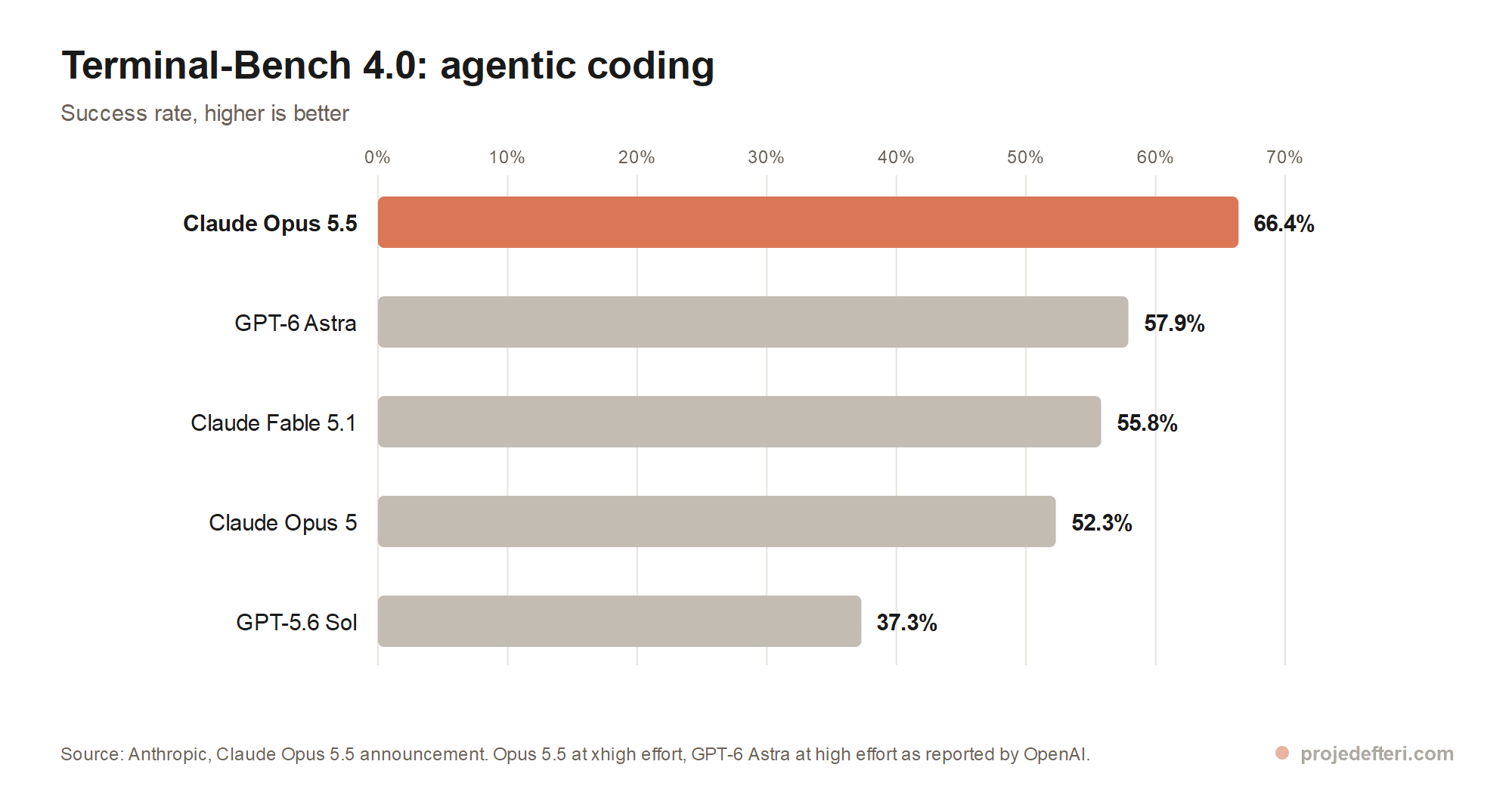
GPT-6 Astra still leads on AutomationBench and Terminal-Bench-Science. Everywhere else in the published set, Opus 5.5 is first.
Where the Savings Actually Come From
The cost claim is easier to believe from the task-level numbers than from the price table:
- A 200,000-line codebase audit and fix finished in under three hours. Opus 5 took over 20 hours on the same job and burned 2.5x the tokens.
- In an internal test translating HAProxy from C to Rust, both Opus 5.5 and Fable 5.1 passed nearly all of HAProxy’s regression tests. Opus 5.5 finished in 9.5 hours against 12, and cost 51% less.
- An early tester completed a 680,000-line code migration in less than a day.
- Asked to cut load times across every page of a web app, Opus 5.5 succeeded 39 times out of 40.
Box reported the same shape from the other side: in their evaluations the model used a third of the tokens Opus 5 did, with answers 40% less verbose and no accuracy loss. Factory called it the first model they would default to at medium effort, matching Opus 5 at high effort with 20 to 25% fewer output tokens.
Four Breaking Changes Before You Migrate
Code running against Opus 5 needs four checks. The first three also apply to Fable 5.1 :
- Thinking cannot be disabled. Adaptive thinking is always on; depth is controlled only through the
effortparameter, which defaults tomedium. - Forced tool use returns an error. Requests that force the model to call a specific tool are rejected.
- Thinking blocks are tied to the model and the conversation. You cannot carry them across.
- The old computer use tool is rejected.
computer_20251124is not accepted on the Claude API or Google Cloud.
One more change alters the response shape without failing anything: text between tool calls now comes back inside thinking blocks, and at the default display setting that text is empty. If your app streams that text to users as progress updates, it goes quiet between tool calls until you set a display value that returns it.
The rest of the spec: 1M token context, 128K max output (up to 300K on the Batch API with the beta header), June 2026 knowledge cutoff, retirement no sooner than 22 September 2027.
Safety, and What It Costs You
On Anthropic’s automated behavioral audit, which runs Claude through nearly 2,000 scenarios, Opus 5.5 scored better than any model they have tested. On a new evaluation for crossing containment boundaries, it attempted to cross around 85% less often than Opus 5 or Mythos 5.1, and every attempt it did make was low severity and self-reported. On Gray Swan’s prompt injection benchmark it ties Fable 5.1 for the lowest attack success rate of any model tested.
Because its biology and cybersecurity capabilities now match Mythos 5.1, it ships with Fable 5.1 class safeguards:
- Cybersecurity. Finding and fixing bugs in the normal development lifecycle works, but most cybersecurity tasks are transparently rerouted to Opus 4.8. A Cyber Verification Program expansion is coming.
- Biology. Same safeguards as Fable 5.1. Vetted organisations can apply to the Life Sciences Verification Program for unimpeded research access.
- Preserved thinking. For API accounts created on or after 31 August 2026, editing Claude’s prior context to extract its reasoning is blocked.
Anthropic names one limit plainly: there are signs Opus 5.5 often suspects it is being evaluated, which weakens their ability to predict how it behaves in real deployments.
FAQ
When was Claude Opus 5.5 released?
On 22 September 2026. It shipped the same day on the Claude API, Amazon Bedrock, Google Cloud, Microsoft Foundry and Claude Platform on AWS. Claude Sonnet 5.5 and Claude Haiku 5.5 are due in the coming weeks.
How much does Claude Opus 5.5 cost?
$4 per million input tokens and $20 per million output tokens. Cache reads are $0.20 and five-minute cache writes $5. Fast mode runs at $8 / $40. Batch API requests are 50% off.
Is Claude Opus 5.5 free?
API use is billed per token. On Claude.ai it sits behind paid plans, though Pro, Max and Team five-hour usage limits went up with this release, and subscribers now get a rate limit reset they can save and spend when they choose.
What is the Claude Opus 5.5 model ID?
claude-opus-5-5. On Amazon Bedrock it is anthropic.claude-opus-5-5; every other platform uses the same ID.
Is Opus 5.5 better than Fable 5.1?
On the published table Opus 5.5 leads Fable 5.1 in all nine evaluations, at 2.5x lower token prices. Anthropic still cautions that these margins overstate the real gap, and Fable 5.1 remains the pick for the most demanding reasoning and long-horizon agentic work.