
Anthropic today announced Claude Opus 5, the new flagship of the Claude family. The model brings a major jump over Opus 4.8 in agentic coding, knowledge work, computer use, and scientific research. Best of all, these gains ship at the same price. Let’s look at what the new model offers and where it stands against its rivals 🚀
What Is Claude Opus 5?
Opus 5 is Anthropic’s most capable general-access model to date. Replacing Opus 4.8 , it shines especially in complex, long-horizon agentic tasks.
Highlights:
- Same price: $5 per million input tokens, $25 per million output tokens (same as Opus 4.8)
- API model ID:
claude-opus-5 - New default model for Claude Max users
- Strongest model available on the Claude Pro plan
- Available via Claude API, Claude.ai, Claude Code, and Claude Cowork
Benchmark Results 📊
From coding to scientific reasoning, Opus 5 outperforms Opus 4.8 and most rivals across a wide range. Here are concrete numbers from Anthropic’s published comparison:
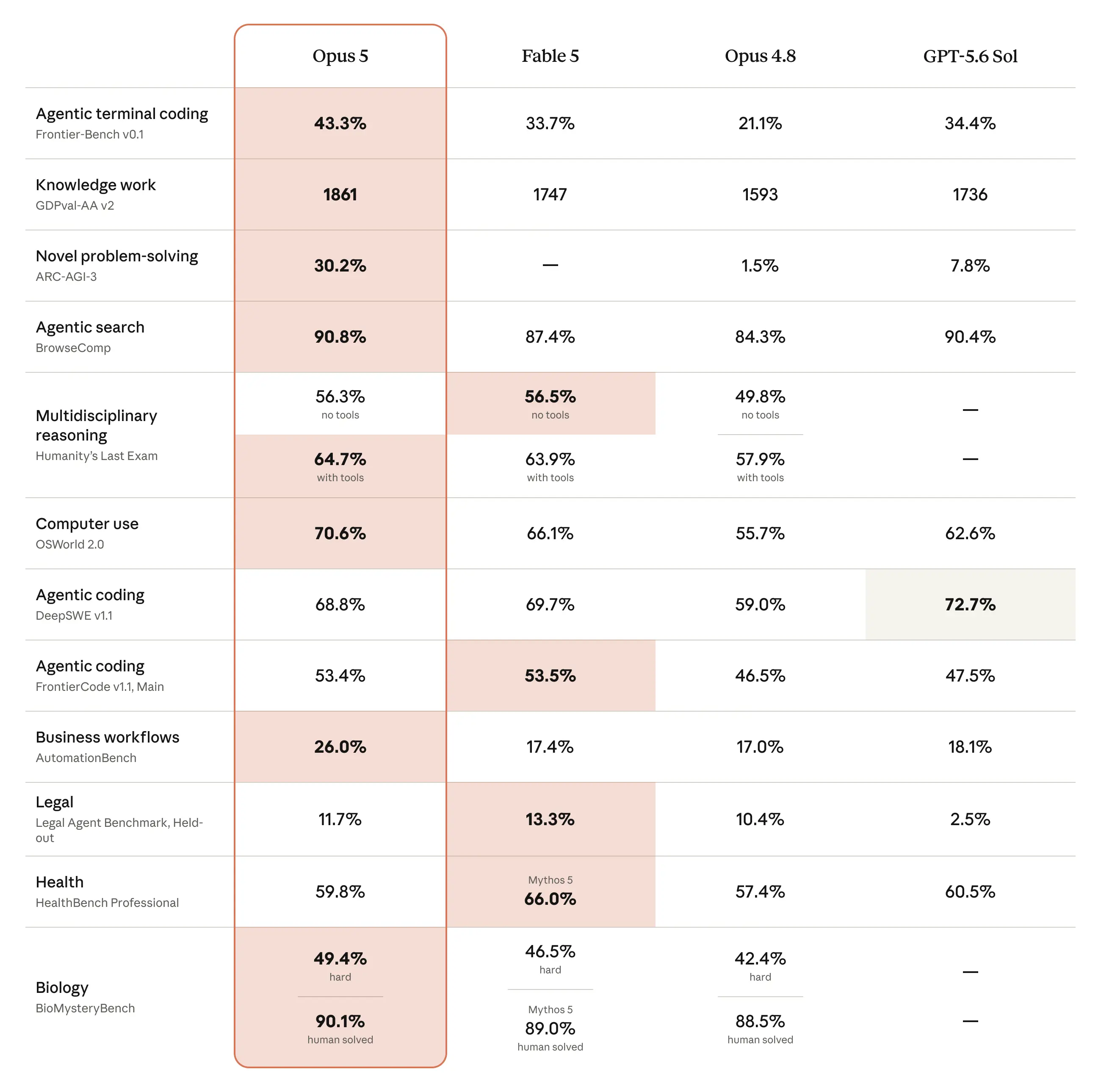
| Evaluation | Opus 5 | Fable 5 | Opus 4.8 | GPT-5.6 Sol |
|---|---|---|---|---|
| Frontier-Bench v0.1 (agentic terminal coding) | 43.3% | 33.7% | 21.1% | 34.4% |
| GDPval-AA v2 (knowledge work, ELO) | 1861 | 1747 | 1593 | 1736 |
| ARC-AGI-3 (novel problem-solving) | 30.2% | - | 1.5% | 7.8% |
| BrowseComp (agentic search) | 90.8% | 87.4% | 84.3% | 90.4% |
| Humanity's Last Exam (with tools) | 64.7% | 63.9% | 57.9% | - |
| OSWorld 2.0 (computer use) | 70.6% | 66.1% | 55.7% | 62.6% |
| FrontierCode v1.1 (agentic coding) | 53.4% | 53.5% | 46.5% | 47.5% |
| AutomationBench (business workflows) | 26.0% | 17.4% | 17.0% | 18.1% |
| BioMysteryBench (biology, hard) | 49.4% | 46.5% | 42.4% | - |
New Features 🎉
1. Fast Mode
Opus 5 introduces fast mode: the same model intelligence delivered roughly 2.5x faster. The trade-off is 2x the token price. A great fit for agentic workflows where low latency is critical.
2. Mid-Conversation Tool Changes (Beta)
On the Claude Platform you can now change the tools you expose to the model in the middle of a conversation. A meaningful convenience for agentic apps whose tool needs shift as a task progresses.
3. Automatic Fallbacks for Safety-Flagged Requests (Beta)
On the API, requests that hit safety filters now get an automatic fallback. When a request is flagged for safety, your app can proceed gracefully instead of failing hard.
Safety and Alignment Profile 🛡️
Anthropic shared Opus 5’s safety profile in detail:
- On automated behavioral audits, it scored 2.3 on the misaligned-behavior scale (the lowest among tested models).
- Cyber classifiers intervene about 85% less often on Opus 5 than on Fable 5, meaning fewer unnecessary refusals on legitimate security work.
- Overall guardrails are similar to Opus 4.8, but with stronger guardrails on select cyber tasks.
Scientific Research Performance 🔬
Opus 5 also moves ahead of Opus 4.8 in science:
- Life sciences: Better than Opus 4.8 across all evaluations
- Organic chemistry: 10.2 points higher than Opus 4.8
- Protein tasks: 7.7 points higher than Opus 4.8
The model is also markedly stronger at visual artifact generation (technical visualizations such as a wind tunnel or a cell illustration).
Early Reactions from the Field 💬
The Zapier CEO noted that Opus 5 topped the AutomationBench leaderboard without extra tokens and hit a 100% pass rate on some tests.
Frequently Asked Questions (FAQ) ❓
What is Claude Opus 5?
Claude Opus 5 is Anthropic’s most capable general-access AI model. It is clearly stronger than Opus 4.8 at agentic coding, knowledge work, computer use, and scientific research. As of July 24, 2026, it is available via Claude API, Claude.ai, Claude Code, and Claude Cowork.
When was Claude Opus 5 released?
Claude Opus 5 was released on July 24, 2026.
How much does Claude Opus 5 cost?
Pricing is the same as Opus 4.8: $5 per million input tokens and $25 per million output tokens. With fast mode the token price doubles, but response speed rises about 2.5x.
Is Claude Opus 5 free?
You can try the model on Claude.ai, but since Opus 5 is the top model it is tied to paid plans: it is the strongest model offered on Claude Pro and the default model on Claude Max. Programmatic use through the Claude API is billed at token rates ($5 / $25).
What is the Claude Opus 5 model ID?
The API model identifier is claude-opus-5. Use it when calling the model through Claude API, Claude Code, or Claude Cowork.
What are the Claude Opus 5 rate limits?
Usage limits depend on your plan, not the model. Claude Pro and Claude Max have their own message and usage quotas, and since Opus 5 is the default model on Max, that plan gives you the most room in practice. Anthropic did not publish a separate limit figure for Opus 5. On the API side there is token-based billing instead of a message cap.
What is the difference between Claude Opus 5 and Opus 4.8?
The most important differences:
- Coding: Doubles Opus 4.8 on Frontier-Bench (21.1% → 43.3%)
- Problem-solving: From 1.5% to 30.2% on ARC-AGI-3
- Computer use: From 55.7% to 70.6% on OSWorld 2.0
- Science: +10.2 in organic chemistry, +7.7 on protein tasks
- Fast mode: Optional 2.5x faster responses
- Safety: Lower misaligned-behavior score and fewer unnecessary refusals on cyber tasks
Claude Opus 5 or GPT-5.6, which is better?
It depends on the use case. Opus 5 beats GPT-5.6 Sol on Frontier-Bench, ARC-AGI-3, OSWorld, and AutomationBench. But GPT-5.6 Sol leads on DeepSWE v1.1 agentic coding (72.7%). For agentic workflows and computer use, Opus 5 is a strong pick.
Claude Opus 5 or Fable 5, which is better?
Fable 5 remains the top intelligence-class model and leads on some tests like FrontierCode, Legal, and HealthBench. But Opus 5 delivers performance very close to Fable 5 at a much lower cost on most tasks. On cost/performance, Opus 5 stands out.
Is Claude Opus 5 safe?
Per Anthropic’s data, Opus 5 scored the lowest misaligned-behavior score (2.3) among tested models on automated behavioral audits. High-risk cyber capabilities such as exploit development are deliberately limited. Still, no AI model is 100% safe.
Access and Pricing 💰
Claude Opus 5 is available on these channels:
- Claude API (direct)
- Claude.ai (web and mobile)
- Claude Code
- Claude Cowork
| Token Type | Price (Per Million Tokens) |
|---|---|
| Input Tokens | $5 |
| Output Tokens | $25 |
Opus 5 is now the default model for Claude Max users and the strongest model offered on the Claude Pro plan.
Conclusion
Claude Opus 5 raises the bar significantly, especially for agentic tasks. Doubling Opus 4.8 on coding, the huge gap on hard tests like ARC-AGI-3, and shipping it all at the same price make the model very compelling on cost/performance.
While Fable 5 still represents the top intelligence class, Opus 5 delivering near-Fable results at a much lower cost makes it the clear choice for many real-world workflows. Fast mode and mid-conversation tool changes add practical value for agentic applications too.
Have you tried Opus 5 yet? Did you feel the difference on coding and agentic tasks? Share it in the comments! 👇🏻
Happy coding! 🚀