- September 3, 2026: Google Research and HHMI Janelia published the complete nervous system map of an adult male fruit fly in Cell. 166,700 neurons, 125 million synapses, the largest brain map by neuron count so far.
- The map, a connectome, is a wiring diagram: which neuron connects to which. Nobody “uploaded” a brain. The netlist was extracted and released under CC-BY.
- Within a week developers put a simple neuron model on top of the wiring and fed game frames into the fly’s eye neurons: Doom (Sept 6), Minecraft and Mario 64 (Sept 7), Beat Saber (Sept 9, 22 million views), crypto trading (Sept 10). Videos below.
- DOOMFLY’s own validation report is blunt: the fly has not learned to survive. It failed all three gates, vision, conditioning and survival. What you see on screen is reflex from the wiring, not learning.
- You can run it yourself: browsing neuron by neuron in neuPrint needs zero install, a full-brain simulation with flypoke runs on a laptop from an 850 MB download, and DOOMFLY or StonkFly need 16 GB of RAM and Python 3.11.
“A fly brain was uploaded to a computer” was everywhere this week. Half of that sentence is true. The true half: an animal’s entire nervous system has been mapped neuron by neuron, synapse by synapse, and the map sits on a server as a file anyone can download. The false half is the idea that the file is a fly.
This post covers what was actually released, how the Doom-playing fly works under the hood, and how to run the simulation on your own machine. 👇🏻
What Happened: MaleCNS v1.0
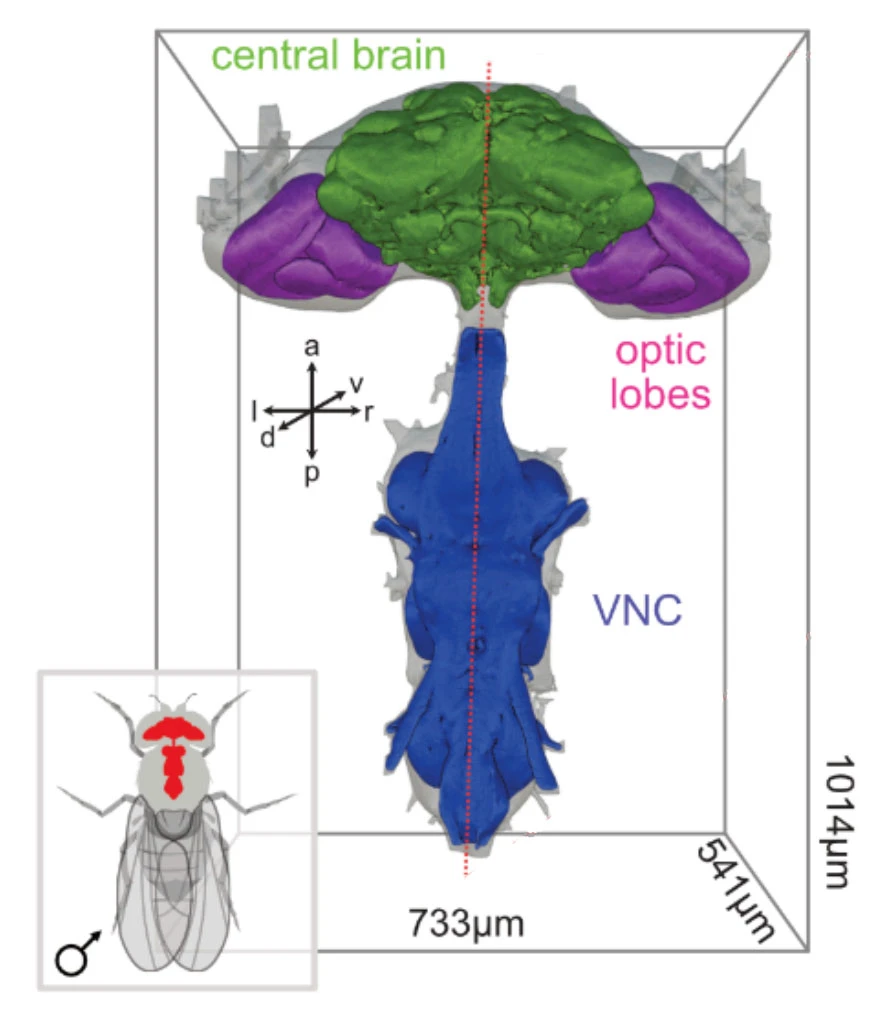
MaleCNS is a joint project of Janelia’s FlyEM team, the University of Cambridge, the MRC Laboratory of Molecular Biology and Google Research. It covers the full central nervous system of an adult male Drosophila melanogaster: brain, optic lobes and the ventral nerve cord, the fly’s equivalent of a spinal cord. The dataset went public as v1.0 on June 8, 2026. The Cell paper and Google’s blog post on September 3 pushed it into the mainstream, and the viral wave started there.
| Property | MaleCNS v1.0 (male) | FlyWire (female, 2024) |
|---|---|---|
| Coverage | Brain + ventral nerve cord | Brain only |
| Neurons | 166,700 | ~139,000 |
| Synapses | ~125 million | ~50 million |
| Neuron-pair connections | 25.6 million | 2.7 million |
| Cell types | 11,691 | ~8,400 |
| Publication | Cell, Sept 3, 2026 | Nature, Oct 2024 |
| License | CC-BY | CC-BY |
The method is the same connectomics pipeline Google has been building since 2018. The fly is cut into millions of thin slices under an electron microscope, each slice is imaged, and an AI model called a flood-filling network reconstructs 3D neuron shapes from the 2D images. This release added a reconstruction system named PATHFINDER and synthetic neurons in the training data to cut error rates. Humans still have the last word: Janelia experts verified all 166,000 neurons by hand and sorted them into 11,691 types.
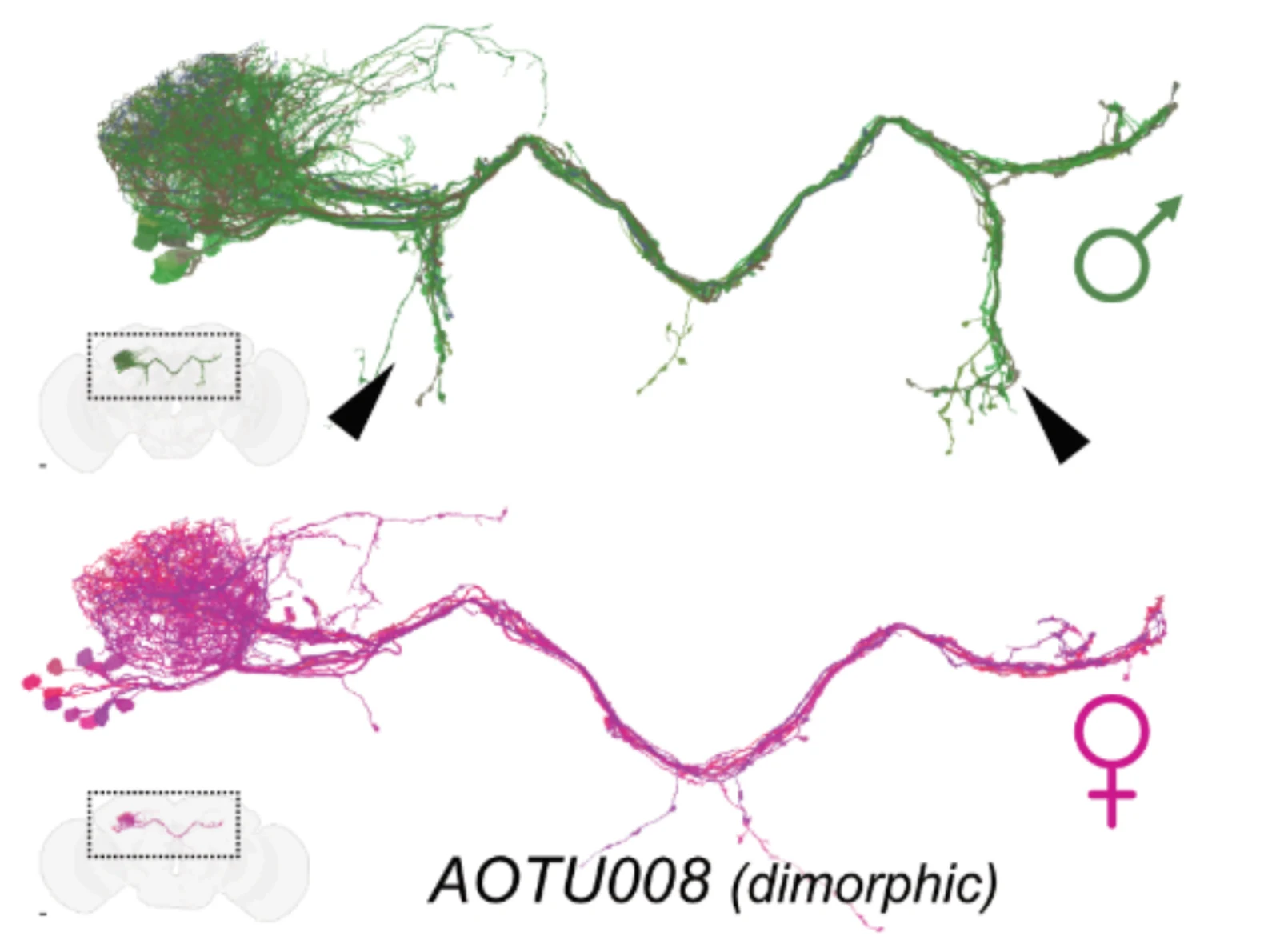
The scientific value of a male map is that it can sit next to the female FlyWire map. The paper’s title says as much: sexual dimorphism. Wiring differences in courtship and aggression circuits can now be compared at synapse resolution for the first time.
What a Connectome Is, and Why “Upload” Is the Wrong Word
A connectome is the list of every neuron in a nervous system and every connection between them. In electronics terms it is a netlist: which pin goes to which pin, and with how many wires. That is all.
A netlist does not tell you what the circuit does. There are no resistor values, no capacitances, no transistor characteristics. The connectome is missing the equivalent: real synaptic weights, membrane dynamics, neurotransmitter quantities, hormonal effects, and every connection that changes with learning. The map is a snapshot of one moment; the living fly rewrites it every second.
So how does an “empty” wiring diagram do anything at all? The answer is the method Philip Shiu and colleagues showed in Nature in 2024. Give every neuron the simplest possible model, leaky integrate-and-fire: the neuron sums incoming signals, fires when it crosses a threshold, otherwise the charge leaks away. Use the count of synapses between two neurons as the connection weight, and mark each connection excitatory or inhibitory based on the predicted neurotransmitter. Nothing more.
Then the experiment: stimulate the sugar-sensing taste neurons at 150 Hz. In the model, the MN9 motor neuron that extends the proboscis fires at 150 Hz, so the fly starts “feeding”. Add the bitter-sensing neurons and MN9 drops to 14 Hz. Nothing about feeding was coded into the model. The behavior fell out of the wiring alone. Every viral demo is built on that result.
How the Doom-Playing Fly Works
Alex Wormuth’s DOOMFLY is open source, so the mechanism is fully known. The loop:
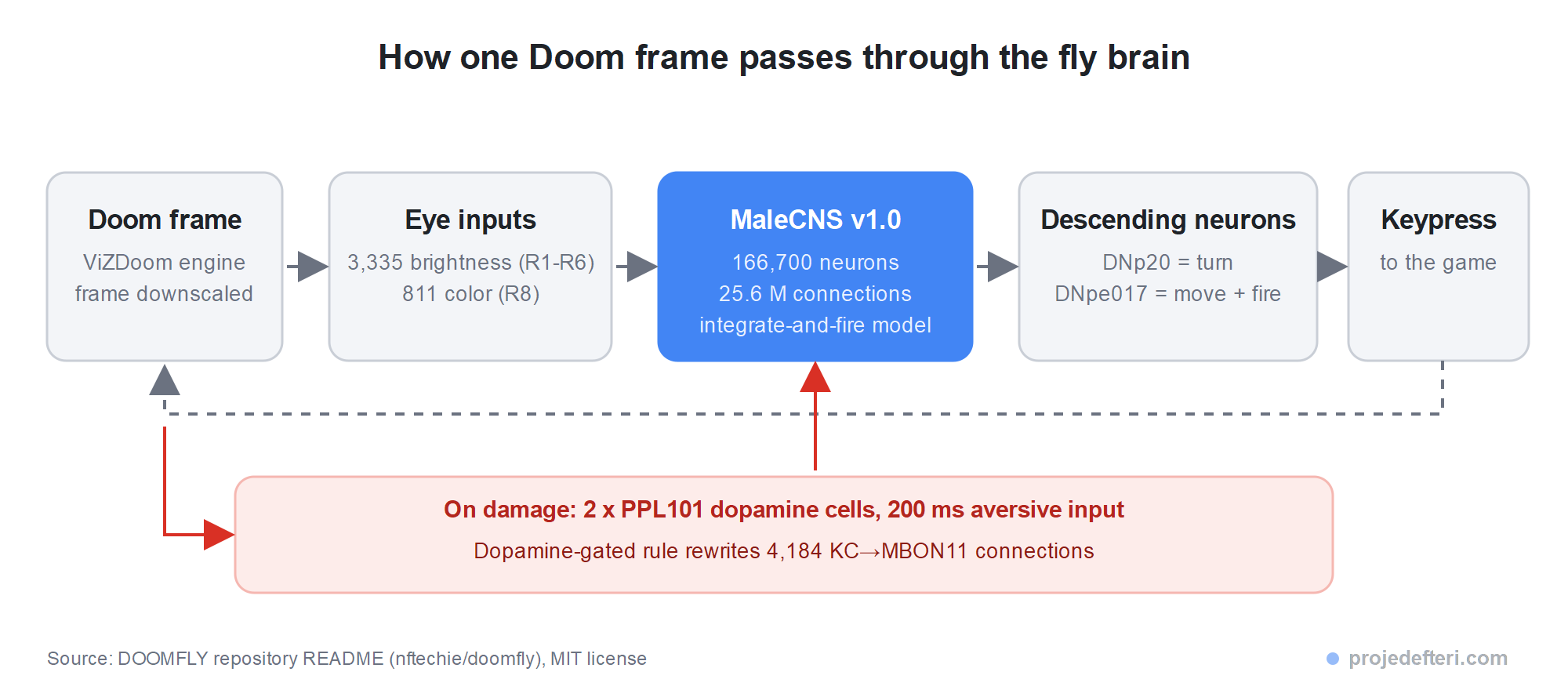
- A frame goes in. The ViZDoom engine renders a Doom frame. It is downscaled and mapped onto the photoreceptors of the fly’s eye: 3,335 brightness inputs (R1-R6 cells) and 811 color inputs (R8 cells). That is how a real fly sees: one ommatidium, one pixel.
- The brain runs. Approximate neural dynamics are computed across 166,700 neurons and 25.6 million connections. The visual signal spreads from the optic lobes into the central brain.
- A key comes out. A fixed interface reads the activity of two groups of descending neurons, the ones that carry commands from brain to nerve cord: DNp20 active means turn, DNpe017 active means move and fire. In a real fly these neurons trigger escape and steering.
- Punishment. When the player takes damage, two PPL101 dopamine cells get a 200 millisecond artificial aversive input. A dopamine-gated memory rule then changes the weights of 4,184 KC→MBON11 connections in the mushroom body. In a real fly, that is exactly the circuit that learns to pair a smell with punishment.
The Beat Saber demo (@lyraaaa) and the Minecraft video (Ro0oney) use the same skeleton: frame in, read descending neurons, map to keys. In StonkFly the input is a candlestick chart and the output is buy, sell or hold; profit stimulates 15 PAM11 dopamine cells, loss stimulates 2 PPL101 cells.
That is also where the joke “the more aroused the fly is, the harder it tries to shoot” comes from. More motion on screen means more firing in the visual neurons, DNpe017 crosses threshold more often, and the character pulls the trigger more. Reflex, not strategy.
The Viral Demos and Timeline
Sept 3: Google Research blog post and the Cell paper.
Sept 6: Alex Wormuth announces he is “training” the fly brain to play Doom. The DOOMFLY demo and source code followed on Sept 9.
Alex Wormuth: training a fly brain to play Doom on MaleCNS v1.0 (video)
Sept 7: Jessica Paquette, a fly brain playing Mario 64. Same day, Ro0oney’s “I Put A Fly’s Conscious Brain into Minecraft”, 241,000 views in three days.
Jessica Paquette: playing Mario 64 using a fly's brain (video)
Sept 9: lyra bubbles’ Beat Saber clip. 22 million views in two days, the real trigger of the wave. The author later clarified that the motor system in the video replays a recorded sequence, while the visual reactions are still being trained with reinforcement learning.
lyra bubbles: "the fly brain can play beat saber" (video)
Sept 10: Wormuth again with StonkFly: he gave the fly brain $100 to trade Bitcoin on Coinbase, 3.4 million views. Same day, a fly brain parallel parking (@alright_mark), 1.5 million.
Alex Wormuth: giving the fly brain $100 to trade Bitcoin (video)
Sept 11-13: worldwide search interest for “fly brain” hit its all-time peak and was still climbing when this post went up.
Run It Yourself: Three Levels
Level 1: Browse in the browser, zero install
The official front door is male-cns.janelia.org , which links to three tools:
- neuPrint (neuprint.janelia.org, dataset
male-cns:v1.0): type a neuron type and it lists every input and output with synapse counts. Type DNp20 from DOOMFLY and see how many neurons feed it. - Neuroglancer: the 3D viewer. Pick a single neuron and rotate it with every branch. Runs in the browser, WebGL is enough.
- Dimorphism Explorer: the same neuron type in the male and female fly, side by side.
The downloads page has images, synapse tables and neuron skeletons. For programmatic access there is neuprint-python and the malecns R package.
Level 2: A full-brain simulation on a laptop
If you want the “does wiring alone produce behavior” experiment without the game layer, the cleanest route is flypoke. It runs the Shiu model on the female FlyWire map (release 783, 139,000 neurons). No GPU required.
git clone https://github.com/vshapenko/flypoke
cd flypoke
uv sync
uv run flypoke download   # ~850 MB, one time
uv run flypoke feeding    # the sugar / bitter experiment
The first run takes about a minute because it builds and caches the weight matrix; later one-second trials take a few seconds. The fun part is poking your own neurons:
uv run flypoke poke --stim "cell_sub_class=sugar/water" --rate 150 --trials 5 \
  --watch "cell_sub_class=ingestion_motor_neuron"
That command reproduces the Nature result on your desk: drive 129 taste neurons at 150 Hz and MN9 answers at 150 Hz; add 65 bitter neurons and it drops to 14 Hz.
Level 3: Doom or the stock market
DOOMFLY (github.com/nftechie/doomfly): Python 3.11 or newer, a C++ compiler, ViZDoom, and Node.js 22 for the spectator UI. The README says “several GB” of RAM; 16 GB is comfortable. Install order: virtual environment, requirements-neural.txt, then python -m doom.connectome malecns_v1 to download the three MaleCNS files and verify their checksums, then doom.prepare and doom.build_kernel. The simulation starts with python -m doom.server --model experimental-v6 --learning, the viewer with npm run dev in a second terminal.
StonkFly (github.com/nftechie/stonkfly) is simpler, four commands:
python3.11 -m venv .venv && source .venv/bin/activate
pip install -e '.[test]'
python -m stonkfly prepare
python -m stonkfly run
The default is paper trading: real BTC-USDC data, a $100 simulated balance, no API key. Live mode needs a Coinbase key, and the repo caps it at a 100 USDC portfolio, $10 orders and 24 attempts per day. Do not try it with real money; the README itself says profitable learning has not been demonstrated.
Does the Fly Learn? Is It Conscious?
Short answer to both: no.
Learning. The DOOMFLY repo ships a validation report, and it is honest: the current v6 candidate failed the vision, conditioning and survival gates. Changing weights and longer rounds do not count as learning. StonkFly carries the same note. The dopamine rule changes something, but the change never turns into a measurable skill.
There is a structural reason. The map has no plasticity. A real fly playing Doom would rewire millions of synapses within hours; the model changes only 4,184 connections, under one hand-picked rule. Then there is the neuromodulator problem: dopamine, octopamine and serotonin change the gain of entire circuits in a real brain, while the model treats them as excitatory or ignores them.
Consciousness. A connectome is not a fly, it is a fly’s connection list. The Reddit scenario of “a fly suffering in an infinite Doom hell” is a good philosophy exercise, but the model contains no mechanism that could produce suffering; the signal into PPL101 is a number. The Human Brain Project promised a simulated human brain within a decade in 2013, was met with an open letter from 750 neuroscientists, and closed in 2023 without reaching that goal. A fly is a much smaller target, and the gap between “wiring plus simple neurons” and “a mind” is still open.
What Comes Next
The scale gap is stark. A fly is 166,000 neurons. The MICrONS dataset released in 2025 covered one cubic millimeter of mouse visual cortex with roughly 200,000 cells and over 500 million synapses; a whole mouse brain is about 500 times that. A human brain is 86 billion neurons. Google’s own estimate is that a complete mouse brain map is feasible within the decade but needs zettabyte-scale data.
The more interesting near-term story is that two complete fly maps now sit side by side. Male-female differences in the courtship circuit are the first concrete finding; how the mushroom body, the learning center, is wired differently in the two sexes is the next question. On the hobbyist side, tools like flypoke have squeezed “brain simulation” onto a laptop for the first time. The next viral demo will probably not be Doom, but a real circuit somebody finds at home.
Frequently Asked Questions
Was a fly brain really uploaded to a computer? No. What was released is the connection map of the neurons, the connectome. Synaptic weights, neuron dynamics and connections that change with learning are not in the map. Developers run simulations by putting a simple neuron model on top of it.
What is a connectome? The list of every neuron in a nervous system and every synaptic connection between them. MaleCNS v1.0 contains 166,700 neurons and about 125 million synapses for the entire male fruit fly.
How does the fly brain play Doom? Each game frame is fed to the eye neurons as 3,335 brightness and 811 color inputs. The signal passes through a 166,700-neuron simulation; if descending neuron DNp20 is active the character turns, if DNpe017 is active it moves and fires. Damage sends a 200 ms punishment signal to the PPL101 dopamine cells.
Does the fly learn? No. According to DOOMFLY’s own validation report, the v6 model failed the vision, conditioning and survival tests. StonkFly has not demonstrated profitable learning either.
Can I run the simulation on my own computer? Yes. flypoke runs on a laptop without a GPU from an 850 MB download. DOOMFLY and StonkFly need Python 3.11, a C++ compiler and 16 GB of RAM. The dataset is CC-BY licensed and can also be browsed in neuPrint with no install.
When will this be done for a human brain? Not soon. A human brain has 86 billion neurons, about 500,000 times the fly. The next target is a full mouse brain, and even that needs zettabyte-scale data.