On July 21, 2026, Google announced three new Gemini models at once: Gemini 3.6 Flash, Gemini 3.5 Flash-Lite, and the defense-focused Gemini 3.5 Flash Cyber. The theme of the announcement is clear: not higher scores, but getting the same job done with fewer tokens.
As agentic workflows move into production, the bill is driven less by how smart a model is and more by how many tokens that intelligence burns. Google aimed straight at that. Here are the details.
Gemini 3.6 Flash: The New Workhorse
Google calls 3.6 Flash its workhorse model, built for coding, knowledge work, and multimodal tasks.
The most striking number is not a benchmark score but an efficiency figure: according to the Artificial Analysis Index, the model completes the same work with 17% fewer output tokens than Gemini 3.5 Flash. On some benchmarks like DeepSWE, that saving reaches 65%.
In absolute terms, average output tokens per task:
- DeepSWE v1.1: 3.5 Flash burned 276,000 tokens, 3.6 Flash finishes the same task in 97,000
- Artificial Analysis Intelligence Index: down from 28,000 to 23,000
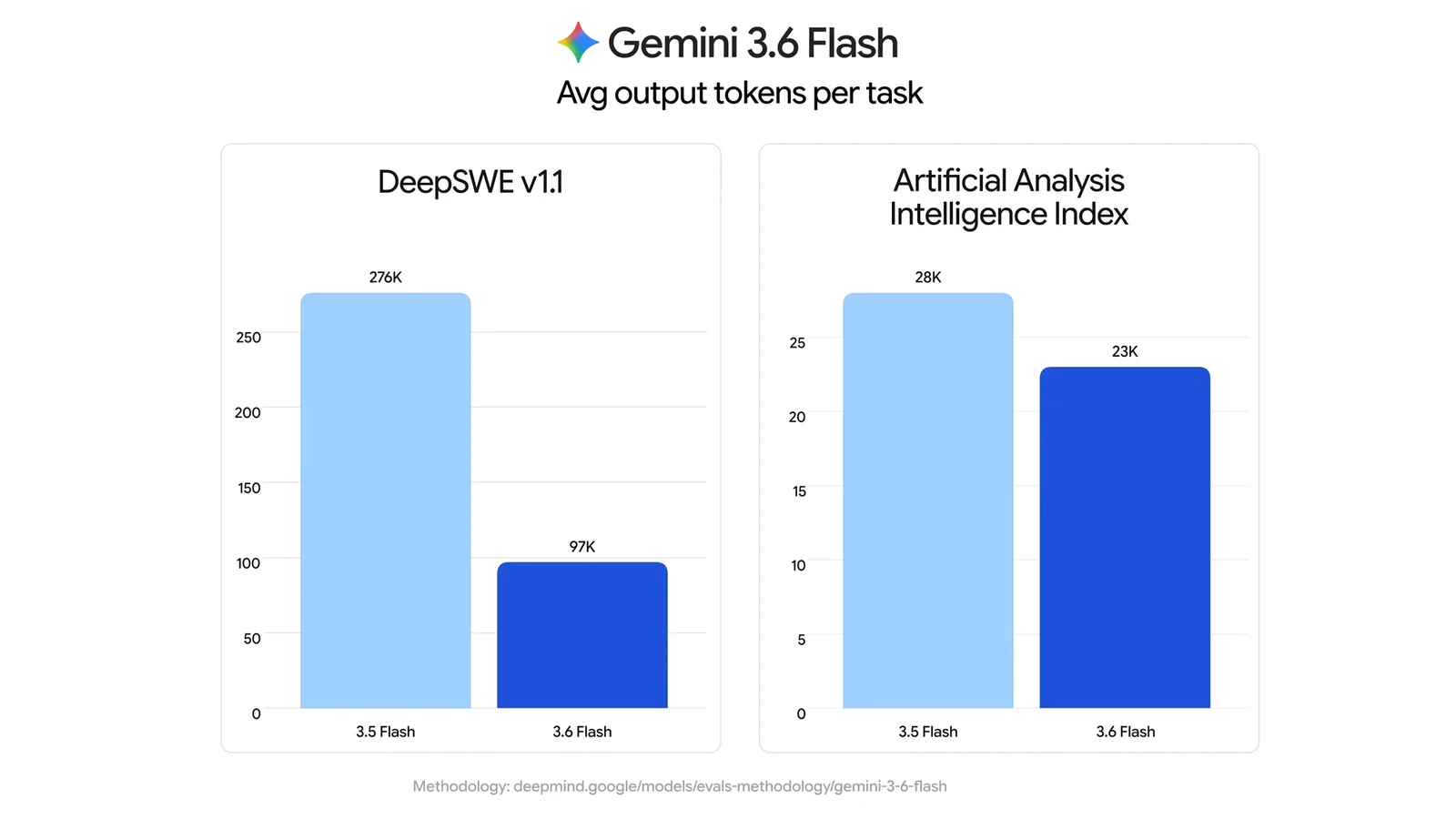
For anyone running a coding agent, that is close to a two-thirds cut in the bill. And the scores went up at the same time.
Benchmark highlights (3.1 Pro / 3.5 Flash / 3.6 Flash):
- DeepSWE v1.1 (long-horizon software engineering): 12% / 37% / 49%
- MLE-Bench (machine learning engineering): 42.6% / 49.7% / 63.9%
- GDPVal-AA v2 (knowledge work, Elo): 965 / 1349 / 1421
- OSWorld-Verified (computer use): 76.2% / 78.4% / 83.0%
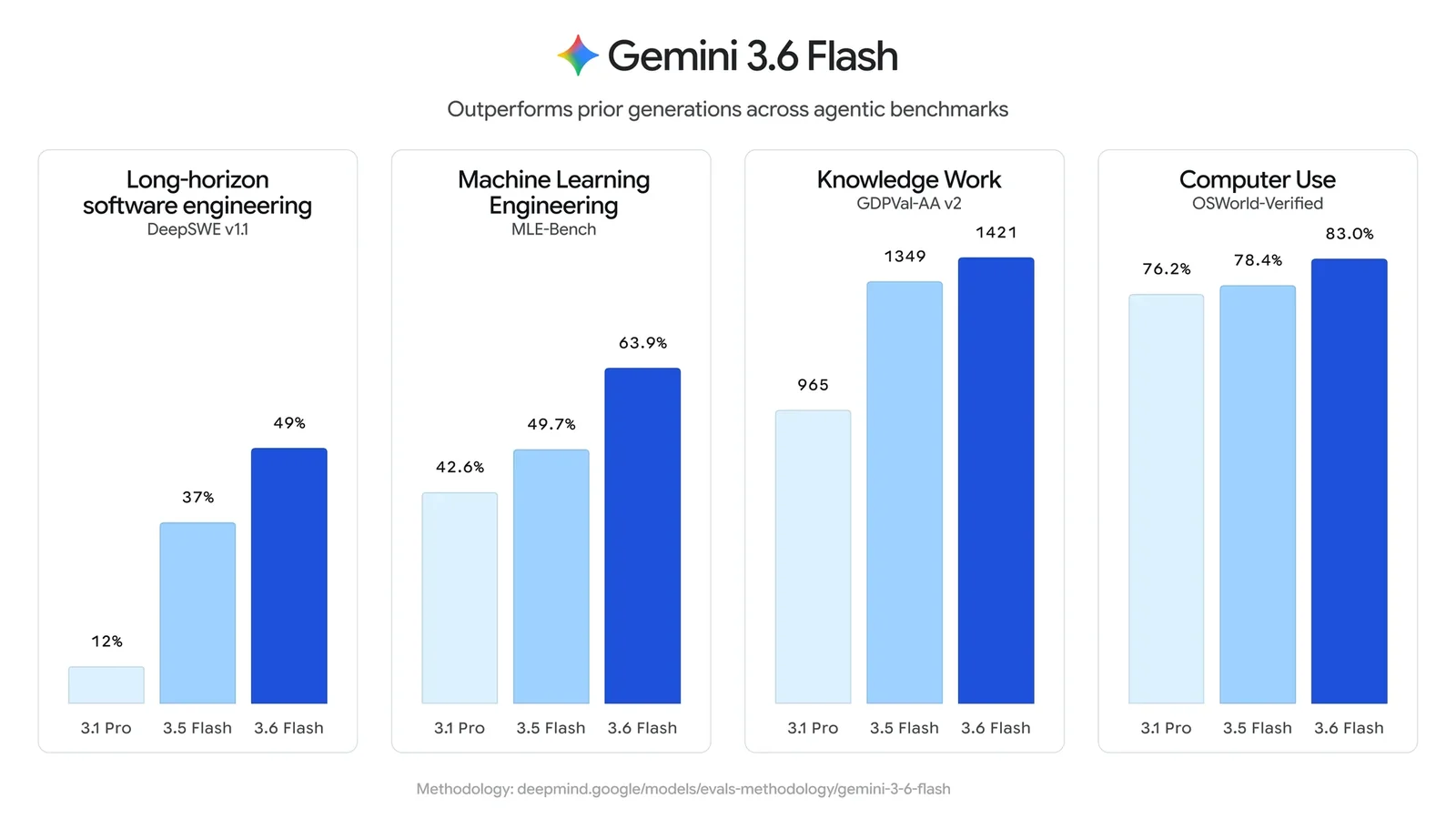
The jump from 12% to 49% on DeepSWE stands out: a Flash-class model quadrupling the Pro model from two generations back.
On the coding side the most concrete win is behavioral: the model makes fewer unwanted file edits and stops falling into repeated execution loops. Those were exactly the two complaints people had about agents in practice.
Where 3.6 Flash Lands Against Rivals
Google published a full table putting 3.6 Flash next to GPT-5.6 Luna, Grok 4.5, and Claude Sonnet 5. It is an honest table, because the places where 3.6 Flash loses are visible too.
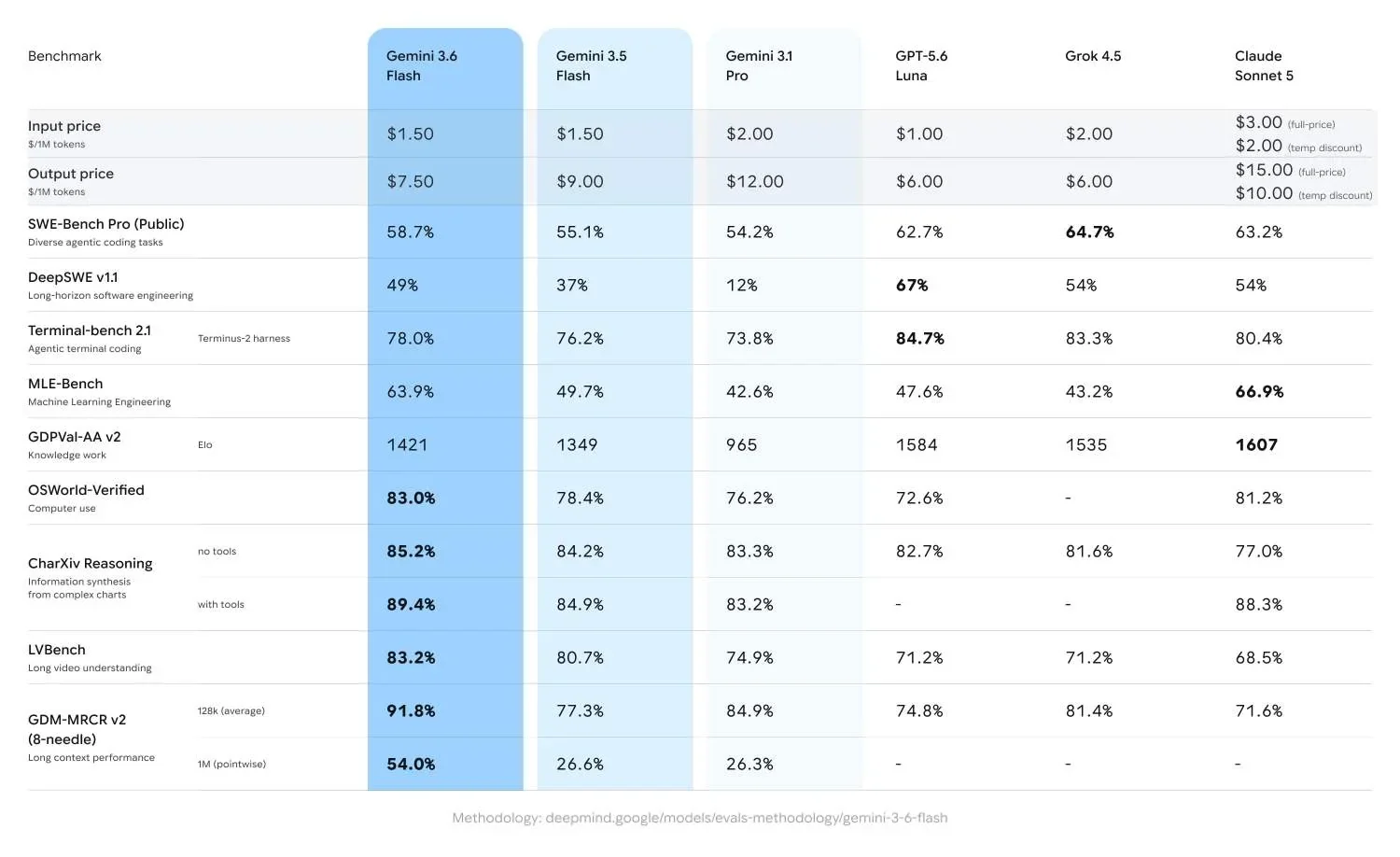
Where 3.6 Flash leads:
- OSWorld-Verified (computer use): 83.0%, top of the table (Claude Sonnet 5: 81.2%, GPT-5.6 Luna: 72.6%)
- GDM-MRCR v2 long context: 91.8% at 128k and 54.0% at 1M, roughly double the runner-up at the 1M mark
- LVBench (long video understanding): 83.2% against 71.2% for the nearest rival
- CharXiv Reasoning (pulling information out of complex charts): 85.2% without tools, 89.4% with tools, first in both modes
Where it falls behind:
- DeepSWE v1.1: 49%, with GPT-5.6 Luna well clear at 67%
- Terminal-bench 2.1: 78.0% versus Luna’s 84.7%
- SWE-Bench Pro: 58.7% versus Grok 4.5’s 64.7%
- GDPVal-AA v2: 1421 versus Claude Sonnet 5’s 1607
The table tells a clear story: 3.6 Flash is not the top pick for pure agentic coding, but it punches above its class on multimodal work, long context, and computer use. Factor in price (Claude Sonnet 5 charges $15 per 1M output tokens against $7.50 here) and the equation shifts again.
Gemini 3.5 Flash-Lite: Speed and Low Cost
Flash-Lite is the fastest and cheapest member of the family, designed for high-throughput, repetitive work: agentic search, document processing, classification.
According to the Artificial Analysis Index it produces 350 output tokens per second, which matters a lot for real-time interfaces.
Scores (its predecessor Gemini 3.1 Flash-Lite in parentheses):
- Terminal-bench 2.1 (agentic terminal coding): 54.0% (31.0%)
- GDPVal-AA v2 (knowledge work, Elo): 1140 (642)
- SWE-Bench Pro: 54.2% (38.3%)
- OSWorld-Verified: 74.0% (54.3%)
- MLE-Bench: 39.2% (22.0%)
- GDM-MRCR v2 (long context, 128k): 72.2% (60.1%)
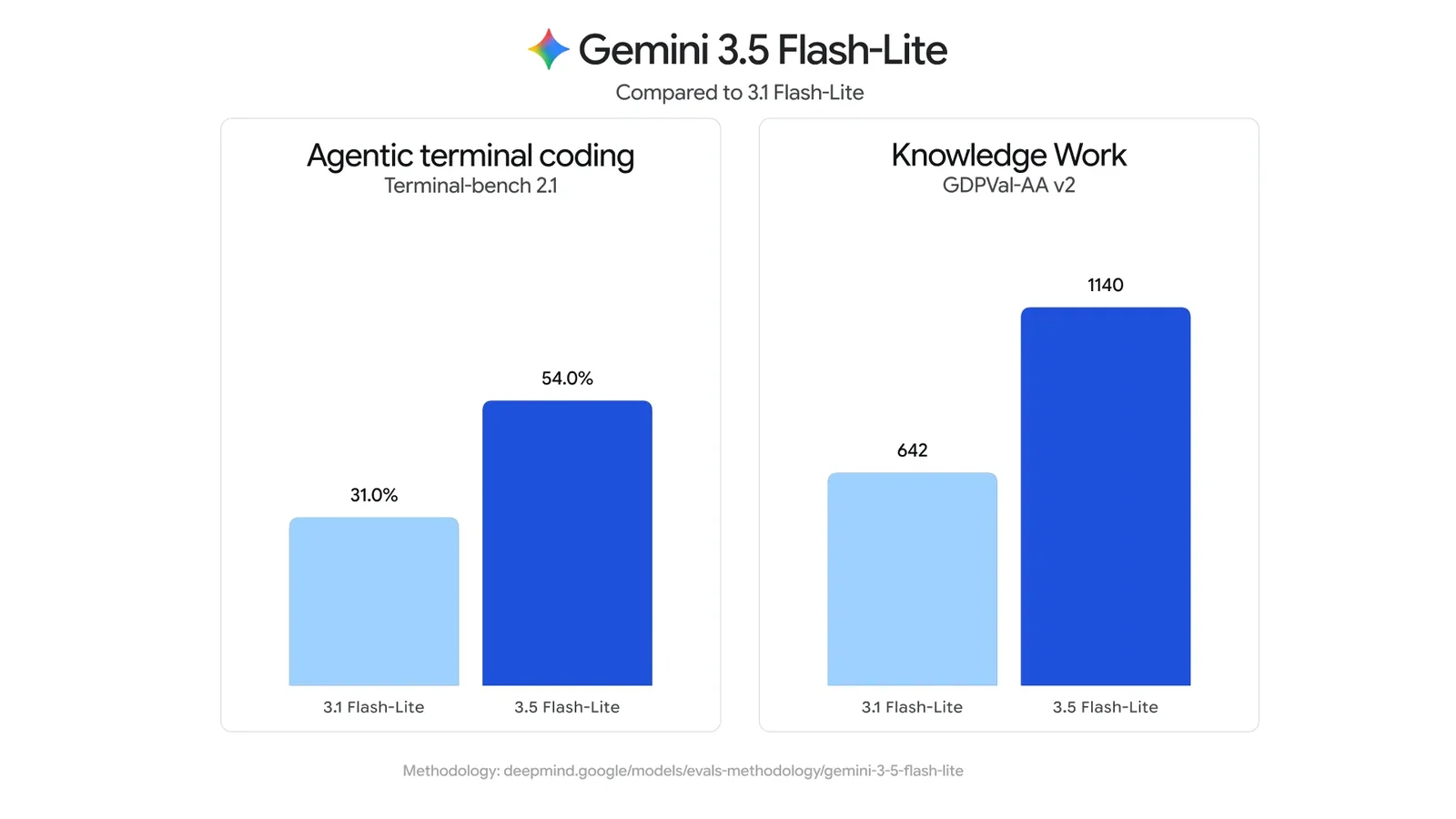
The jump from 642 to 1140 on GDPVal-AA v2 is the single most dramatic data point in the whole announcement, and it comes from the smallest model. Nearly double.
Here is the more interesting part: Flash-Lite now also beats the full-size Flash model from the previous generation.
- SWE-Bench Pro (Public): 3 Flash 49.6% → 3.5 Flash-Lite 54.2%
- OSWorld-Verified: 3 Flash 65.1% → 3.5 Flash-Lite 74.0%
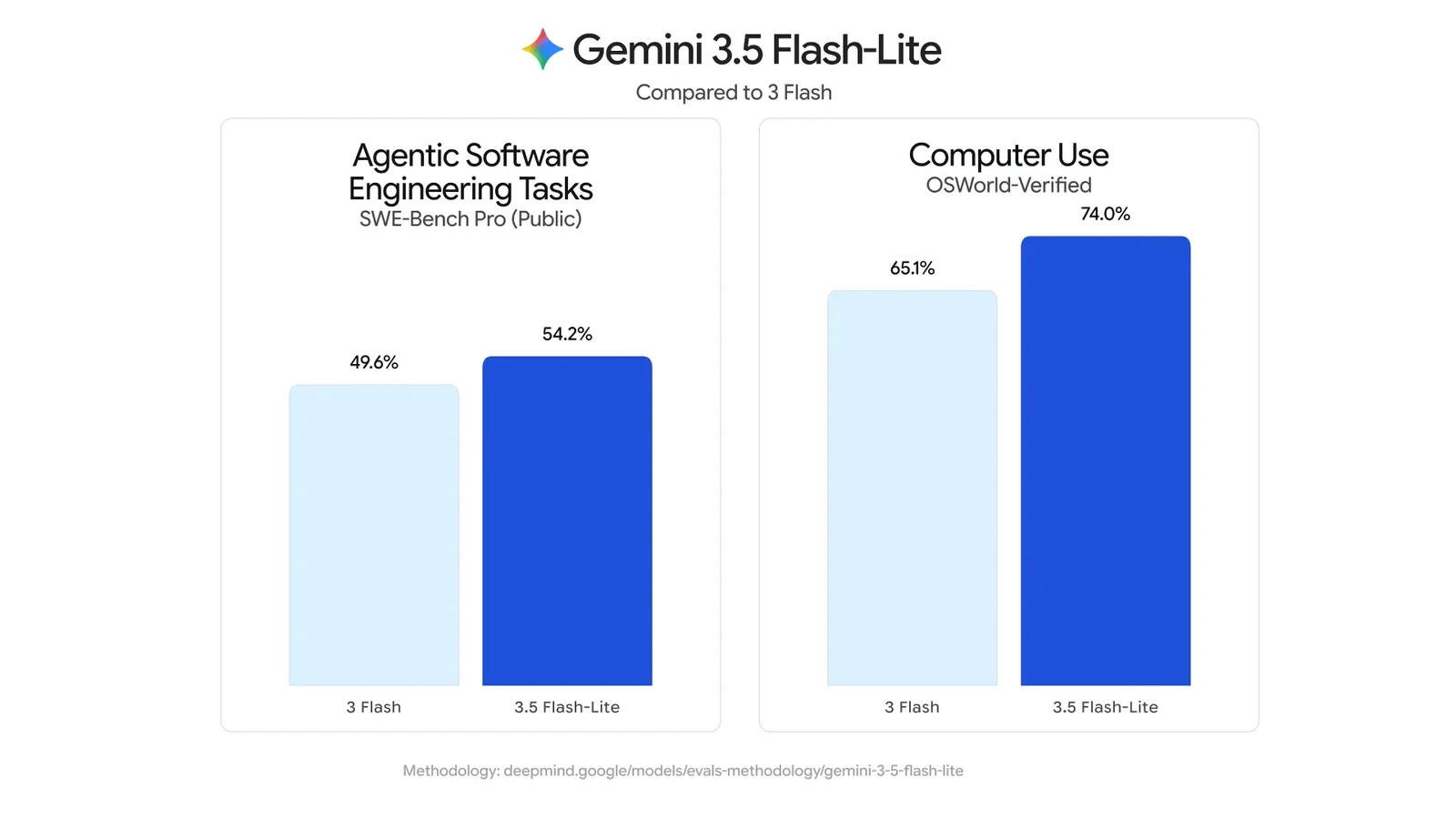
The “Lite” label carries less meaning than it used to. If you are still on last generation’s main model, moving to this generation’s cheapest one buys you both lower cost and higher scores.
Against rivals the picture holds up too:
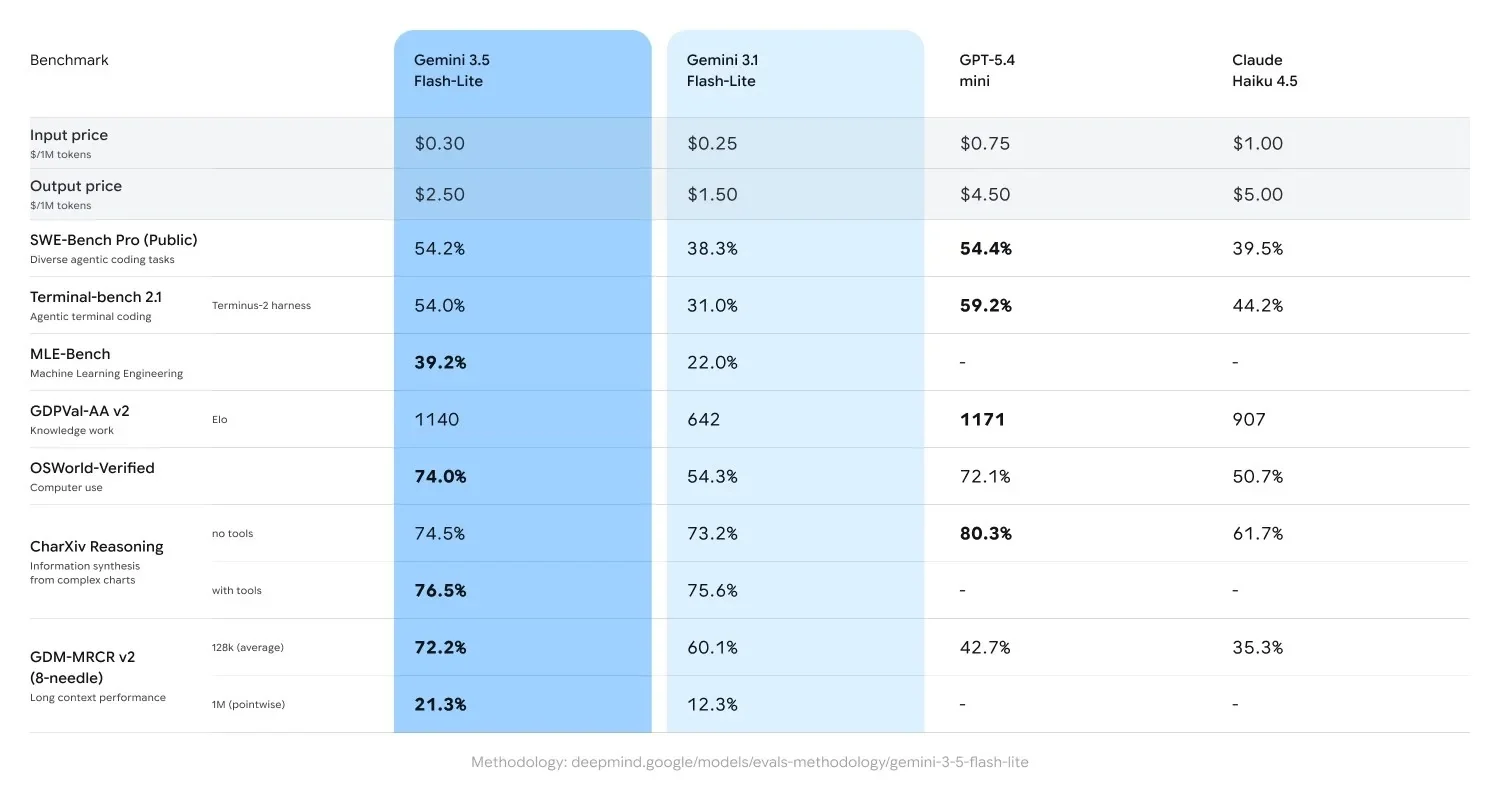
At 74.0% on OSWorld-Verified, Flash-Lite beats both GPT-5.4 mini (72.1%) and Claude Haiku 4.5 (50.7%). The long-context gap is wider still: 72.2% on GDM-MRCR v2 at 128k against 42.7% for GPT-5.4 mini and 35.3% for Haiku 4.5. GPT-5.4 mini does take agentic terminal coding, though, at 59.2%.
Flash-Lite also exposes configurable thinking levels: minimal, low, and higher. For simple classification jobs you can pick minimal and push the cost down as far as it goes.
Pricing: The Real Story
Prices per 1M tokens:
| Model | Input | Output |
|---|---|---|
| Gemini 3.6 Flash | $1.50 | $7.50 |
| Gemini 3.5 Flash-Lite | $0.30 | $2.50 |
Output on 3.5 Flash was $9, so 3.6 Flash drops it to $7.50. Add the 17% reduction in generated tokens on top, and the total cost drop on a given workload is considerably larger than the headline price cut suggests.
Where You Can Use Them
Both models are available starting today through:
- Gemini API and Google AI Studio
- Android Studio
- Google Antigravity (3.6 Flash)
- Gemini Enterprise Agent Platform and the Gemini Enterprise app
- The Gemini app
- GitHub Copilot (3.6 Flash)
- Google Search (3.5 Flash-Lite, rolling out)
Figma, Harvey, Hebbia, JetBrains, Palo Alto Networks, and Ramp appeared in the announcement as early adopters. Their comments all land on the same point: the balance between token efficiency and accuracy.
When Is Gemini 3.5 Pro Coming? What About Gemini 4?
Two sentences at the end of the post turned out to be the most discussed part:
- Gemini 3.5 Pro is currently in testing with partners and will go broadly available “as soon as it’s ready.” No date was given.
- Gemini 4 has entered pre-training. Google describes it as its “most ambitious pre-training run yet.” No release date either.
The real message here is half-hidden. Google could not get its flagship Pro model out, and shipped two Flash-class models instead. Seeing 3.5 Pro stuck in partner testing makes this announcement read like a gap-filler.
The numbers still work in Google’s favour, though: 3.6 Flash beats Gemini 3.1 Pro, two generations up, on nearly every benchmark (49% vs 12% on DeepSWE, 83.0% vs 76.2% on OSWorld-Verified), while costing $1.50 instead of $2.00 on input and $7.50 instead of $12.00 on output. Plenty of people waiting on Pro can just move to Flash.
So this release is not a season finale, it is an interim update. The bigger move is still ahead.
Conclusion
Gemini 3.6 Flash and 3.5 Flash-Lite mark the new front in the AI race. The question is shifting from “which model is smarter” to “which model finishes the same job for less.” For teams already running agents in production, that is worth far more than a few points on a leaderboard.
Which one will you try? Is token cost or raw performance the priority in your projects? Let us know in the comments! 👇
Frequently Asked Questions
What is Gemini 3.6 Flash?
Gemini 3.6 Flash is the AI model Google announced on July 21, 2026, built for coding, knowledge work, and multimodal tasks. Its headline trait is token efficiency: it completes the same work with 17% fewer output tokens than Gemini 3.5 Flash, and on benchmarks like DeepSWE that saving reaches 65%.
When was Gemini 3.6 Flash released?
It was announced on July 21, 2026 and became available the same day, alongside Gemini 3.5 Flash-Lite and the limited-access Gemini 3.5 Flash Cyber.
How much does Gemini 3.6 Flash cost?
$1.50 per 1M input tokens and $7.50 per 1M output tokens. Gemini 3.5 Flash charged $9 on output, so output got cheaper. Gemini 3.5 Flash-Lite is the budget option at $0.30 input and $2.50 output.
Is Gemini 3.6 Flash free?
You can try the model through the Gemini app and Google AI Studio. Programmatic use through the Gemini API is billed at the token prices above.
How do I use Gemini 3.6 Flash through the API?
Get an API key from Google AI Studio and call the Gemini API with the gemini-3.6-flash model id. The model is also reachable through Android Studio, Google Antigravity, GitHub Copilot, and the Gemini Enterprise Agent Platform.
What is the difference between Gemini 3.6 Flash and 3.5 Flash?
3.6 Flash scores higher while spending fewer tokens: 49% vs 37% on DeepSWE, 63.9% vs 49.7% on MLE-Bench, 83.0% vs 78.4% on OSWorld-Verified. Average output tokens on the same task drop from 276K to 97K, and the output price falls from $9 to $7.50.
Who is Gemini 3.5 Flash-Lite for?
High-throughput, repetitive work: agentic search, document processing, classification. It produces 350 output tokens per second and exposes configurable thinking levels (minimal, low, higher). It also beats the previous generation’s full-size 3 Flash model.
When is Gemini 3.5 Pro coming out?
Google said 3.5 Pro is in testing with partners and will go broadly available “as soon as it’s ready.” No firm date was given.
When is Gemini 4 coming?
Gemini 4 has entered pre-training, which Google calls its “most ambitious pre-training run yet.” No release date was shared.