
- Google DeepMind announced Gemini 4 Argon on 30 September 2026 and opened it up on 13 October 2026: Google AI Pro and Ultra subscribers in the Gemini app, the paid tier of the API (
gemini-4-argon). - Introductory price: $2 input / $10 output per million tokens, cached input 95% off. That is exactly half of Claude Opus 5.5, until the promo ends on 30 November 2026 and the price moves to $4 / $20, the same as Opus.
- Output limit jumps from 64K to 1 million tokens.
- First on Vals Index, DeepSWE v1.1 and the legal and finance agent benchmarks. Opus 5.5 and GPT-6 Astra still lead on Terminal-Bench 4.0 and FrontierSWE.
- Not on free Gemini accounts. Antigravity and AI Studio access needs Ultra.
Google’s fourth-generation model is here. Gemini 4 Argon went first to teams that defend systems against cyberattacks on 30 September; two weeks later, on 13 October, it opened to developers, businesses and paying Gemini app subscribers. The price is aggressive: half of Claude Opus 5.5, a fifth of GPT-6 Astra.
The announcement is signed by Koray Kavukcuoglu, Chief AI Architect at Google. “Argon” had been floating around in leaks for weeks; in our Gemini 4 release date roundup we flagged it as unconfirmed. It is now the official name.
Can You Use Gemini 4 Argon Today?
Yes, if you pay. Two weeks after the announcement, on 13 October 2026, Google declared Argon “available for everyone” and started a global rollout. Who gets it where:
- Gemini app and AI Mode in Search: Google AI Pro and Ultra subscribers can pick Argon in the model menu. Free accounts do not get it.
- Developers: the paid tier of the Gemini API, model ID
gemini-4-argon. Not on the free tier. Trying it in Google AI Studio, Antigravity or Android Studio takes an Ultra subscription. - Enterprises: Gemini for business, the API and Antigravity.
- Scientists and researchers: applications are open for six months of free access to Antigravity’s highest usage tier, subject to eligibility and capacity.
- Cyber defenders: apply to the Fairwind Program for a version of Argon without the cyber guardrails.
The Gemini app got two more things the same day: a toggle that turns a chat into a task Gemini keeps working on while you are away, and Antigravity’s coding interface inside the macOS app. Google also says Argon answers more directly, with less hedging and less repetition.
One API detail worth knowing: the 1M token limit is a unified budget shared by input and output. For long jobs Google added a new continuation protocol, and the developer docs cover the setup.
Gemini 4 Argon Pricing
Google calls this an introductory price, and a footnote in the announcement spells out what comes next: once the introductory period expires, $4 input / $20 output per million tokens applies. That matches Opus 5.5 exactly. The 13 October launch post added the end date: 30 November 2026. For how the two compare in independent tests and on cost per task, see Gemini 4 Argon vs Opus 5.5 . Cached input is 95% off the input rate, which works out to $0.10 per million tokens.
| Per million tokens | Gemini 4 Argon | Claude Opus 5.5 | GPT-6 Astra | Gemini 3.8 Flash |
|---|---|---|---|---|
| Input | $2 | $4 | $10 | $0.75 |
| Output | $10 | $20 | $50 | $3.75 |
| Cached input | $0.10 | $0.20 | - | - |
Worked example: a job with 1M input and 200K output tokens costs $4 on Argon, $8 on Opus 5.5 and $20 on GPT-6 Astra. Plug in your own numbers: Argon is already in our LLM cost calculator and token counter .
Is Gemini 4 free? No. It is limited to Google AI Pro and Ultra in the Gemini app and to the paid tier of the API. Nothing has been said about free accounts.
Benchmarks
Google compares Argon with GPT-6 Astra, Claude Fable 5.1 and Claude Opus 5.5. Our pick of the rows:
| Benchmark | Gemini 4 Argon | GPT-6 Astra | Claude Fable 5.1 | Claude Opus 5.5 |
|---|---|---|---|---|
| Vals Index (knowledge work) | 68.9% | 63.1% | 65.8% | 67.0% |
| AutomationBench (business workflows) | 51.3% | 41.4% | 31.4% | 42.5% |
| Vals Finance Agent v2 | 65.4% | 53.5% | 58.9% | 58.6% |
| Harvey Legal Agent | 19.6% | 5.4% | 6.7% | 3.8% |
| DeepSWE v1.1 (agentic coding) | 77.9% | 74.1% | 67.4% | 74.2% |
| FrontierSWE v2 (agentic coding) | 55.0% | 65.5% | 56.3% | 62.3% |
| Terminal-Bench 4.0 | 57.4% | 58.2% | 57.9% | 66.4% |
| Terminal-Bench Science 0.1 | 57.6% | 68.1% | 52.6% | 63.3% |
| LABBench 2 (science) | 88.8% | 85.4% | 68.6% | 73.1% |
| GraphWalks 256K-1M (long context) | 84.2% | 71.8% | 65.0% | 66.8% |
| OSWorld-2.0 (computer use) | 69.2% | 72.6% | - | - |
| LVBench (long video) | 91.7% | 87.5% | 79.7% | 83.7% |
| CWE-bench v1 (cybersecurity) | 68.0% | 68.0% | 58.0% | 67.0% |
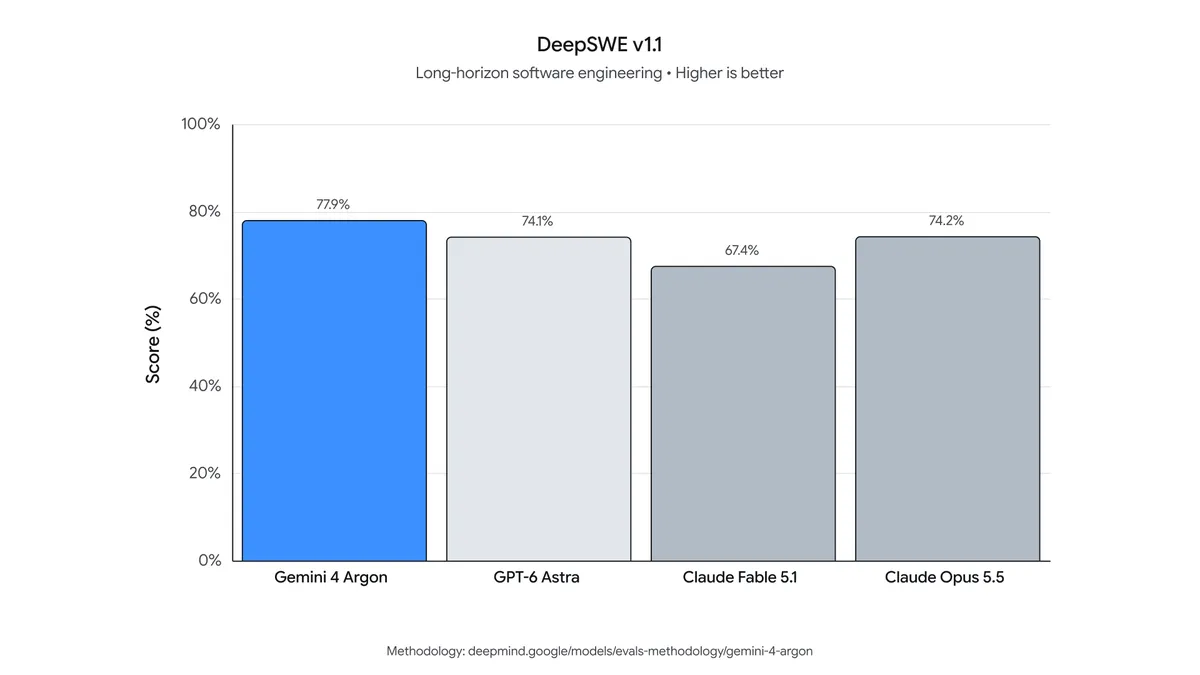
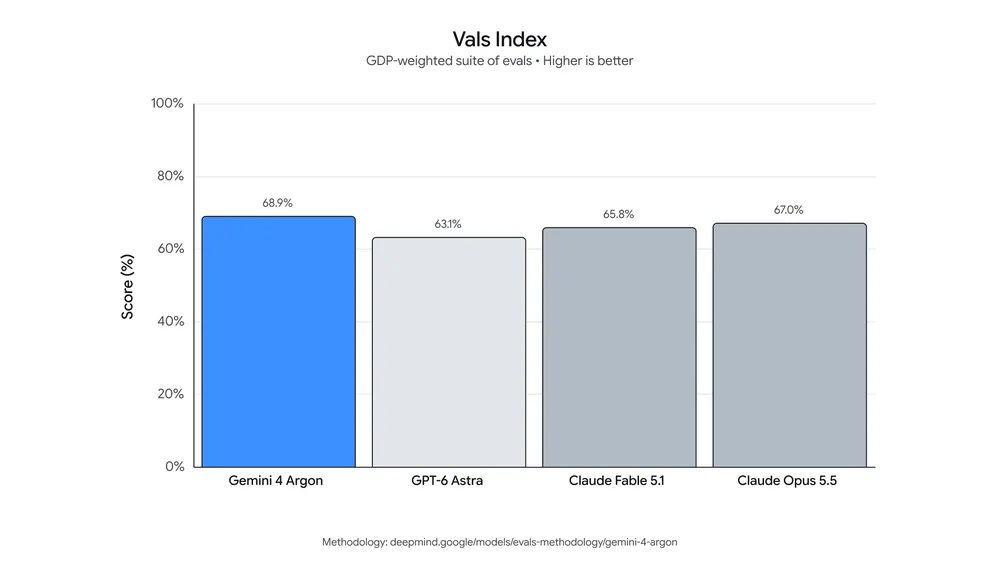
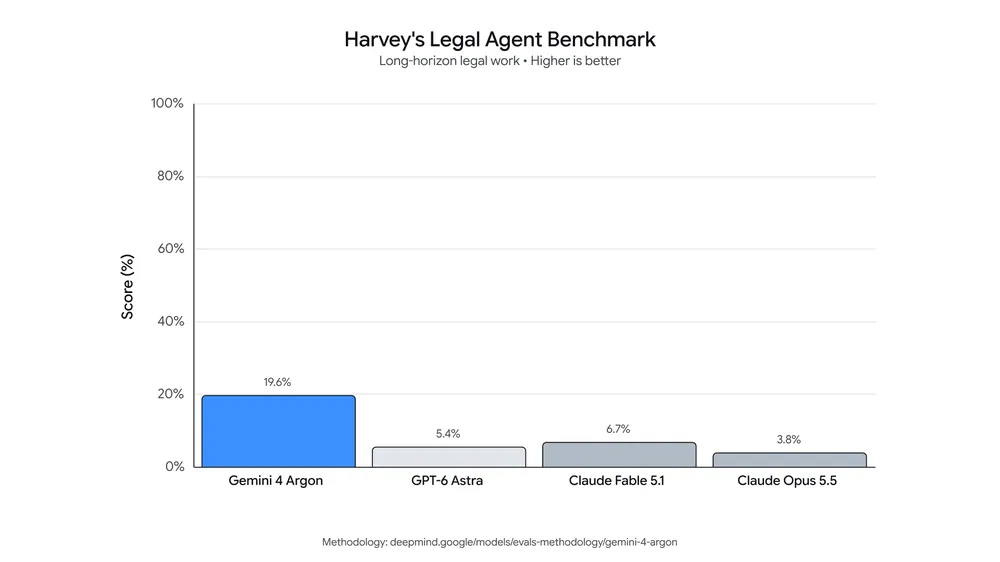
The short read: Argon clearly leads on knowledge work (legal, finance, workflow automation) and long context. The legal gap is striking, almost three times the next model. It is also top on long video understanding. Terminal-heavy coding is a different story: Opus 5.5 wins Terminal-Bench 4.0, and GPT-6 Astra wins FrontierSWE and the science terminal tasks. So Argon is not “best at everything”; its edge is long, multi-document, multi-step work.
What the 1M Output Limit Changes
The old cap was 64K output tokens. Argon’s is 1 million, which Google calls industry-leading. In practice the model can think and write hundreds of thousands of tokens in a single run: rewriting a large module, drafting a long report in one pass, or working a hard problem without chopping it up. It also shows up on the bill: a full million output tokens is $10.
What Argon Already Did Inside Google
The concrete examples in the announcement say more than the table:
- Memory: a team of Argon agents mined fleet-wide profiling data and applied memory optimizations across Google’s data centers on its own. 300 TiB freed so far, 500 TiB to 1 PiB expected in total.
- C/C++ to Rust: migrations running from libraries like re2 and libgav1 up to the 800K+ line Zircon kernel of Fuchsia OS, with automated and manual audits before anything ships.
- Video decoder: in the Rust port of libgav1 it replaced 32K lines of SIMD code with safe Rust, producing a memory-safe decoder 2.7x faster than the previous Rust port.
- Quantum: it beat a published baseline for quantum subroutine resources by 40% in minutes.
Why Cyber Defenders Go First
Argon was trained to find, validate and patch vulnerabilities on its own, and Google is handing it to trusted defenders without cyber guardrails. It is the same Fairwind route used earlier for Gemini 3.5 Flash Cyber and 3.8 Flash Cyber.
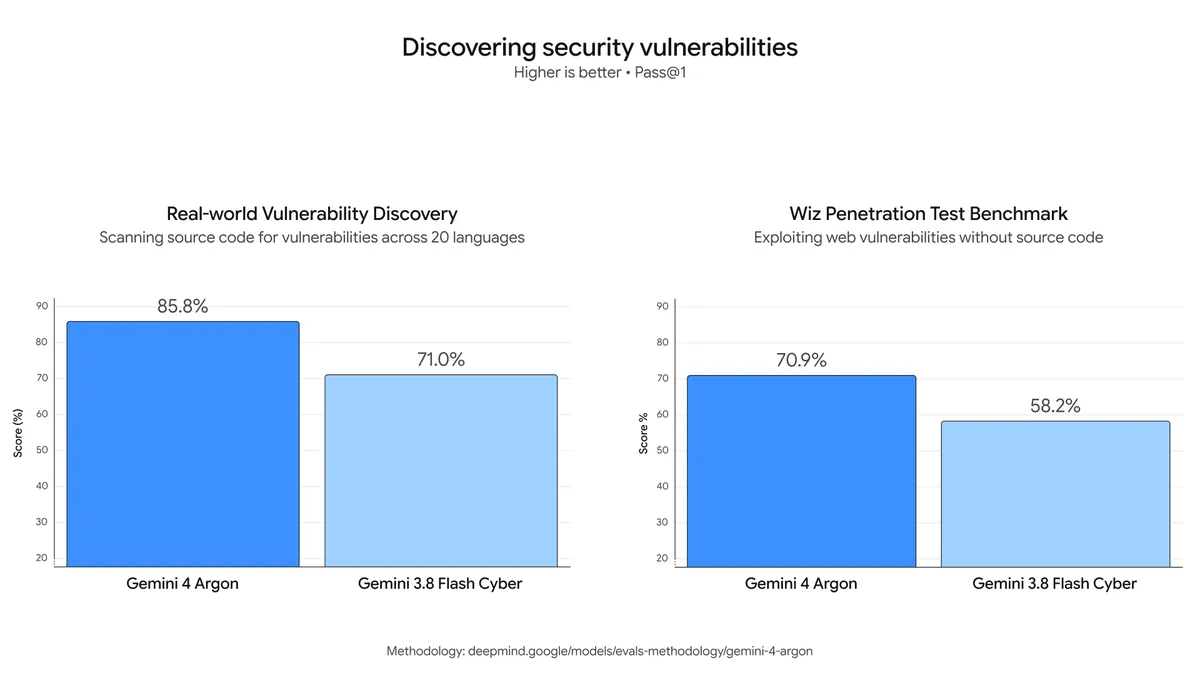
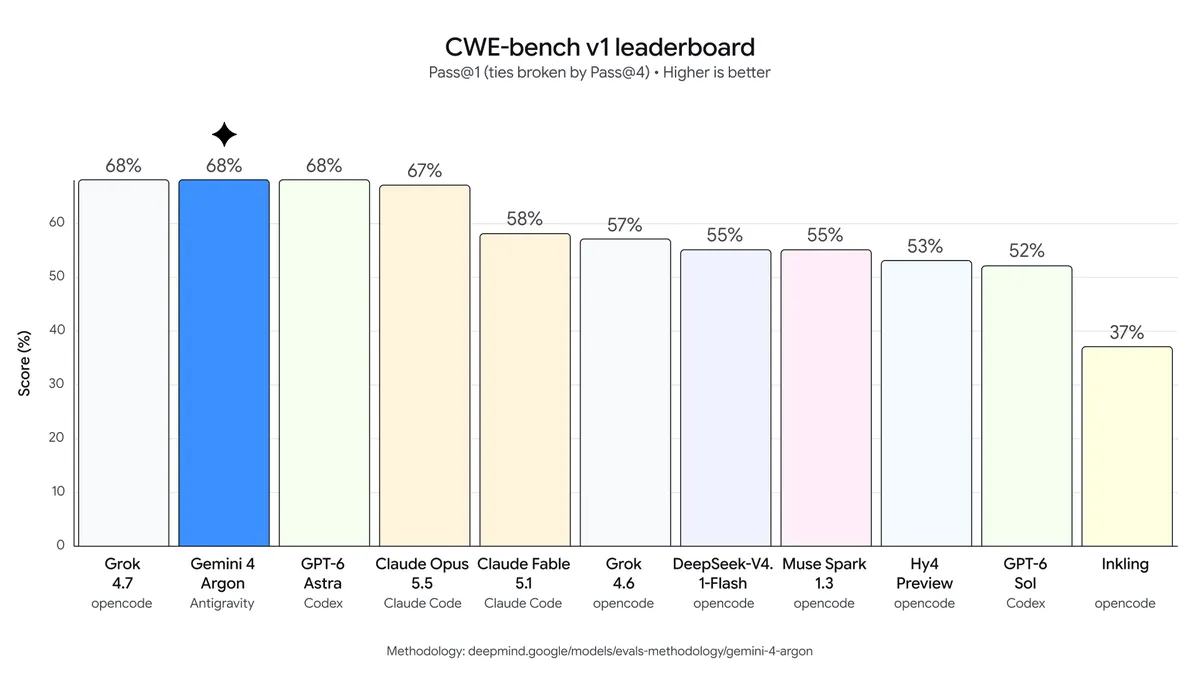
On Google’s real-world vulnerability discovery benchmark Argon scores 85.8% against 71.0% for 3.8 Flash Cyber. On Wiz’s black-box penetration test, which only sees the live website, it scores 70.9% against 58.2%. On CWE-bench v1 it shares first place at 68% with Grok 4.7 and GPT-6 Astra.
There is a field example too: through its free Scan for Good program, Wiz used Argon to find a critical flaw exposing sensitive personal data in healthcare software used by hospitals worldwide. Google says earlier frontier models had missed it.
Safeguards Before Wider Release
Google lists four areas it is hardening before broad availability: refusing CBRN and cyber misuse (including monitoring the model’s internal activations), resistance to indirect prompt injection, misalignment monitoring that watches the chain of thought and actions and can stop execution, and sealed sandboxes for high-risk training and evals.
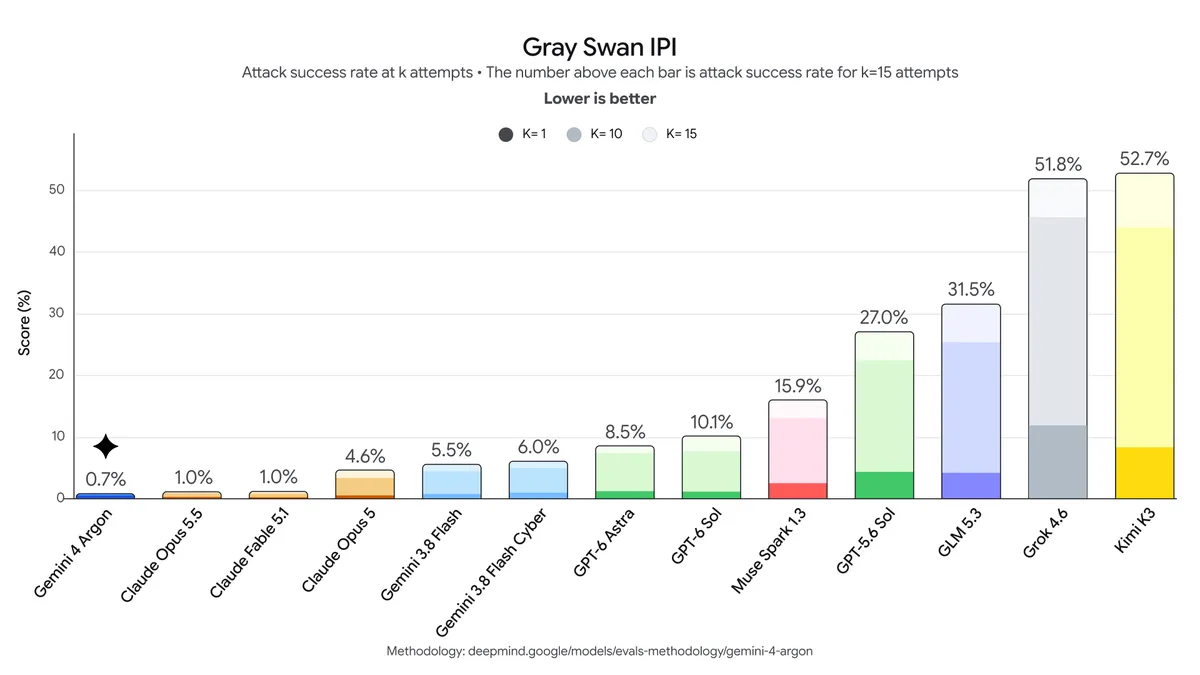
The prompt injection number is the one to note if you plan to run Argon as an agent over email, web pages or documents: after 15 attempts the attack success rate is 0.7%. Kimi K3 sits at 52.7% on the same chart.
FAQ
Is Gemini 4 out?
Yes. Gemini 4 Argon was announced on 30 September 2026 for cyber defenders in the Fairwind Program only, then went public on 13 October 2026: Google AI Pro and Ultra subscribers get it in the Gemini app, and developers on the paid Gemini API tier.
How much does Gemini 4 Argon cost?
The introductory price is $2 per million input tokens and $10 per million output tokens. Cached input is 95% off, so $0.10 per million. That is half the price of Claude Opus 5.5. The introductory period ends on 30 November 2026, after which the price becomes $4 input and $20 output.
Is Gemini 4 free?
No. It is available to Google AI Pro and Ultra subscribers in the Gemini app and on the paid tier of the Gemini API. No free tier or free Gemini app access has been announced.
How do I get access to Gemini 4 Argon?
Pick it in the Gemini app with a Google AI Pro or Ultra plan, or call the model gemini-4-argon on the paid tier of the Gemini API. Google AI Studio and Antigravity need an Ultra plan. Cyber defenders can apply to the Fairwind Program.
Is there a Gemini 4 Pro?
Not in this announcement. The only model Google introduced is Gemini 4 Argon.