
- Price: Argon’s $2 / $10 is a launch promotion. Google’s own footnote says the price moves to $4 / $20 once it ends, exactly what Opus 5.5 costs. The promo ends on 30 November 2026.
- Independent benchmarks: On the Artificial Analysis Intelligence Index, Opus 5.5 scores 58 and Argon 53. Cost per task is $1.99 for Argon at promo pricing versus $5.98 for Opus.
- Hallucinations: Argon’s hallucination rate is 15%, Opus 5.5’s is 59%. Argon says “I don’t know” far more often, while Opus knows more but also guesses when it shouldn’t.
- Coding: Opus leads Terminal-Bench 4.0 in both Google’s table and the independent run. Argon leads on workflow automation.
- Access: Both are available today. Argon opened on 13 October to Pro and Ultra subscribers in the Gemini app and the paid API tier.
When Google announced Gemini 4 Argon on September 30, the headline number was simple: a frontier model at half the price of Claude Opus 5.5. A day later, two things are clearer. That price has an expiry date, and the first independent benchmark run puts the two models in a different order than Google’s own chart.
This post compares them on the questions that decide a real choice: what you will actually pay, how they score when someone else runs the tests, how often they make things up, how they code, and which one you can use today. For the full Opus 5.5 launch details, see our Opus 5.5 write-up .
The Short Answer
| If you need | Gemini 4 Argon | Claude Opus 5.5 |
|---|---|---|
| A model you can use today | Available (since 13 October) | Available |
| Highest overall intelligence score | 53 | 58 |
| Fewest hallucinations | 15% | 59% |
| Terminal-heavy coding | 57.1% | 59.6% |
| Workflow automation | 77.5% | 69.5% |
| Cost per task | $1.99 ($3.98 at standard price) | $5.98 |
| Very long single outputs | 1M tokens | 128K tokens |
For general use and coding, Opus 5.5 is ahead. Argon, open to everyone since 13 October, is the stronger pick wherever a confident wrong answer costs more than an honest “I don’t know”, and for long multi-app agent workflows.
Gemini 4 Argon Pricing: How Long Does Half Price Last?
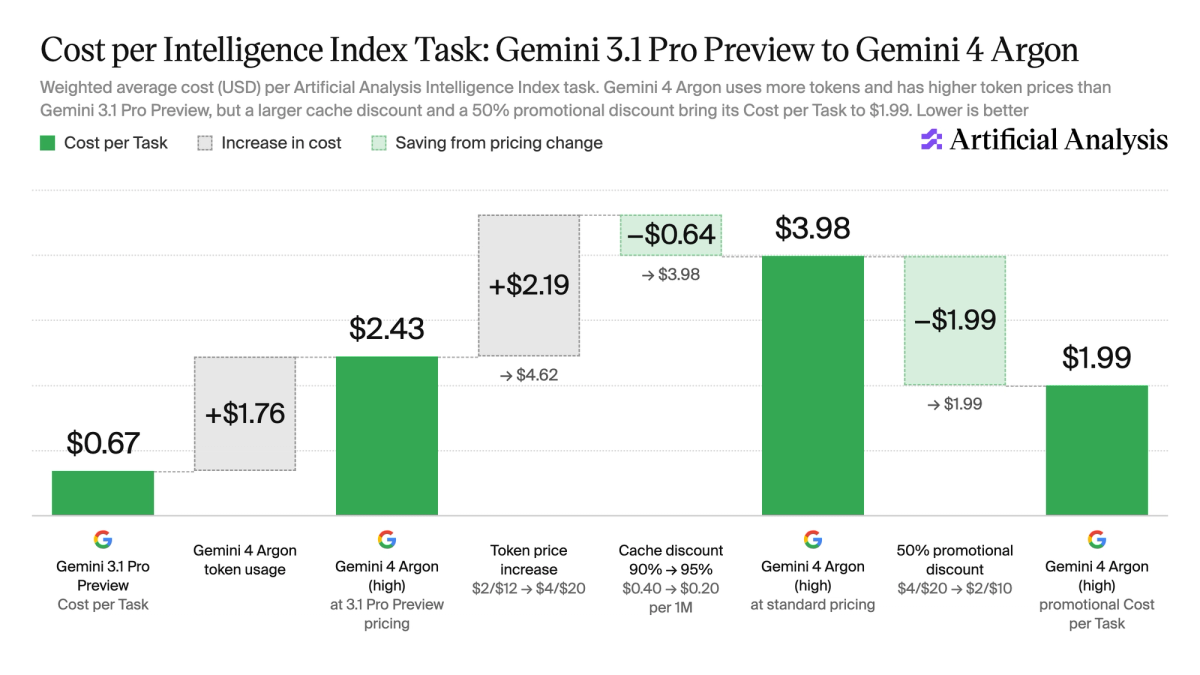
Google’s announcement calls $2 / $10 an “introductory price” and attaches a footnote to it. The footnote reads that once the introductory period expires, $4 per million input tokens and $20 per million output tokens apply. That is Claude Opus 5.5’s price to the cent.
Google’s 13 October launch post gave the end date: 30 November 2026. So “half the price of Opus” holds until the end of November, but if you are budgeting a project that runs into next year, plan on $4 / $20.
| Per million tokens | Gemini 4 Argon | Claude Opus 5.5 |
|---|---|---|
| Input (launch promo) | $2 | $4 |
| Output (launch promo) | $10 | $20 |
| Input (after promo) | $4 | $4 |
| Output (after promo) | $20 | $20 |
| Cached input | $0.10 (then $0.20) | $0.20 |
| Fast mode | None | $8 / $40 |
Caching is a draw too. Both discount cached input by 95%, so after the promo Argon’s cached input lands on the same $0.20 as Opus.
The number that actually separates them is cost per task, not price per token. Running its 10-test suite, Artificial Analysis saw Argon use about 62K output tokens per task, against 119K for Opus 5.5 at max effort. Opus simply thinks longer. That is why Argon stays cheaper per task even after the promo: $3.98 against $5.98.
Both models are in our LLM cost calculator if you want to plug in your own volumes. Quick example: a job with 1M input and 200K output tokens costs $4 on Argon today and $8 on Opus 5.5. After the promo, both cost $8.
Independent Benchmarks: Artificial Analysis Results
Google’s benchmark table is built from tests Google picked. Artificial Analysis runs every model through the same 10-test suite with the same method, which makes it the closest thing to a neutral scoreboard. It tested Argon at its highest reasoning setting (high) and Opus 5.5 at max effort.
| Benchmark | Gemini 4 Argon | Claude Opus 5.5 |
|---|---|---|
| Intelligence Index (10-test summary) | 53 | 58 |
| AutomationBench-AA (workflows) | 77.5% | 69.5% |
| Terminal-Bench 4.0 (coding) | 57.1% | 59.6% |
| Humanity's Last Exam | 57% | 61% |
| SciCode (scientific coding) | 62% | 67% |
| AA-Briefcase (knowledge work, Elo) | 1,494 | 1,822 |
| AA-Omniscience accuracy | 50% | 66% |
| Hallucination rate (lower is better) | 15% | 59% |
| Output tokens per task | 62K | 119K |
On overall capability, Opus 5.5 is ahead and sits alone at the top of the index. Argon’s 53 ties GPT-6 Astra. For Google that is still a big jump: its previous Pro-class model, Gemini 3.1 Pro Preview, scored 30 on the same index.
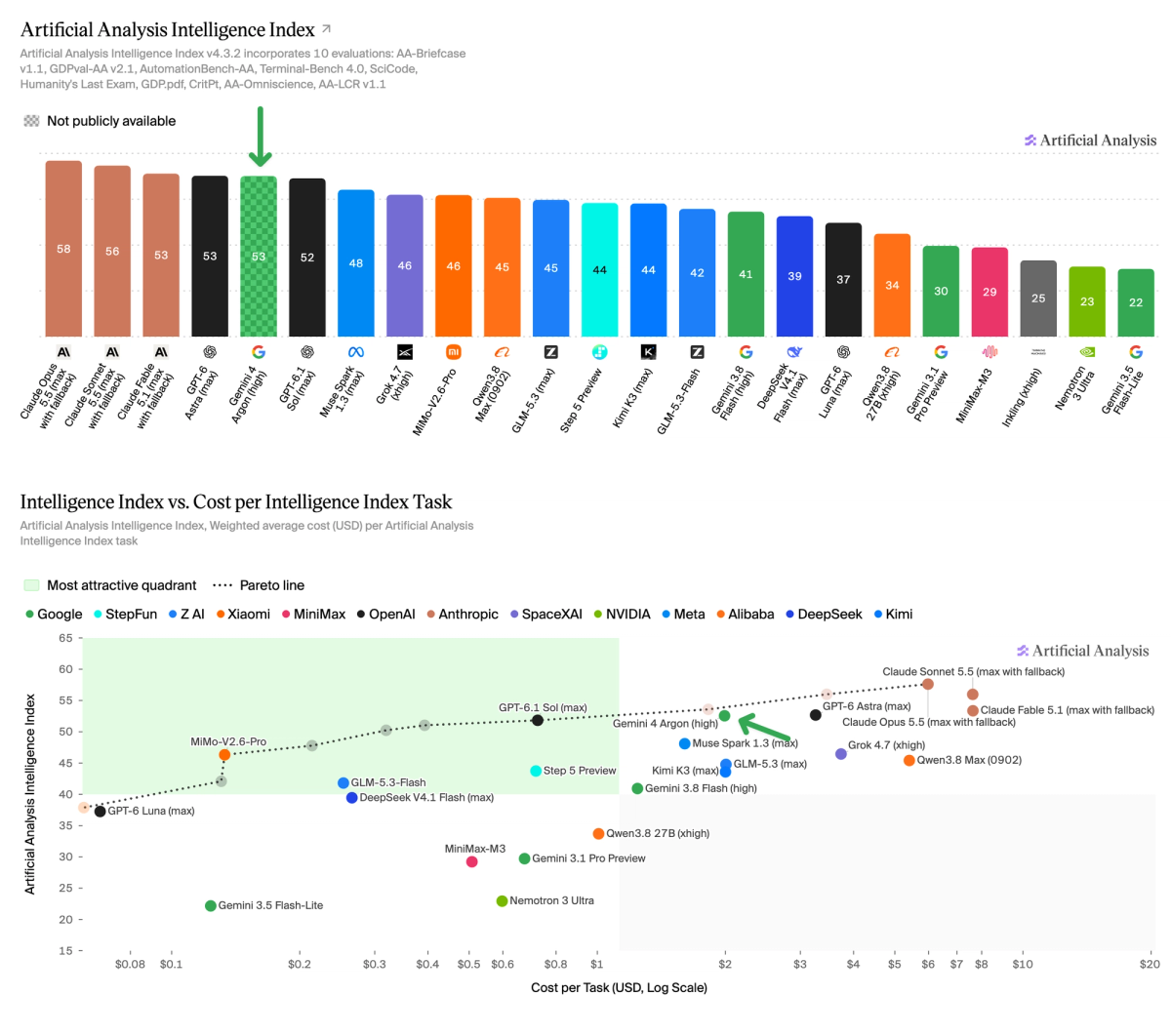
One detail in that chart is easy to miss: Claude Sonnet 5.5 is second, at 56. Sonnet 5.5 costs $2 / $10 per million tokens, the same as Argon’s promo price, and you can use it right now. If what you want is a cheap frontier-class model today, start there. We compared it with Opus in Claude Sonnet 5.5 vs Opus 5.5 .
Hallucinations: Argon’s Biggest Edge
The most striking number in this matchup is not a benchmark score. AA-Omniscience asks models factual questions and scores wrong answers harshly, while declining to answer costs nothing.
- Argon gets 50% of the questions right and, when unsure, mostly declines. Its hallucination rate is 15%, the lowest of any model scoring above 45 on the index.
- Opus 5.5 gets 66% right, so it simply knows more. But on the questions it does not know, it usually answers anyway. Its hallucination rate is 59%.
In practice: Opus 5.5 hands you the right answer more often, while Argon is the model least likely to hand you a wrong one. For an agent that replies to customers, a legal or medical summary, or anything that writes extracted facts into a database, that trait may matter more than the price.
Which One Is Better for Coding?
On coding, Google’s numbers and the independent run point the same way but disagree on the size of the gap. Terminal-Bench 4.0 shows it best:
| Benchmark | Gemini 4 Argon | Claude Opus 5.5 | Source |
|---|---|---|---|
| Terminal-Bench 4.0 | 57.4% | 66.4% | |
| Terminal-Bench 4.0 | 57.1% | 59.6% | Artificial Analysis |
| DeepSWE v1.1 | 77.9% | 74.2% | |
| FrontierSWE v2 | 55.0% | 62.3% | |
| SciCode | 62% | 67% | Artificial Analysis |
In Google’s table, Opus 5.5 leads Terminal-Bench by 9 points. In the independent run the gap shrinks to 2.5. Differences like that usually come from the harness, the effort setting and the number of attempts. The verdict holds either way: for terminal-driven coding agents Opus 5.5 is still ahead, but Argon is closer than Google’s own chart suggests.
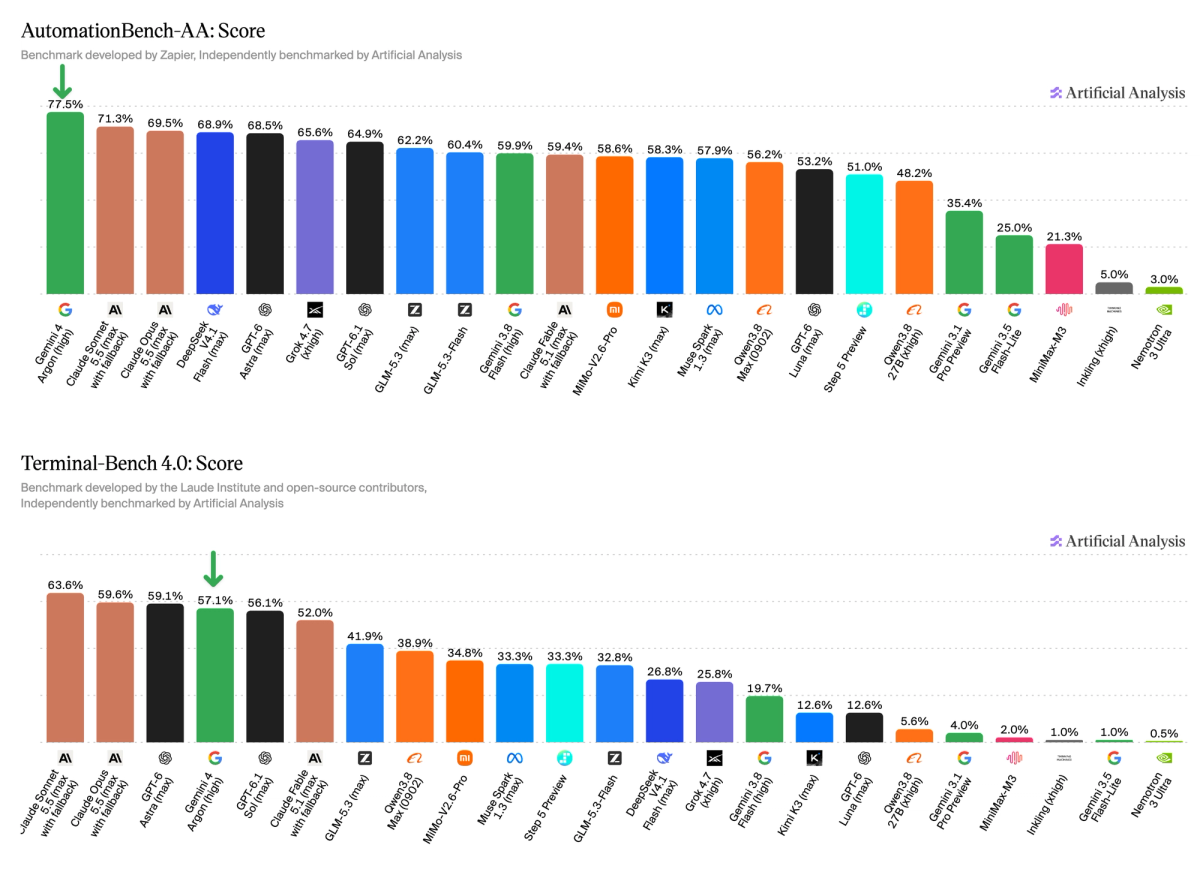
Where Argon clearly wins is agent work that strings SaaS apps together: it tops AutomationBench-AA at 77.5%. Google’s own legal (Harvey) and finance agent tests show the same pattern, with Argon well clear of Opus.
There is also the tooling gap. Opus 5.5 runs inside Claude Code today, with Anthropic’s whole agent stack around it. Since 13 October Argon is in Google’s agent-first coding platform Antigravity and in Android Studio too, but only for Google AI Ultra subscribers.
Context, Output Limit and Inputs
| Spec | Gemini 4 Argon | Claude Opus 5.5 |
|---|---|---|
| Context window | 1M tokens | 1M tokens |
| Max output | 1M tokens | 128K (300K in Batch API beta) |
| Input types | Text, image, video, speech | Text, image |
| Reasoning settings | "High" is the top setting | 5 effort levels (low to max) |
| Output speed | Not measured yet | 90 tokens per second |
Argon’s 1M output cap relies on a new Gemini API feature called Long Decode Continuation: a long response pauses and resumes across follow-up calls instead of hitting a request timeout. Artificial Analysis ran its tests with it switched on. Opus 5.5 tops out at 128K tokens per response, so for one-shot long reports or large code generation Argon has a real structural advantage.
Can You Use Gemini 4 Argon Today?
Claude Opus 5.5 has been generally available since September 22. You can call it through the Claude API, Amazon Bedrock, Google Cloud and Microsoft Foundry, and use it in Claude.ai on the paid plans (Pro, Max, Team).
Gemini 4 Argon started with cyber defense teams in the Fairwind Program on 30 September and went public on 13 October 2026: Google AI Pro and Ultra subscribers get it in the Gemini app and AI Mode in Search, developers on the paid tier of the Gemini API (model ID gemini-4-argon). AI Studio and Antigravity need Ultra, and free accounts do not get it. Full details in our Gemini 4 Argon post.
Which One Should You Use?
- Strongest general-purpose model: Claude Opus 5.5. It leads the independent index by 5 points.
- Coding agents, terminal work, Claude Code: Opus 5.5. It leads in both measurements.
- Work where a wrong answer is expensive (customer replies, summaries, data extraction): Argon. Its hallucination rate is about a quarter of Opus’s.
- Cross-app workflow automation, legal and finance agents: Argon. Its strongest area in both Google’s and the independent numbers.
- Very long single outputs (big reports, bulk code generation): Argon, with its 1M output cap.
- Video or audio input: Argon. Opus 5.5 accepts text and images only.
- Cheapest option: Argon until the end of November, at half the price of Opus. Claude Sonnet 5.5 costs the same, scores 3 points higher on the index and stays at that price after the promo.
FAQ
Is Gemini 4 Argon better than Claude Opus 5.5?
On the independent Artificial Analysis Intelligence Index, Opus 5.5 scores 58 and Argon 53. Argon leads on workflow automation and has a far lower hallucination rate, 15% against 59%. Opus 5.5 is stronger for general use and coding, Argon for work where a wrong answer is costly.
Is Gemini 4 Argon cheaper than Opus 5.5?
For now, yes. The launch price is $2 per million input tokens and $10 per million output tokens, half of Opus 5.5. Google’s footnote says the price becomes $4 input and $20 output once the introductory period ends, the same as Opus 5.5. The introductory period ends on 30 November 2026.
What is Gemini 4 Argon’s release date for developers?
It is out. Google opened Argon on 13 October 2026: developers can use it on the paid tier of the Gemini API, and Google AI Pro and Ultra subscribers in the Gemini app.
Which is better for coding, Gemini 4 Argon or Opus 5.5?
Opus 5.5 leads Terminal-Bench 4.0 in both Google’s table and the Artificial Analysis run, and it also leads on SciCode and FrontierSWE. Argon only comes out ahead on Google’s DeepSWE test.
Is Gemini 4 Argon free?
No. It is available to Google AI Pro and Ultra subscribers in the Gemini app and on the paid tier of the Gemini API. There is no announced plan for free accounts.