
- Sol and Luna are not new names: they arrived this summer as part of GPT-5.6. On 22 September 2026 OpenAI moved both to GPT-6 and halved the price, roughly 90 minutes after Anthropic shipped Claude Opus 5.5.
- Sol: $2 in / $10 out per million tokens. Opus 5.5 is $4 / $20, so Sol is exactly half.
- Luna: $0.10 / $0.50, 40x cheaper than Opus 5.5. Free and Go users get it in the ChatGPT desktop app.
- Every OpenAI chart compares against Opus 5, not Opus 5.5. On the one benchmark both vendors report, Opus 5.5 leads: 40.0% vs 33.2% on AutomationBench.
- Pick Opus 5.5 for quality, Sol for volume, Luna for simple high-volume jobs.
GPT-6 Sol vs GPT-5.6 Sol: What Changed?
The Sol, Terra and Luna tiers first shipped this summer with GPT-5.6 . Earlier this month GPT-6 Astra took the top slot, while Sol and Luna stayed on GPT-5.6. This release moves those two onto the GPT-6 generation: Sol for coding and agentic work, Luna for high-volume jobs with a clear goal, such as summarising documents, extracting fields or answering quick questions.
Three things changed: both were retrained with methods similar to Astra’s, factuality and coding scores went up, and the API price was cut in half. Terra did not get a GPT-6 update.
90 Minutes Apart: Anthropic vs OpenAI
Here is how the day went. Anthropic released Claude Opus 5.5 and cut the Opus price from $5 / $25 to $4 / $20. That matched, to the cent, what OpenAI was charging for its model in the same tier, GPT-5.6 Sol. About 90 minutes later OpenAI announced GPT-6 Sol at $2 / $10. Anthropic drew level, and OpenAI halved the price the same afternoon. TechCrunch read the gap between the two launches the same way: a sign of how intense the competition has become.
It is the second time this month. Anthropic shipped Claude Fable 5.1 at $10 / $50 on 1 September, and two days later OpenAI launched GPT-6 Astra at exactly the same price. In three weeks the two labs have traded moves at every tier:
| Date | OpenAI | Anthropic |
|---|---|---|
| 1 September | - | Claude Fable 5.1: $10 / $50 |
| 3 September | GPT-6 Astra: $10 / $50 | - |
| 22 September | - | Claude Opus 5.5: $4 / $20 (was $5 / $25) |
| 22 September, ~90 min later | GPT-6 Sol: $2 / $10 (was $4 / $20) GPT-6 Luna: $0.10 / $0.50 | - |
The rush shows in the announcement itself: every OpenAI chart uses Opus 5 as the rival, and Opus 5.5 is nowhere. Nobody benchmarks a new model in 90 minutes. For buyers the result is simple: the tier that cost $4 / $20 when the day started cost $2 / $10 before it ended.
GPT-6 Sol vs Opus 5.5: Price
OpenAI cut both models to 50% of their GPT-5.6 prices, crediting caching and inference improvements. It also notes that the old GPT-5.6 rates were promotional, and the new ones are half of those.
| Per million tokens | GPT-6 Sol | GPT-6 Luna | Claude Opus 5.5 | GPT-5.6 Sol |
|---|---|---|---|---|
| Input | $2 | $0.10 | $4 | $4 |
| Output | $10 | $0.50 | $20 | $20 |
| Cached input | $0.20 | $0.01 | $0.20 | - |
| Cache write | $2.50 | $0.125 | $5 (5 min) | - |
| Context window | 1.05M | 1.05M | 1M | - |
| Max output | 128K | 128K | 128K | - |
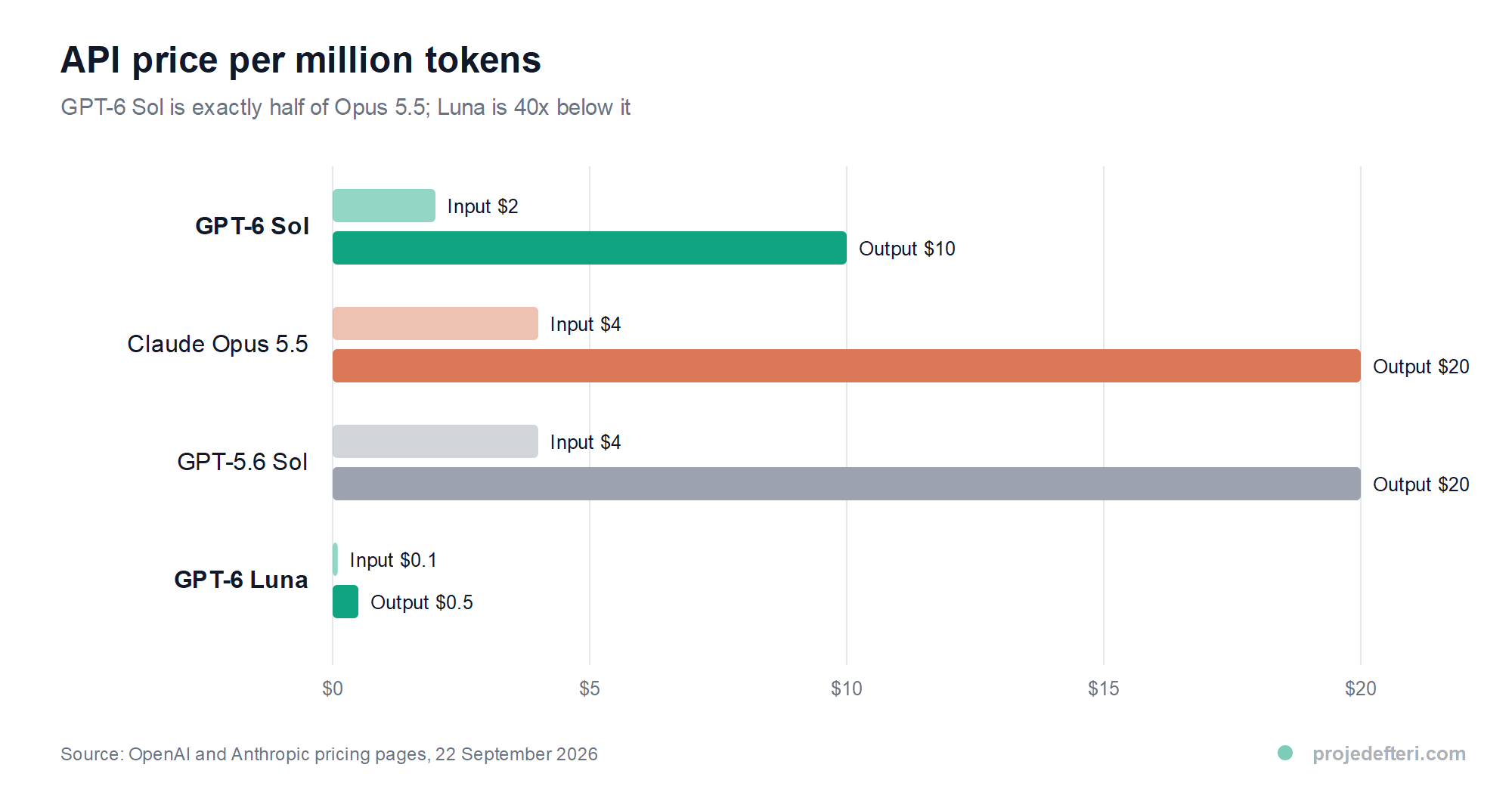
The row to watch is cached input. GPT-6 bills cache reads at 10% of the input rate, which puts Sol at $0.20, the same as Opus 5.5. So the gap lives in fresh input and output, not in the cache.
What “half price” means on a real bill
Take an agent session with 10M input tokens, 8M of them served from cache, plus 1M output tokens. Ignoring cache writes:
- GPT-6 Sol: 2M × $2 + 8M × $0.20 + 1M × $10 = $15.60
- Claude Opus 5.5: 2M × $4 + 8M × $0.20 + 1M × $20 = $29.60
That is a 47% saving rather than 50%. The more cache-heavy your workload, the narrower the gap; the more output-heavy, the closer it gets to a clean half. To run your own numbers, both the LLM cost calculator and the token counter now list Sol and Luna, and the token counter’s compare mode opens on Sol vs Opus 5.5 by default.
Fine print: requests over 272K input tokens pay 2x on input and cache and 1.5x on output for the whole request. Batch and Flex are half price, Fast mode is double.
GPT-6 Sol vs Opus 5.5: Benchmarks
OpenAI’s charts put Sol against Opus 5 and Fable 5/5.1. Opus 5.5 was only 90 minutes old, so it is missing. The table below sets OpenAI’s numbers next to what Anthropic published for Opus 5.5 on the same test.
| Benchmark | GPT-6 Sol | GPT-6 Luna | OpenAI's comparison | Claude Opus 5.5 |
|---|---|---|---|---|
| AutomationBench 1.0.6 (business workflows) | 33.2% (xhigh) | not published | Opus 5 max: 26.9% | 40.0% (max) |
| DeepSWE v1.1 (software engineering) | 68.8% (max) | 66.6% (max) | Fable 5 xhigh: 69.9% | no data |
| Agents' Last Exam V1 | 56.4% (max) | not published | Opus 5: lower | no data |
| OSWorld 2.0 offline (computer use) | 60.5% (xhigh) | not published | Opus 5 medium: 60.3% | no data |
AutomationBench is the one row you can compare fairly, because both vendors print identical numbers for Opus 5 (26.9%) and Fable 5.1 (31.4%). On that test Opus 5.5 scores 40.0%, 6.8 points ahead of Sol and close to GPT-6 Astra’s 41.4%.
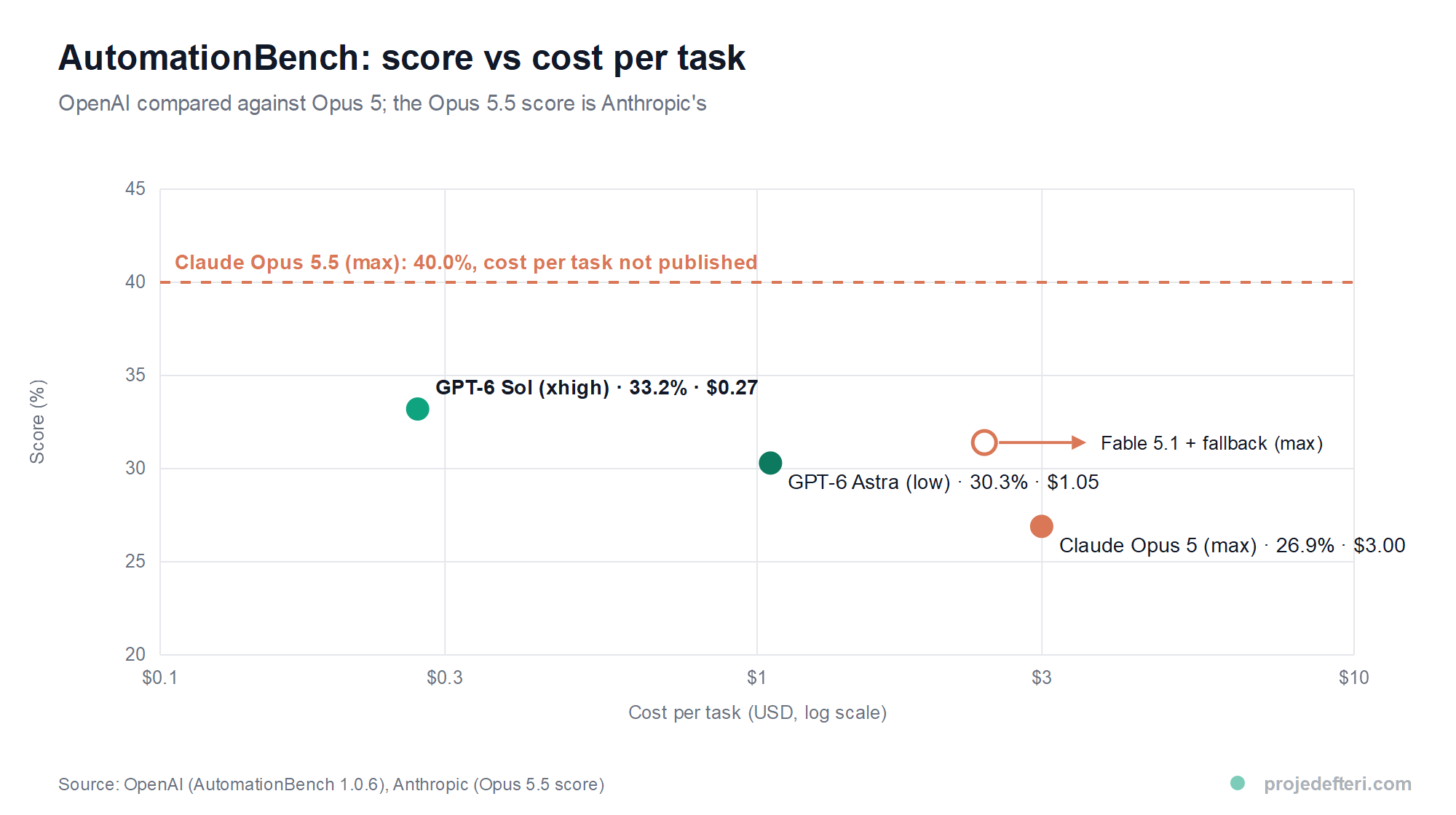
OpenAI’s real pitch is cost per task, not score. On AutomationBench Sol spends $0.27 per task and Opus 5 spends 11.1 times that. On DeepSWE Sol lands within 1.1 points of Fable 5’s best score for roughly 80% less per task, and on OSWorld it matches Opus 5 at medium effort for about 80% less. One caveat on that last one: 60.3% is Opus 5’s medium-effort result. Anthropic reports Opus 5.5 at 81.8% on OSWorld 2.0 at max effort.
Which One Should You Use?
- Opus 5.5 when quality decides. It wins the only head-to-head test and, per Anthropic, also beats GPT-6 Astra on Terminal-Bench 4.0, FrontierCode and GDPval.
- GPT-6 Sol when volume decides. Half the list price, and the lowest cost per task in every chart OpenAI published. Teams running many agents or retrying tasks feel that gap fastest.
- GPT-6 Luna for simple, repetitive work. Summaries, classification, extraction: 1/40th of Opus 5.5’s price.
Anthropic cut its own costs too, measuring 40% savings over Opus 5 on typical workloads. So OpenAI’s 11.1x gap shrinks against Opus 5.5, but it remains a gap measured in multiples, not percentages.
Is GPT-6 Luna Free?
Partly. Sol and Luna are live in ChatGPT Work and Codex for Plus, Pro, Business, Enterprise and Edu users. Free and Go users can use Luna in the ChatGPT desktop app. Neither model is in the regular Chat view yet, and the Work and Codex rollout is staged through the day, so if Sol is missing, check back later.
OpenAI’s claim for Luna: at high effort it matches GPT-5.6 Sol on factuality at about a hundredth of the cost, and on DeepSWE it scores 66.6%, level with Opus 5 and Fable 5 at medium effort, for 93% less per task than Opus 5.
What Else Changed
Factuality: on OpenAI’s internal test built from real conversations where users flagged errors, Sol makes about half as many mistakes as its predecessor. Style: Astra’s shorter, less jargon-heavy answers carry over to Sol and Luna. Caching: changing reasoning effort or the tool list no longer breaks the cache, and GitHub reports more than 50% fewer prompt tokens needing fresh processing in Copilot. Specs: six effort levels from none to max, knowledge cutoff 20 April 2026 for Sol and 18 May 2026 for Luna, API IDs gpt-6-sol and gpt-6-luna.
FAQ
When was GPT-6 Sol released?
On 22 September 2026, together with GPT-6 Luna. Both went live the same day in ChatGPT Work, Codex and the OpenAI API, with the ChatGPT rollout staged through the day.
How much does GPT-6 Sol cost?
$2 per million input tokens and $10 per million output tokens. Cached input is $0.20 and cache writes $2.50. GPT-6 Luna is $0.10 in and $0.50 out. Both are 50% cheaper than their GPT-5.6 versions.
Is GPT-6 Sol better than Claude Opus 5.5?
Not on quality. On AutomationBench, the only test both vendors report, Opus 5.5 scores 40.0% and Sol 33.2%. On price Sol wins clearly at $2 / $10 against $4 / $20.
Is GPT-6 Luna free?
Free and Go users can use GPT-6 Luna in the ChatGPT desktop app. GPT-6 Sol requires Plus or higher. API usage is billed per token.
Is there a GPT-6 Terra?
Not in this announcement. OpenAI extended GPT-6 with Sol and Luna and did not mention a GPT-6 version of GPT-5.6 Terra.