A powerful move has arrived on the price and efficiency front of the AI race! On July 8, 2026, xAI, Elon Musk’s AI company now operating under the SpaceX umbrella, announced Grok 4.5, its first major model release since going public. The model is also the fruit of a collaboration with the Cursor team, and its pitch is clear: not the highest benchmark score, but the most efficient way to get work done.
So can Grok 4.5 really challenge its rivals? Let’s look at the numbers.
What Is Grok 4.5 and What Does It Do Differently?
Grok 4.5 is built on a mixture-of-experts (MoE) architecture and is introduced as the first model xAI has built “for more than software engineering”. Its training incorporated high-quality STEM tasks, research papers, and general knowledge work. Thanks to the Cursor collaboration, trillions of tokens capturing how developers interact with real codebases were also included in the training data.
The model’s standout capability areas:
- Software engineering: Long-running agentic tasks that require creative tool use
- Data science and finance: Tables, analysis, and reporting work
- Legal: Ranked #1 on Harvey’s Legal Agent Benchmark
- General computer work: Office integration with Word, PowerPoint, and Excel plugins
Benchmark Results: Not the Summit, but Efficiency
Grok 4.5 is not aiming for the top of the benchmark charts, and xAI does not hide this. The real claim is finishing the same job in less than half the steps of comparable models. According to xAI, the model uses 4.2 times fewer tokens than Opus 4.8 on SWE-Bench Pro tasks.
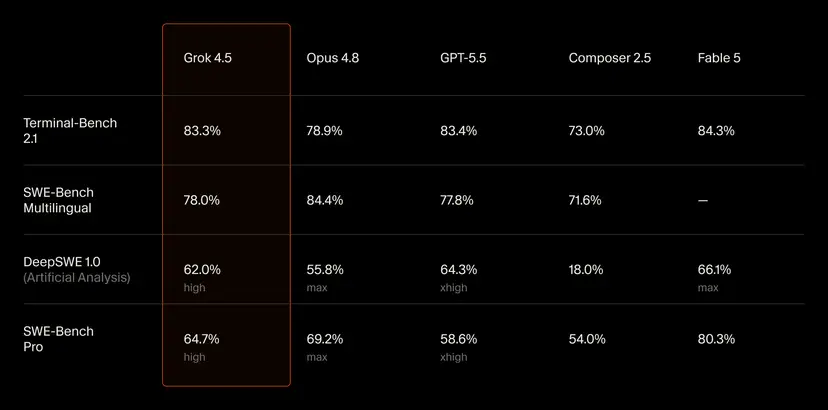
Key scores and how they compare to the competition:
- Terminal-Bench 2.1: Grok 4.5 (83.3%) - GPT-5.5 (83.4%) - Claude Fable 5 (84.3%) - Opus 4.8 (78.9%)
- SWE-Bench Pro: Grok 4.5 (64.7%) - Claude Fable 5 (80.4%) - Opus 4.8 (69.2%) - GPT-5.5 (58.6%)
- DeepSWE 1.1: Grok 4.5 (53%) - Claude Fable 5 (70%) - GPT-5.5 (67%) - Opus 4.8 (59%)
The model goes nearly head-to-head with GPT-5.5 on terminal tasks but trails Claude Fable 5 on deep software engineering work. The real story, however, is in the next section.
Pricing: The Game-Changing Part
The most striking side of Grok 4.5 is its price tag. Prices per 1 million tokens:
- Grok 4.5: $2 input / $6 output (cached input just $0.50)
- Grok 4.5 Fast: $4 input / $18 output
- Opus 4.8: $5 input / $25 output
- GPT-5.5: $5 input / $30 output
- Claude Fable 5: $10 input / $50 output
Where Can You Use It?
Grok 4.5 is available as of July 8, 2026 through Grok Build, Cursor (on all plans, with double usage for the first week), and the xAI console. According to Elon Musk, general public access via grok.com follows on July 9. Desktop, web, iOS, CLI, and SDK support are all in place. On the API side, generous limits of 150 requests per second and 50 million tokens per minute are offered.
Conclusion
Rather than chasing the “smartest model” crown, Grok 4.5 is competing to be the model that delivers the most value for the money. Claude Fable 5 still leads by a wide margin on hard software tasks, but for everyday coding, office work, and legal use cases, Grok 4.5’s price/performance ratio makes it a serious alternative. In an era when AI costs are straining project budgets, this strategy may well pay off.
What do you think about Grok 4.5? Is the price advantage enough to make you switch? Let’s meet in the comments!