If you are searching for “Arduino Uno download”, the software you actually need is the Arduino IDE: the free official program that lets you write code for the Arduino Uno (and every other Arduino board) and upload it to the board. This guide walks through downloading and installing the current release, Arduino IDE 2.3.10.
To learn more about the boards themselves, read the History of Arduino first. 🙂
Prefer to watch instead of read? The 36-second walkthrough below covers the whole process. (It was recorded during the 1.8.x era, so arduino.cc has been redesigned since and downloading now takes fewer steps. Follow the written steps below for the current screens.)
Downloading the Arduino IDE Step by Step
1. Open the official download page
Go to arduino.cc/en/software. Near the top you will find the Arduino IDE 2.3.10 heading, a dropdown and a DOWNLOAD button. The dropdown detects your system and selects itself (on Windows it reads “Win 10 or newer, 64-bit”); open it if you need a different operating system or package type. The old layout with a list of every platform on the right side is gone.
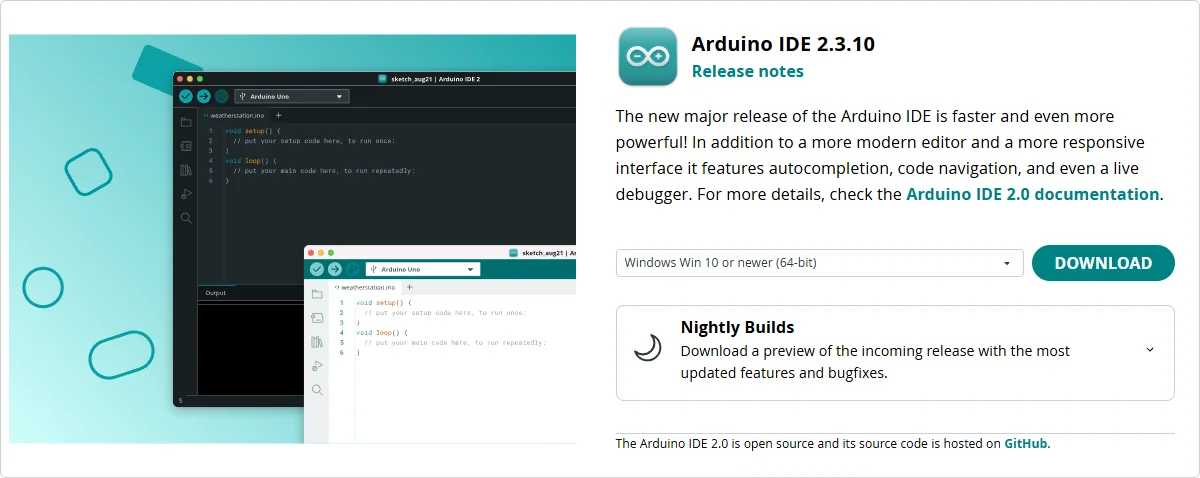
The Nightly Builds box right below it offers unreleased development builds. Leave it alone for everyday use and stay on the stable release.
2. Run the installer
Clicking DOWNLOAD starts the file transfer straight away; the old “Support the Arduino IDE” donation screen has been removed, so there is no intermediate step.
Double-click the downloaded .exe file, accept the licence agreement, keep the default install folder and click Install. Near the end Windows may ask you to approve one or more driver installations; these are the USB drivers for Arduino boards, so approve every one of them. If you decline, your board will not show up on the computer.
3. Launch the IDE for the first time
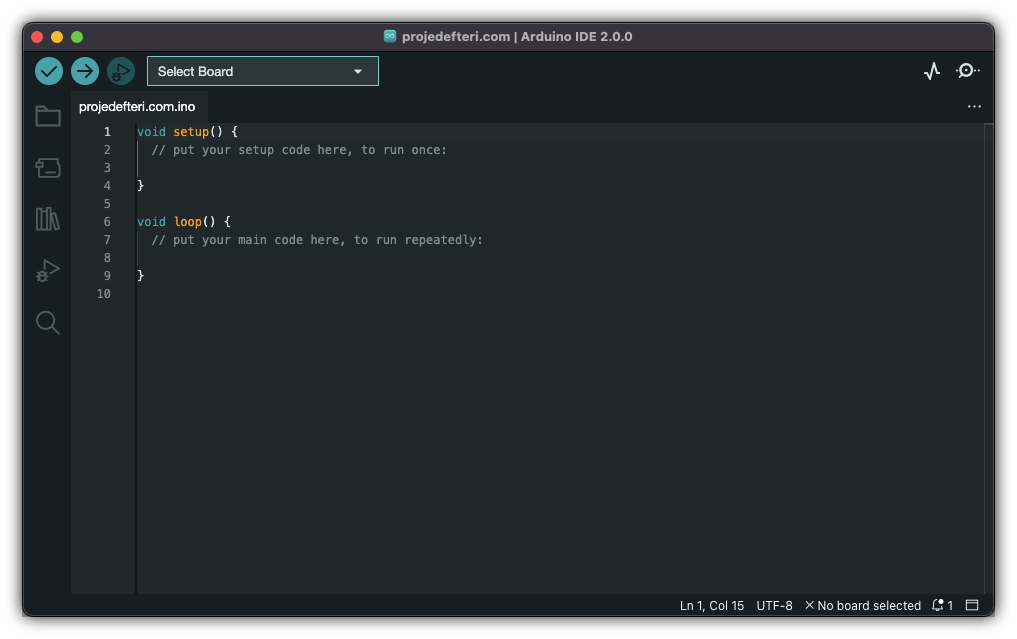
Start the Arduino IDE once the installer finishes. On first launch, version 2.x spends a few seconds preparing itself and downloading the tools it needs, which is normal. When you can see the board and library manager icons down the left edge and the board/port selector at the top, the installation is complete. 🎉
To test it, plug your board in over USB, pick the board and port from the selector, then open File > Examples > 01.Basics > Blink and hit the upload button.
Arduino IDE Will Not Open or Is Stuck on the Splash Screen
If the installation finished but the program refuses to start, or freezes on the splash screen, work through these in order:
- Wait it out first. On its first run, IDE 2.x downloads the compiler toolchain in the background. On a slow connection this takes a few minutes, and it can look frozen while it works.
- Check your antivirus and firewall. Some antivirus products block the
arduino-cliprocess the IDE runs in the background. Add the Arduino IDE installation folder to your exclusions and try again. - Reset the configuration folder. A corrupted settings file is the most common cause. Quit the IDE completely, find
C:\Users\<your username>\.arduinoIDE(it is hidden, so enable hidden items in the View menu) and rename it to.arduinoIDE-backup. The IDE starts with a clean configuration next time, and your old settings stay in the renamed folder. On macOS and Linux the same folder lives at~/.arduinoIDE. - Roll back a version. If the trouble started with a new release, install the previous one from the GitHub releases page.
Changing the Arduino IDE Language
The IDE starts in English, but it ships with a long list of translations:
- Open File > Preferences
- Pick your language from the Language dropdown
- Close and reopen the IDE
Menus and messages switch to the selected language. Code keywords always stay in English, which is expected.
Board Not Detected? Install the CH340 Driver
Budget Arduino Uno clones usually use the CH340 USB chip, and Windows does not always recognise it automatically. If the Port entry is greyed out or your board is missing from the list after plugging it in:
- Download the CH340/CH341 driver from the manufacturer’s official site
- Run the installer and click Install
- Unplug the board and plug it back in; the COM port will appear under Tools > Port
Genuine Arduino boards use an ATmega16U2 chip and generally need no driver, so this problem is mostly limited to clones.
Downloading the Legacy Arduino IDE (1.8.19)
There are two reasons to want 1.8.19: you are on Windows 7 / 8 or a 32-bit system (IDE 2.x will not install there), or the tutorial or library you are following was written for the classic interface. The Legacy IDE (1.8.19) section further down the download page still offers the “Win 7 and newer” build.
Arduino’s old “Old Software Releases” page has been retired; older builds now live on GitHub:
- Previous IDE 2.x releases (2.3.9, 2.3.8, 2.3.7 and so on) are on the arduino-ide releases page, each with Windows, macOS and Linux files. Handy for rolling back if a new release breaks something for you.
- The whole 1.x line (1.8.19, 1.8.18, 1.6.x …) is on the Arduino repository releases page.
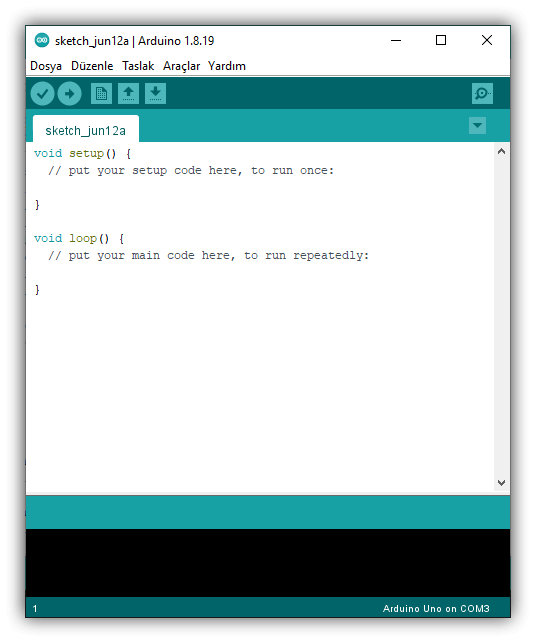
If you are starting out and your system supports it, stay on 2.x: it brings autocompletion, a live debugger and a far faster editor. See our Arduino IDE 2.0 article for the differences.
What Is Arduino App Lab, and Should You Install It Instead?
Below the IDE on the download page you will spot a second program called Arduino App Lab. Do not confuse the two: it is not a newer replacement for the Arduino IDE.
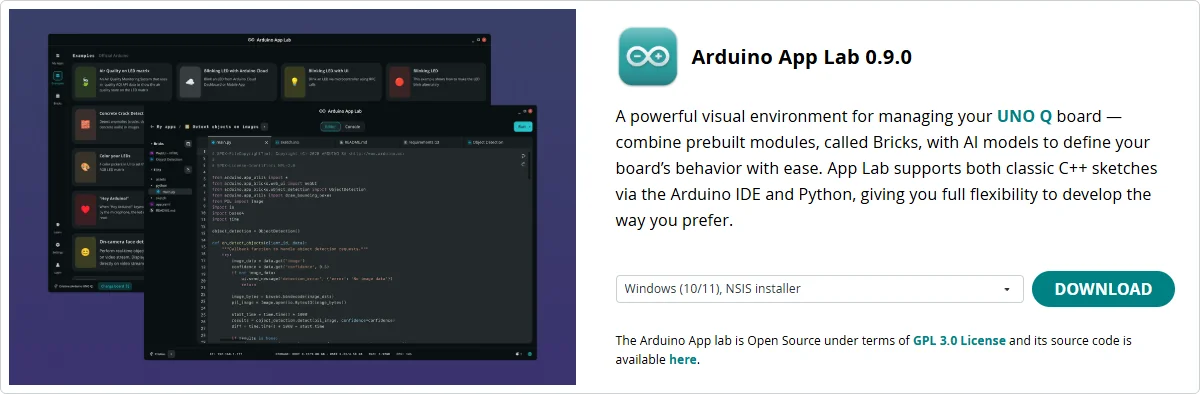
App Lab was built for Arduino’s newer Linux-capable boards such as the UNO Q. It lets you combine prebuilt modules (Arduino calls them Bricks) with AI models to define how the board behaves, and it supports both Python and classic C++ sketches through the Arduino IDE. It requires Windows 10/11.
In short:
- Working with classic boards like the Uno R3, Uno R4, Nano, Mega, ESP32 or ESP8266? The Arduino IDE is all you need.
- Got a UNO Q, or want to run Linux and AI models on the board itself? That is where App Lab comes in.
Using It Without Installing: Arduino Cloud Editor
If you cannot install software on your machine (a school or work computer, for example), use the browser-based Arduino Cloud Editor. The free plan has a daily compilation limit that is plenty for basic projects; uploading to a board requires a small browser plugin.
For ESP32 and ESP8266 Boards
The Arduino IDE is not limited to Arduino boards; you can program WiFi-capable boards such as the ESP32 and ESP8266 with it too. You need to add the board definitions first, which our NodeMCU ESP8266 setup guide covers step by step.
Frequently Asked Questions
Which program do I need for the Arduino Uno? You need the Arduino IDE to upload code to an Arduino Uno. It is Arduino’s official, free development environment and you can download it from arduino.cc for Windows, Mac and Linux.
Is the Arduino IDE free? Yes, the Arduino IDE is completely free and open source. Clicking DOWNLOAD on arduino.cc starts the file transfer directly, with no account, payment or donation step.
Which operating systems does the Arduino IDE run on? The current Arduino IDE 2.3.10 requires Windows 10 or newer (64-bit), macOS or Linux. Version 2.x does not run on Windows 7 / 8 or 32-bit systems; those machines need the legacy 1.8.19 release.
How do I change the Arduino IDE language? Open File > Preferences, pick your language from the Language dropdown and restart the IDE.
My board is plugged in but no port shows up. What should I do? Clone boards usually use the CH340 USB chip, which Windows may not recognise automatically. Install the CH340 driver, reconnect the board, and the COM port will appear under Tools > Port.
Can I download an older version of the Arduino IDE? Yes. The classic 1.8.19 build sits in the Legacy IDE section of the download page. Everything else is on GitHub: previous IDE 2.x releases on the arduino/arduino-ide releases page, and the full 1.x line on the arduino/Arduino repository.
Is Arduino App Lab replacing the Arduino IDE? No. App Lab is a separate environment for Linux-capable boards such as the UNO Q. To write code for classic boards like the Uno, Nano, Mega or ESP32 you still install the Arduino IDE.
Can I install the Arduino IDE on a phone? Is there an APK? The official Arduino IDE is desktop only, and Arduino does not publish an Android APK. Anything listed as “Arduino IDE” in an app store is a third-party app, not an official release. To write code on a phone, the browser-based Arduino Cloud Editor is the safer route; a computer is still the most reliable way to upload to a board.
The Arduino IDE will not open. What should I do? Remember that the first launch downloads the toolchain, so give it a few minutes. If it persists, make sure your antivirus is not blocking the arduino-cli process, then rename the C:\Users\<your username>\.arduinoIDE folder so the IDE starts with a clean configuration.