
AI at Meta: introducing Muse Spark Open (October 15, 2026)
- Meta released the weights of Muse Spark Open on October 15, 2026: 816B total parameters, 42B active, 1M-token context, text, image, video and audio input.
- Local: the smallest usable GGUF needs about 180 GB of combined RAM and VRAM. Unsloth recommends the 2-bit quant (250 GB+) as the starting point.
- Ollama: only a cloud tag exists,
muse-spark-open:cloud. It runs on Ollama’s servers, not your machine. - API: $1.25 input, $0.15 cached, $4.25 output per million tokens on OpenRouter, Together, Fireworks and others. Artificial Analysis scores it 39, the top US open model, behind GLM 5.3 (45) and Kimi K3 (44).
“Open weights” and “runs on your laptop” are two different promises, and Muse Spark Open only makes the first one. The weights are a free download on Hugging Face, but even the most aggressive quantization needs a machine with close to 200 GB of memory. For most people the real choice is between an API key, the Ollama cloud tag, or a serious workstation.
This guide walks through each route with the actual numbers, then covers what the license allows and how the model compares to the Chinese open models it is up against.
Can You Run Muse Spark Open Locally?
Only on big hardware. The model is a mixture-of-experts with 256 experts, 8 active per token, so it is fast for its size, but every expert still has to sit in memory. Here is what each version needs, as total memory (RAM plus VRAM, or unified memory on a Mac):
| Version | Memory needed | Download | Good for |
|---|---|---|---|
| UD-IQ1_S (1-bit) | 180-212 GB | 175.6 GB | Chat only, agentic quality drops |
| UD-IQ2_XXS (2-bit) | 250-316 GB | 225.6 GB | Unsloth's recommended start |
| UD-Q2_K_XL (2-bit) | 250-316 GB | 311.2 GB | Better 2-bit |
| UD-Q4_K_XL (4-bit) | 512 GB | 505.5 GB | Very close to full precision |
| NVFP4 (Meta) | 700 GB+ VRAM | - | One 4-GPU Blackwell node |
| BF16 (Meta) | 2 TB VRAM | - | Data center |
Unsloth’s own KL-divergence tests show quants below UD-IQ2_S degrade on general tasks, so treat UD-IQ2_S as the floor for coding or agent work. The 1-bit files are fine for chat-style use. If you want a Meta model on a single gaming GPU, Muse Glimmer (30B) is still the one that fits.
Run the GGUF with llama.cpp
The easiest path is Unsloth Desktop: search “Muse Spark Open” in its model hub, pick a quant, and it sets the sampling parameters for you. With llama.cpp directly, you need a build that includes Muse Spark Open support (Unsloth links prebuilt binaries in its guide while the upstream pull request lands), then:
llama-server -hf unsloth/Muse-Spark-Open-816B-A42B-GGUF:UD-IQ2_XXS \
  --temp 1.0 --top-p 1.0 --top-k 0
Those are Meta’s recommended sampling settings: temperature 1.0, top_p 1.0, top_k disabled. If your RAM is smaller than the file, llama.cpp can offload part of it to disk, but generation will crawl.
Two Mac Studios with MLX
This is the setup Meta and Apple promoted at launch. Two M5 Ultra Mac Studios with 512 GB of unified memory each, linked over Thunderbolt 5 with RDMA, hold the NVFP4 checkpoint between them. Four 256 GB Mac Studios also work. MLX splits every layer across the machines, so each one stores half the weights and does half the work per token. Meta says it used this setup to ship real bug fixes to the open-source Mastodon app Ice Cubes and to drive DaVinci Resolve end to end, fully on-device.
Muse Spark Open on Ollama
There is an Ollama library entry, but it only has a cloud tag:
ollama run muse-spark-open:cloud
The :cloud suffix means the model runs on Ollama’s servers and you are billed per token: $1.25 input, $0.15 cached and $4.25 output per million, the same as everywhere else. What you gain is the Ollama workflow. One command plugs it into a coding agent:
ollama launch claude --model muse-spark-open:cloud
The same pattern works for OpenCode, Hermes Agent and OpenClaw. We cover the full Claude Code setup with Ollama-hosted models in our Claude Code with Ollama guide .
Muse Spark Open API: OpenRouter and Others
Hosted inference went live on launch day at Baseten, Fireworks AI, Groq, Modal, Nebius, OpenRouter and Together AI. All the providers we checked on OpenRouter charge the same: $1.25 input, $0.15 cached input, $4.25 output per million tokens. That matches the closed Muse Spark 1.3. The OpenRouter ID is meta/muse-spark-open, and any OpenAI-compatible client works:
from openai import OpenAI

client = OpenAI(base_url="https://openrouter.ai/api/v1", api_key="YOUR_OPENROUTER_KEY")
resp = client.chat.completions.create(
    model="meta/muse-spark-open",
    messages=[{"role": "user", "content": "Summarize this repo's README in three bullets."}],
)
print(resp.choices[0].message.content)
The default reasoning effort is xhigh, which is slow and token-hungry for simple prompts. Meta’s card lists low, medium, high and xhigh; drop to low or medium for quick answers. To see what your own workload costs, the model is now in our LLM cost calculator and token counter .
Muse Spark Open vs GLM 5.3 and Kimi K3
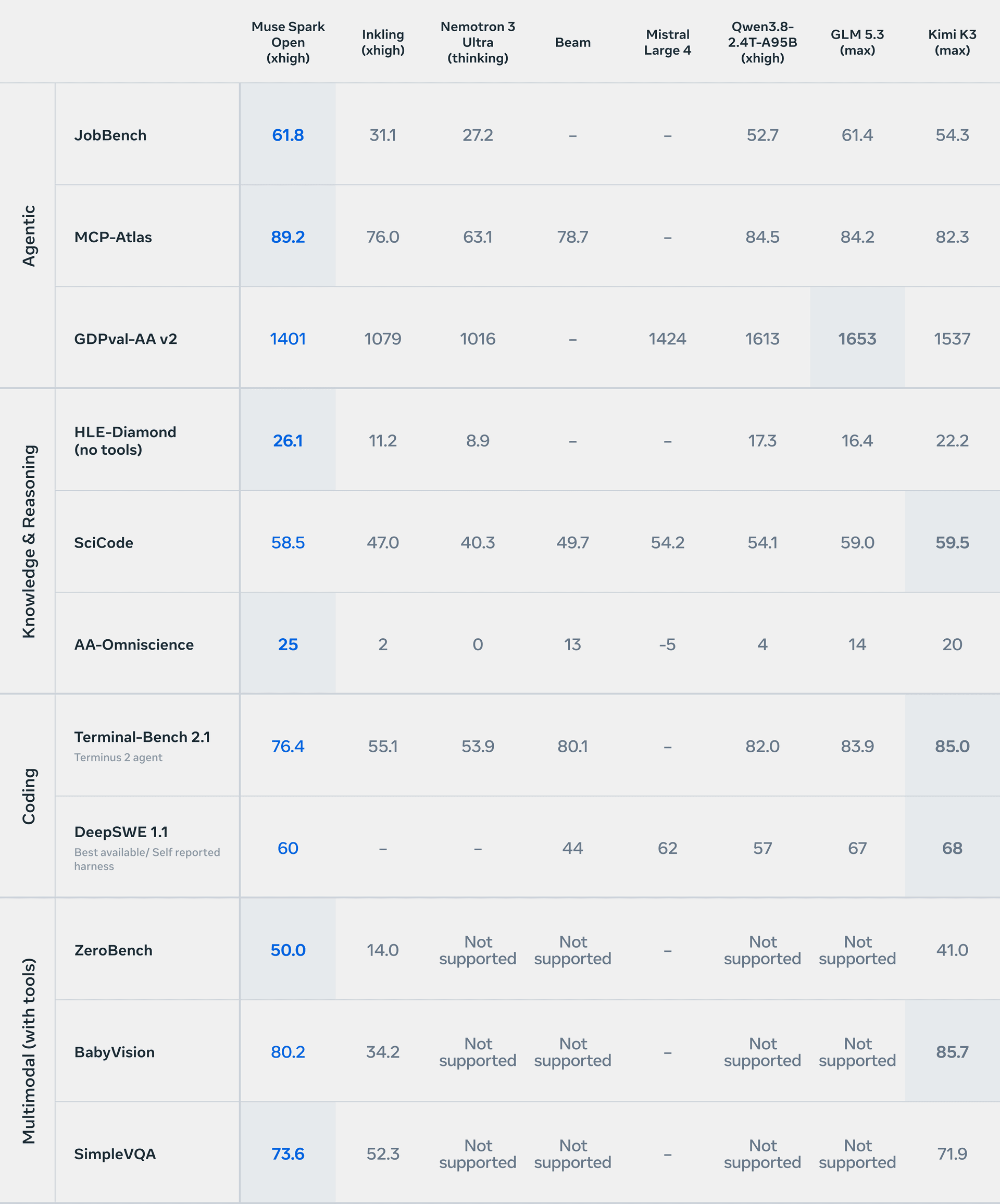
Meta compared it with open models of similar size. Numbers from Meta’s model card, Muse at xhigh:
| Benchmark | Muse Spark Open | GLM 5.3 | Kimi K3 | Qwen3.8 2.4T |
|---|---|---|---|---|
| AA Intelligence Index | 39 | 45 | 44 | 40 |
| MCP-Atlas (tool use) | 89.2 | 84.2 | 82.3 | 84.5 |
| HLE-Diamond (no tools) | 26.1 | 16.4 | 22.2 | 17.3 |
| AA-Omniscience | 25 | 14 | 20 | 4 |
| Terminal-Bench 2.1 | 76.4 | 83.9 | 85.0 | 82.0 |
| DeepSWE 1.1 | 60 | 67 | 68 | 57 |
| Image and video input | Yes | No | Yes | No |
The split is clean. Muse wins on tool calling and on knowledge accuracy, where AA-Omniscience rewards right answers and penalizes made-up ones. GLM 5.3 and Kimi K3 win on coding, by 7 to 9 points on Terminal-Bench and DeepSWE. Artificial Analysis reached the same verdict independently, calling agentic work a relative weakness against the Chinese leaders.
Cost per task is where Muse makes up ground. Artificial Analysis measured 40k output tokens per Intelligence Index task, the fewest among the nine best open models and 43% fewer than GLM 5.3. At launch pricing that works out to $0.84 per task, against $2.01 for GLM 5.3 and $0.27 for DeepSeek V4.1 Flash.
Is Muse Spark Open Free? The License
The weights are free to download, but Muse Spark Open is open-weight, not open source: Meta did not release training data or training code. Hugging Face asks for your name, date of birth and country before it unlocks the files. The Muse Model License then says:
- Use, modify, fine-tune, distill and sell are all allowed.
- Attribution is mandatory. Any product built on the model, or on a model derived from it, must show “Built with Muse Spark Open” in its UI, docs, website or settings.
- The $20M rule only hits API resellers. If you sell model access to third parties and your company’s revenue exceeds $20 million over 12 months, you need a separate agreement with Meta. Powering a feature of your own product is exempt.
- Not for under-18s, and the usage policy bans military use, malware and the usual list.
For an individual developer or a startup, that makes it free in practice. The cost is the hardware.
Should You Use It?
Pick Muse Spark Open if you need image or video input in an open model, if an agent that calls tools without inventing facts matters more than raw coding scores, or if you are required to use a US-origin model. It is also the cheapest per task of the strong open models after DeepSeek. If coding is the whole job, GLM 5.3 or Kimi K3 still beat it at a similar price.
Frequently Asked Questions
Can I run Muse Spark Open locally? Yes, if you have roughly 180 GB of combined RAM and VRAM for the smallest 1-bit GGUF, or 250 GB or more for the recommended 2-bit quant. Meta’s own NVFP4 checkpoint needs about 700 GB of VRAM. Two M5 Ultra Mac Studios with 512 GB each can run it with MLX.
Is Muse Spark Open on Ollama? Only as a cloud model: ollama run muse-spark-open:cloud. It runs on Ollama’s servers and costs $1.25 input and $4.25 output per million tokens. There is no local Ollama tag; for local use, run Unsloth’s GGUF files with llama.cpp or Unsloth Desktop.
Is Muse Spark Open open source? No, it is open-weight. Meta released the weights under the Muse Model License, which allows commercial use, fine-tuning and distillation, but not the training data or code. Products must display “Built with Muse Spark Open”, and API resellers above $20 million in annual revenue need a separate deal with Meta.
How much does the Muse Spark Open API cost? $1.25 per million input tokens, $0.15 per million cached input tokens and $4.25 per million output tokens on OpenRouter, Together AI, Fireworks, Baseten, Nebius and Modal. Artificial Analysis puts the average cost at $0.84 per Intelligence Index task.
Is Muse Spark Open better than GLM 5.3? Not overall. GLM 5.3 scores 45 on the Artificial Analysis Intelligence Index against 39 and leads on coding benchmarks. Muse Spark Open leads on tool use (MCP-Atlas 89.2 vs 84.2), on knowledge accuracy, on cost per task, and it accepts image and video input, which GLM 5.3 does not.