
Apple announced the iPhone Duo at its “Surprise and shine” event on September 9, 2026. The company’s first foldable iPhone measures 7.6 inches open and 5.4 inches closed, and it starts at $1,999.
That much is on every tech site today. The more interesting part is this: Apple squeezed the whole thing into 5.2 mm when open, and to get there it gave up Face ID, the SIM tray and the single-piece battery. This piece is less about the price list and more about how those trades were made.
What Is the iPhone Duo? 📱
A book-style folding iPhone. Closed, it pockets like a normal phone. Open, it becomes a canvas close to an iPad mini.
- Inner display: 7.6-inch Super Retina XDR, ProMotion 120Hz, Always On, 3000 nits peak, nano-texture finish
- Outer display: 5.4-inch Super Retina XDR, 90 percent of the iPhone 18 Pro’s screen area
- Thickness: 5.2 mm open, 11.3 mm closed
- Weight: 254 g
- Chip: A20 Pro (2 nm)
- Build: Grade 5 titanium, Ceramic Shield 2 front, Ceramic Shield back
- Durability: IP68, 6 metres for 30 minutes
- Authentication: Touch ID in the side button (no Face ID)
- SIM: eSIM only, worldwide
- Colours: star white, night sky
- Software: iOS 27.1
Both displays share the same aspect ratio. That reads like a footnote, but the consequence is large: open an app on the outer screen, unfold the phone, and the layout scales up proportionally instead of reflowing.
The Crease Problem and Apple’s Three-Layer Answer 🔬
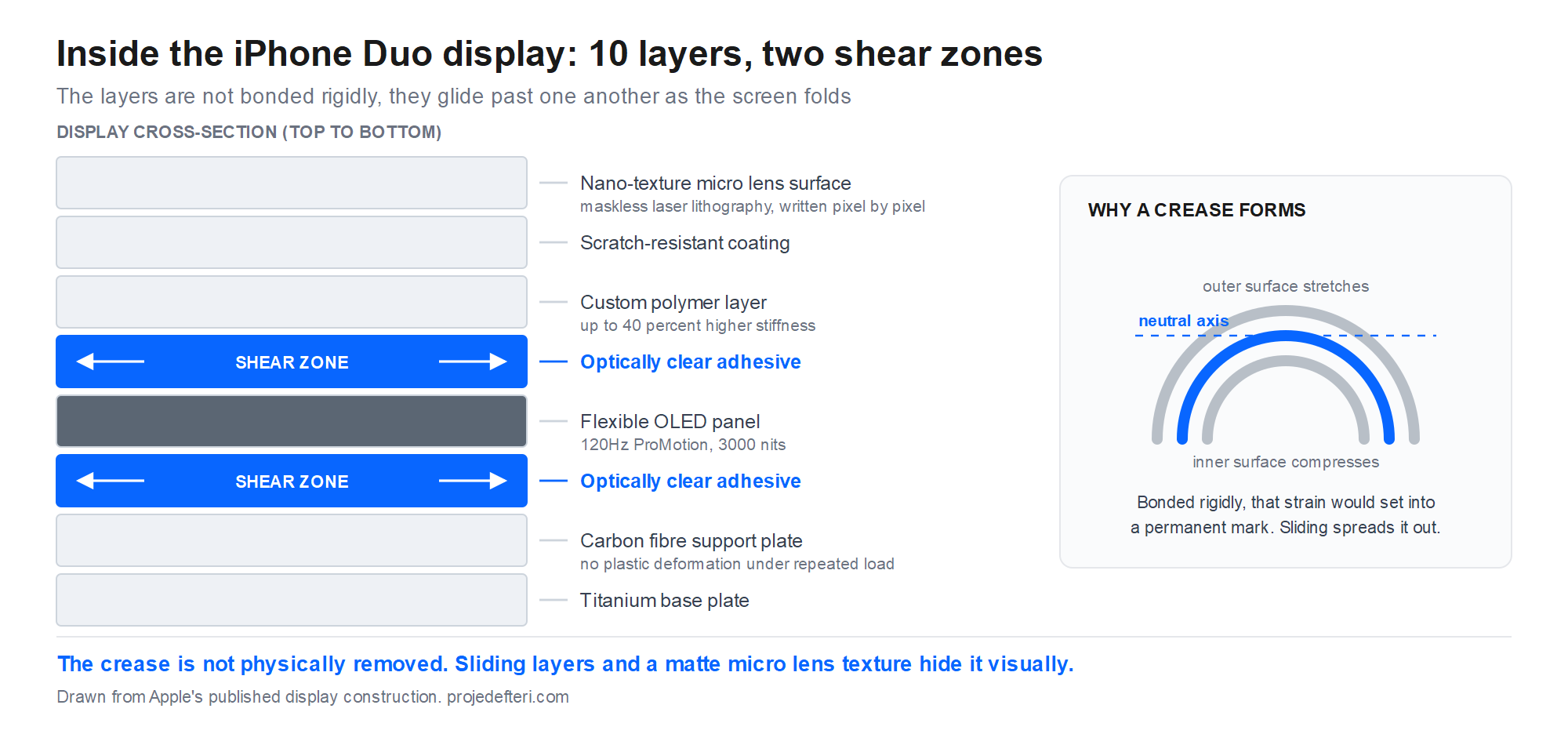
Seven years into foldable phones, the visible crease at the hinge line is still the shared flaw. The cause is plain material mechanics: bend a stack of layers and the outer surface stretches while the inner one compresses. Every layer away from the neutral axis sits under strain, and if the layers are bonded rigidly, that strain turns into permanent deformation. That is the crease.
Apple attacked it from three directions.
1. The layers do not stick, they slide
The inner display is built from 10 ultrathin layers. What holds them together is not a rigid bond but optically clear adhesives that behave viscoelastically: as the screen folds, they let the layers glide slightly past one another. Apple’s own comparison is pages shifting inside a book.
Mechanically, this splits the strain of one thick layer into many small sliding movements across thin ones. Each layer stays close to its own neutral axis, so none of them is stressed hard enough to leave a permanent mark. The same flexible OLED family shows up in a much smaller, non-folding form in hobby projects: Arduino OLED SSD1306 tutorial .
2. A micro lens texture that hides the crease
The second move is optical. Apple wrote a micro lens texture onto the inner display using maskless laser lithography, which writes each lens pixel by pixel.
This is the descendant of the nano-texture tech in the Pro Display XDR and Studio Display. The result, in Apple’s words, is a “perceptually flat matte surface.” By scattering reflections it removes the thing that gives a crease away most: light bouncing off the fold line at a different angle from the rest of the panel.
So the crease is not physically eliminated, it is visually neutralised. Those are not the same claim, and Apple does not make the stronger one. Its wording is “virtually imperceptible.”
3. A titanium plate and carbon fibre underneath
Beneath the panel sit a titanium base plate and carbon fibre support plates. Carbon fibre is not a styling choice here: its stiffness-to-weight ratio is high, and unlike metal it does not yield into plastic deformation under repeated loading. It does not develop a memory after a few hundred thousand folds.
The Hinge: 100+ Parts and 3D-Printed Titanium ⚙️
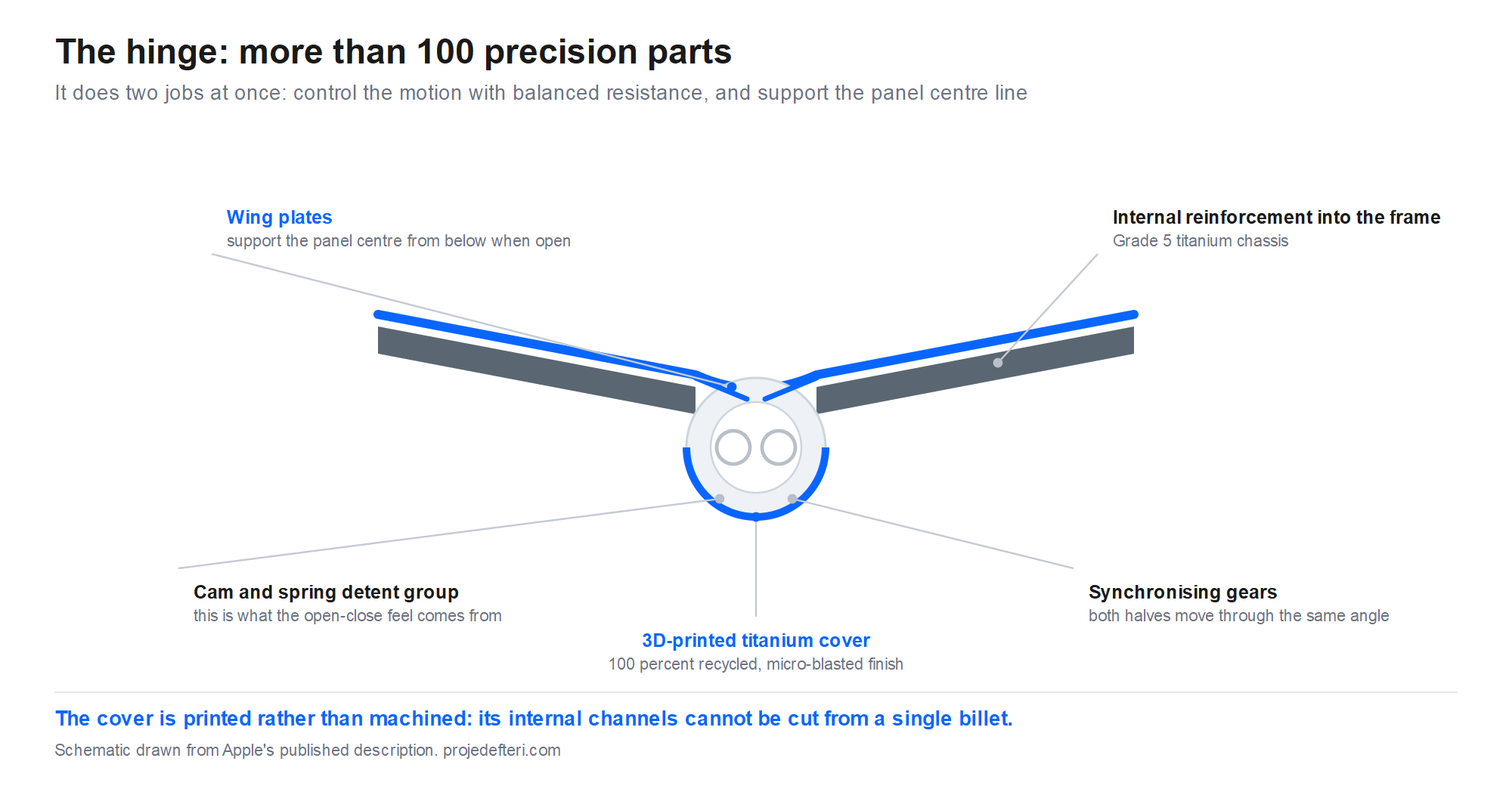
The hinge is made of more than 100 precision components. It does two jobs at once: it controls the opening and closing motion with balanced resistance, and it supports the centre of the display from below when the phone is open. The second job matters more than it sounds, because an unsupported centre line sags under a fingertip and re-bends the panel on every press.
The most interesting manufacturing detail is the hinge cover: 3D printed from 100 percent recycled titanium. Unlike the mirror-polished titanium of the body, the cover has a micro-blasted matte finish.
Why print instead of machine it? Two reasons. Geometry first: the cover carries internal channels and variable wall thickness, and cutting that from a single billet is either impossible or absurdly expensive. Material second: titanium is hard and costly to machine, and on a CNC most of the block leaves as swarf. Additive manufacturing uses only what the part needs, and here that material is recycled titanium to begin with.
What Fits in 5.2 mm? The Volume Budget 📐
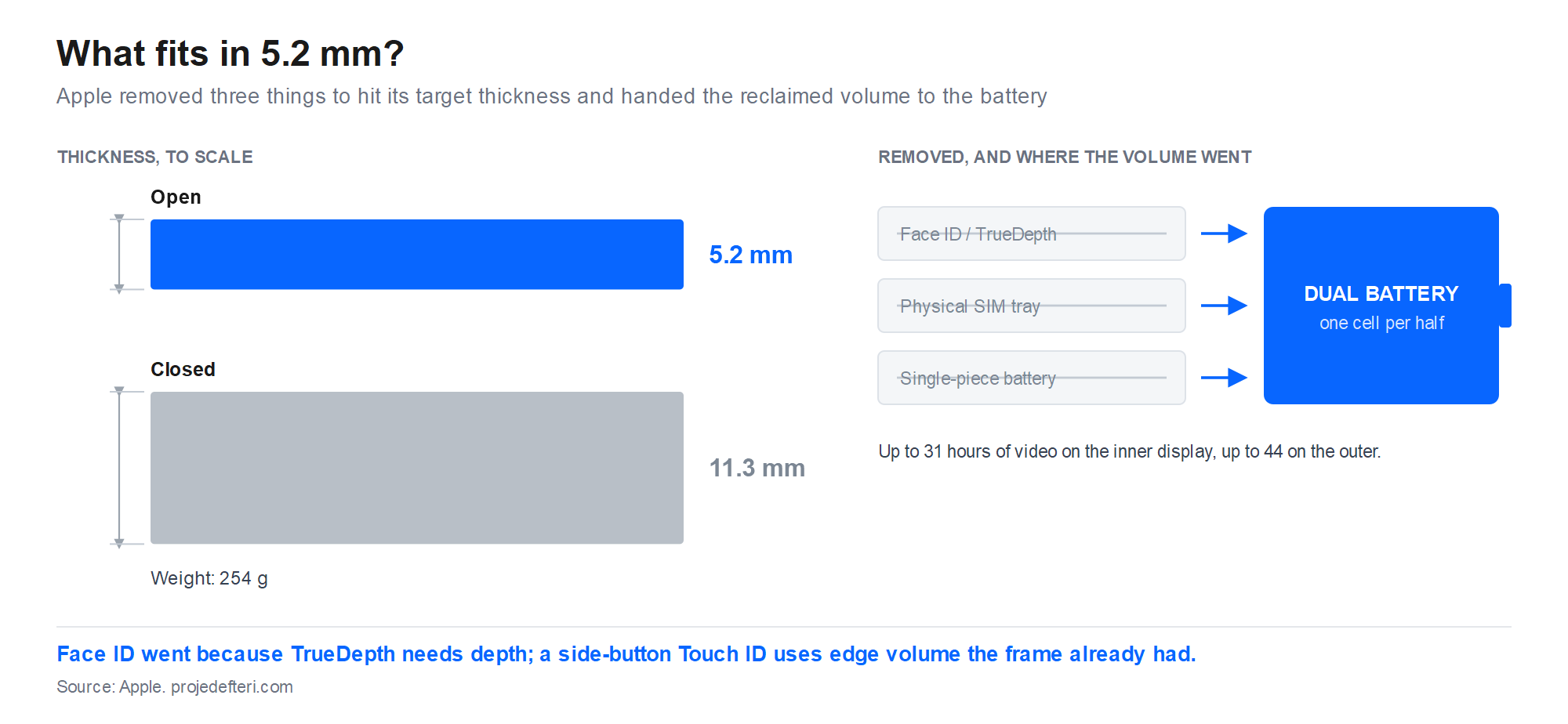
Here is where the real engineering story sits. 5.2 mm open means each half is roughly 5.6 mm folded, once the hinge allowance is subtracted from 11.3 mm. Display stack, logic board, battery and cooling all have to live inside that. Apple bought the space back in four places.
Face ID is gone, Touch ID is back
The iPhone Duo has no Face ID. Authentication runs through a Touch ID sensor built into the side button, and it works whether the phone is open or closed, supports multiple fingers, and pairs with unlock-with-Apple-Watch.
This is not nostalgia, it is volume. Face ID’s TrueDepth system needs a dot projector, an infrared camera and a flood illuminator, and that package demands depth. It does not fit into a 5.2 mm half. A side-button sensor uses the edge volume the frame already has and asks for no new depth at all.
The SIM tray is gone
The iPhone Duo is eSIM only worldwide. No market gets a physical tray. A SIM tray costs more room than it looks: the tray itself, its slot, the gasket, and the clearance behind it. Apple handed that volume straight to the battery.
Two batteries, not one
There are two high-energy batteries, one per half, and the system manages them as a single cell. The reason is structural: a single cell cannot span the hinge, because cells do not bend. Two smaller cells fill each half’s flat volume completely instead.
Apple’s numbers:
- Video playback on the inner display: up to 31 hours
- Video playback on the outer display: up to 44 hours
- Using both equally: up to 24 hours
- 50 percent charge over cable: about 20 minutes
- 50 percent over MagSafe or Qi2: about 30 minutes
- A 5-minute charge: up to 5 hours of outer-display playback
That 44-hour outer figure is the interesting one. The small panel draws far less power, and the combined capacity of both cells feeds just that one screen. In practice, time spent using the phone closed is time added directly to battery life.
A vapour chamber
Running a chip like the A20 Pro under sustained load inside a 5.2 mm body is a thermal problem. Apple bonded a vapour chamber directly to the A20 Pro package, with a design it says was inspired by M-series Apple silicon. The claim is up to 35 percent better sustained performance than the iPhone 17 Pro.
Cameras and the Under-Display FaceTime Camera 📷
On the back sit a 48MP Fusion Main camera (zero shutter lag, integrated 2x optical telephoto, 24MP by default) and a 48MP Fusion Ultra Wide with macro. Video records at 4K120 in Dolby Vision.
The front arrangement is the clever part. The outer screen carries a 12MP Center Stage camera. The inner screen hides a FaceTime camera under the display, delivering 1080p video. An under-display camera always costs image quality, because the sensor is looking through a pixel matrix. Rather than solve that, Apple split the workload: serious shots go to the rear cameras, video calls go to the hidden one.
Duo Preview is the most practical win the form factor buys. When you shoot with the rear cameras, the person in front of you sees their own live preview on the outer display. In other words, selfies get taken on a 48-megapixel rear camera. Alongside it are Smart Take, which analyses the scene on-device and fires when subjects pose, Kid Cue for the child-facing screen, and Duo FaceTime, which uses both displays at once.
Software: Split View Arrives on iPhone 🖥️
The most concrete change in iOS 27.1 is Split View: two apps side by side on an iPhone for the first time, with saveable app pairs. The Lock Screen moves to the side and the Dynamic Island runs vertically.
On the hardware side, a new Display Engine drives both panels simultaneously. Combined with the shared aspect ratio, the practical outcome is that developers do not write two layouts. The same layout scales.
Connectivity runs on Apple’s own C2 modem (up to 50 percent faster than the C1X, with mmWave in the US) and the N1 networking chip (Wi-Fi 7, Bluetooth 6, Thread).
iPhone Duo Price and Release Date 💰
| Item | iPhone Duo | Detail |
|---|---|---|
| Starting price | $1,999 | 256GB, up to 2TB |
| Pre-orders | October 16 | 5:00 a.m. PT |
| On sale | October 23 | 70+ countries |
| Second wave | October 30 | 28 more countries |
| Case / Folio | $79 / $129 | MagSafe and Qi2 25W |
On sustainability, the device uses 35 percent recycled content overall, 100 percent recycled cobalt in the battery and 100 percent recycled titanium in the 3D-printed hinge cover.
What Else Was Announced? 🎯
The Duo did not ship alone:
- iPhone 18 Pro and 18 Pro Max: the same A20 Pro chip, a variable aperture camera, a smaller Dynamic Island cutout and larger batteries
- Apple Watch Series 12: a ceramic case option and a claim of the most accurate heart rate sensing in a wearable
- Apple Watch Ultra 4
- AirPods 5: two versions, with and without active noise cancellation
- Software: release dates for iOS 27, iPadOS 27, macOS Golden Gate, tvOS 27, watchOS 27 and visionOS 27
Siri’s rebuilt AI version rolls out in beta on September 14, English first. How assistants like this decide what to do under the hood is covered in our piece on AI agents .
The Takeaway
The news in the iPhone Duo is not that an iPhone folds. Samsung did that in 2019. The news is that Apple went after the crease optically rather than mechanically, and that it was willing to drop a flagship feature like Face ID to hit 5.2 mm.
Whether the approach worked comes down to two things: whether the nano-texture surface really hides the crease in daily light, and whether a 100-part hinge still feels the same two years in. Neither can be answered today. The first teardowns arrive within weeks of October 23, and they will settle both.