I’m back with a groundbreaking development that is shaking up the tech world! Yes, as you guessed from the title, we are talking about Kimi K2.5. Developed by the Chinese company Moonshot AI, this model is currently taking the world by storm with its 1.04 Trillion parameters and technical specifications. 🚀
In this post, we will take a close look at the technical details, features, and popularity of Kimi K2.5, which is challenging giants like GPT-4.1 and Claude. 👇🏻
What is Kimi K2.5?
Kimi K2.5 is a flagship open-source AI model released by Moonshot AI in early 2026. However, calling it just a “language model” would be unfair. Because it is a beast equipped with Native Multimodal and Agentic capabilities! 🦖
1. Architectural Infrastructure: MoE and MuonClip 🏗️
Friends, when we step into the kitchen, we are greeted by a massive structure. Kimi K2.5 possesses a Mixture-of-Experts (MoE) architecture with 1.04 Trillion (yes, trillion!) parameters.
“How does such a huge model not become sluggish?” you might ask. The answer is Sparse Activation. For every operation, our model selects and activates only the most relevant 8 experts out of a total of 384 experts. So, it uses only the relevant ~3% of its brain for each question. This gives it both speed and the power of “32 Billion Active Parameters”.
Let’s dive a bit deeper into the technical details:
- Layers: 61
- Attention Heads: 64
- Hidden Dimension: 7,168
- Vocabulary: 160,000 tokens
2. Agent Swarm: An Army of One! 🐝
Here is where it gets very interesting! If you say “One mind isn’t enough, I need an army,” Kimi K2.5 steps in. Thanks to the Agent Swarm feature, it can split a complex task into up to 100 sub-agents and solve them in parallel.
Doing market research? Let the Main Agent plan the task, while the Sub-Agents scour the internet and report the results to you. This feature speeds things up incredibly. 🚀
Performance: Intimidating the Competition
Let’s cut to the chase and look at the scores. Kimi K2.5 is making proprietary (closed-source) competitors sweat, especially in math and coding.
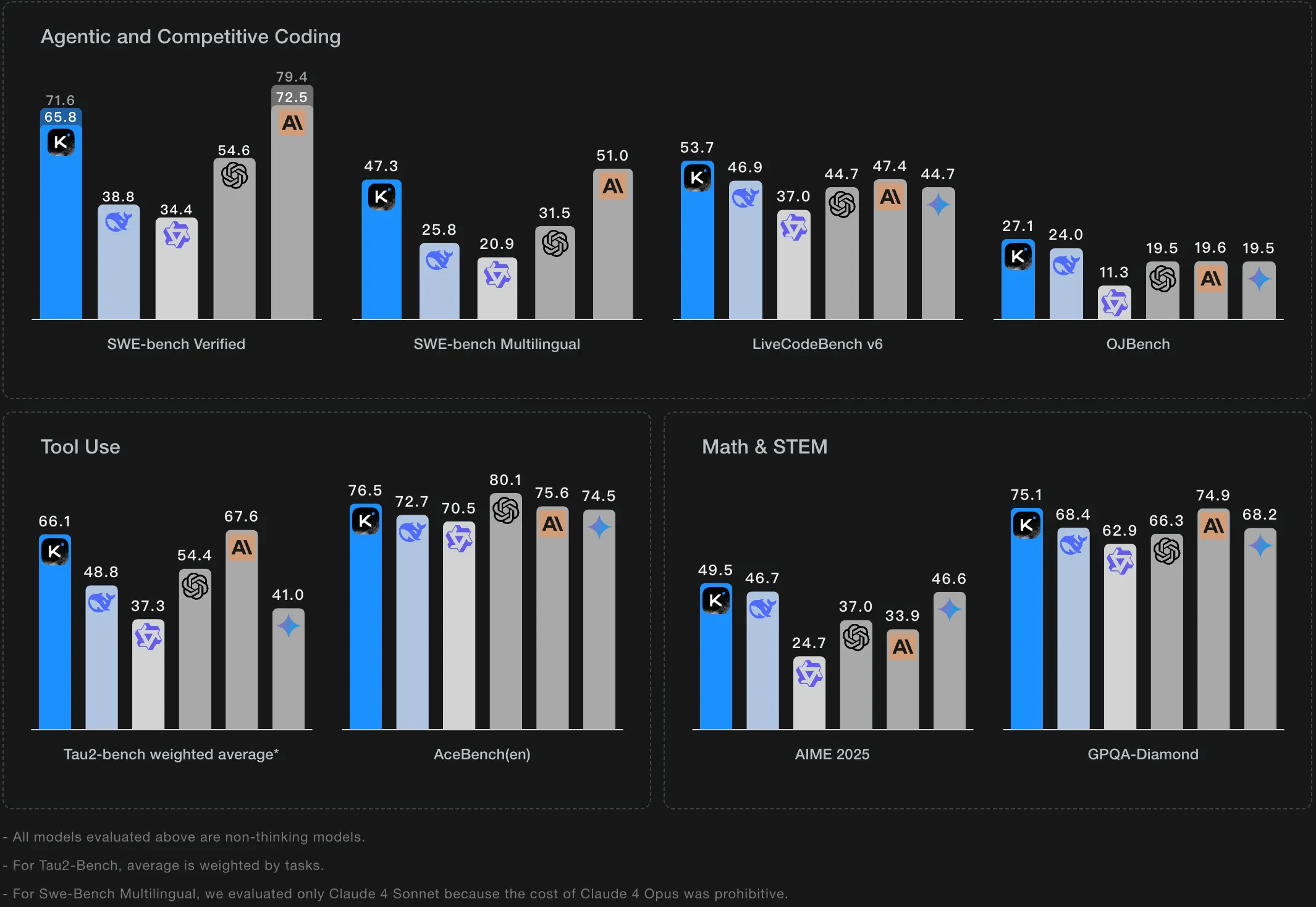
Here are some striking results:
| Category | Benchmark | Kimi K2.5 Score | Competing Models |
|---|---|---|---|
| Math | MATH-500 | 97.4% | GPT-4.1 (92.4%), Claude Opus 4 (94.4%) |
| Coding | SWE-bench Verified | 65.8% | GPT-4.1 (54.6%), Claude S4 (~72.7%) |
| General Language | MMLU | 89.5% | GPT-4.1 (90.4%), Claude Opus 4 (92.9%) |
| Tool Use | Tau2 Telecom | 65.8 | GPT-4.1 (38.6), Claude S4 (45.2) |
Especially the 97.4% score in the MATH-500 test teaches a lesson to models claiming to be “good with numbers”. It solves graduate-level math problems like eating peanuts! 🧮
Price Revolution: Dirt Cheap! 💸
Let’s get to the emotional (financial) part… 😂 Perhaps the biggest deal about Kimi K2.5 is its price. It is 5 times cheaper than its competitors!
Cost Comparison (Per 1 Million Tokens):
- Kimi K2.5: Input $0.15 / Output $2.50
- GPT-4.1: Input $2.00 / Output $8.00
- Claude Sonnet 4: Input $3.00 / Output $15.00
So a company could reduce its annual AI costs from $68,000 to $120. Isn’t that incredible? Bosses will be very happy to hear this… 🤑
Licensing Status 📝
Kimi K2.5 comes with a Modified MIT License. Its use is quite free, but there is a small condition:
Conclusion
Friends, to wrap it up, Kimi K2.5 is one of the most explosive open-source projects of 2026. It doesn’t burn a hole in your pocket, and its performance is through the roof. It creates wonders especially with its Agent Swarm feature and massive context window.
What do you think about Kimi K2.5? Is the throne of the GPT series shaking? Let’s meet in the comments, I’m very curious about your thoughts! 😉
For more technical details, you can check out the Kimi K2.5 Blog Post or visit Kimi.com to try the model. 👇🏻
Stay healthy, stay coding! ✨