- Kimi K3 is the new AI model Chinese company Moonshot AI announced on July 16, 2026; at 2.8 trillion parameters, it is the largest open source model released so far.
- In a single 48-hour run it designed a working chip, finished an astrophysics study in 2 hours instead of 2 weeks, and cut a teaser video from 56 raw clips.
- It reads 1 million tokens at once: roughly like reading the entire Lord of the Rings trilogy in one sitting and remembering all of it.
- On coding it plays in the same league as the strongest Claude and ChatGPT models, and beats them on some tests. It falls behind on hard knowledge questions.
- You can try it in the Kimi app and on kimi.com. The model files go public on July 27, 2026.
Ask an AI to design a chip for you and what happens? It probably writes you a nice article about how chips are designed.
Kimi K3, the model Moonshot AI announced on July 16, 2026, did not do that. Without asking anyone and without anyone stepping in, it worked alone for 48 hours and produced a chip design that actually works: 1.46 million logic cells, decoding more than 8,700 words per second in simulation.
Here is the interesting part: this model is open source. It does not sit locked in a company vault the way ChatGPT or Gemini does. On July 27, Moonshot hands the model’s files to everyone: download it, install it on your own machine, use it however you like. For a 2.8 trillion parameter model, that has never happened before.
The official spelling is Kimi K3. You will also see it searched as Kimik3 or Kimi3, and all three refer to the same model.
Let’s look at what it is and why everyone is talking about it. 👇🏻
What Is Kimi K3?
Kimi K3 is the flagship AI model from the Chinese company Moonshot AI. It does what ChatGPT or Claude does: you ask, it answers. It writes code, reads documents, understands images and video, and researches the web on your behalf.
The difference hides in two numbers: 2.8 trillion parameters and 1 million tokens.
What does “2.8 trillion parameters” mean?
Think of parameters as tiny adjustment knobs where the model stores what it has learned. More knobs, more capacity. 2.8 trillion is the biggest number ever released to the public.
So how does a model this enormous run at a reasonable speed? The answer is an approach called mixture of experts. K3 holds 896 separate “experts” inside it, but only 16 of them wake up for any given word.
Picture it this way: you walk into a colossal hospital staffed by 896 doctors, but only the 16 who handle your specific problem ever see you. The hospital is huge. Your bill is not.
How much is “1 million tokens”?
A token is roughly a piece of a word. One million tokens comes out to about 750,000 words.
To make that concrete: the Lord of the Rings trilogy runs about 480,000 words. So you could hand K3 all three books and ask “how does Frodo’s state of mind shift across the story,” and the whole thing stays in its head. Kimi K2.5, which we covered back in February, had a quarter of that room (256K tokens).
Curious how many tokens your own text comes to? Paste it into our token counter and you will see the number instantly. It is a useful habit: token counts rarely match your word count, and that gap is what you end up paying for.
But What Did It Actually Do? 🤯
Numbers are boring. Work is not. These are the real examples from Moonshot’s own announcement:
A chip design in 48 hours. In a single autonomous run, with no human stepping in, it designed a chip. It closes timing at 100 MHz, packs 1.46 million standard cells, and sustains over 8,700 tokens per second of decode throughput in simulation. This normally eats weeks of an engineering team’s time.
Two weeks of research in two hours. On an astrophysics task it read and cross-validated 20+ scientific papers, evaluated 300+ equations of state, and wrote over 3,000 lines of Python. Moonshot says this work usually takes one to two weeks. K3 finished in roughly two hours.
A video cut from 56 clips. It edited a teaser out of raw footage: choosing which clip goes where, making motion-matched cuts, syncing to the beat of the music with frame accuracy. One to two working days for an experienced editor.
It wrote its own games. Using Three.js WebGPU it built a 3D open-world game, a GBA emulator, and a fighting game, generating the environments and 3D assets itself.
It read 11,000 pages. For an analysis of the AI chip industry it ran 2,800+ web searches and pulled from 11,000+ pages. In another study it ran 20+ helper agents at once and produced 7 scientific visualizations.
GPU kernel optimization. Given up to 24 hours on NVIDIA H200 hardware, it went toe to toe with Claude Fable 5 and beat Claude Opus 4.8 by a clear margin.
How Does It Stack Up? 📊
AI models get measured with standardized exams. K3’s opponents here are the two strongest models around: Claude Fable 5 and GPT-5.6 Sol.
The official coding results:
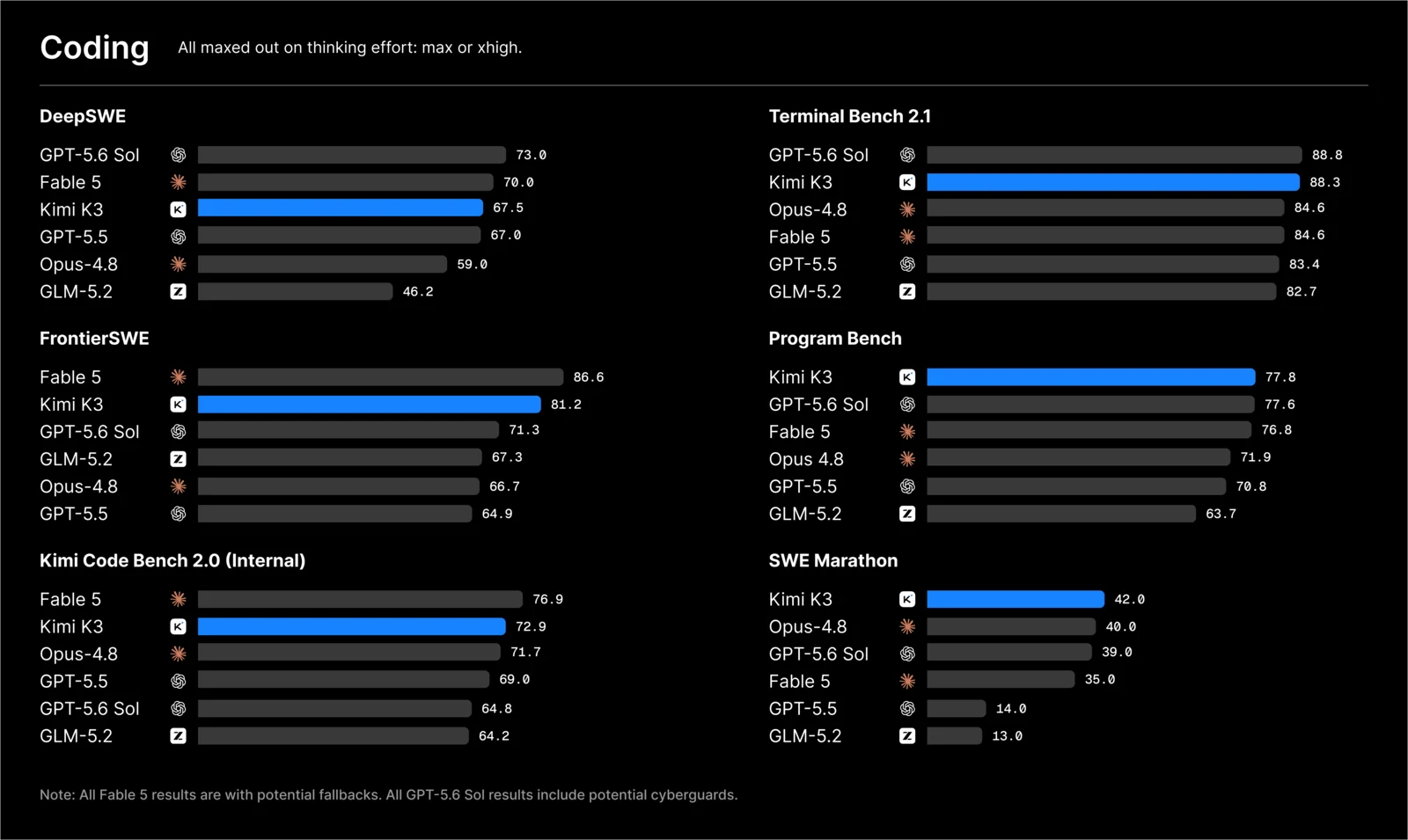
The short version: K3 beats every rival on long-horizon software work (SWE Marathon) and general programming (Program Bench). On terminal use it sits half a point behind GPT-5.6 Sol, but above both Claude models.
For agent and visual skills, the picture looks like this:
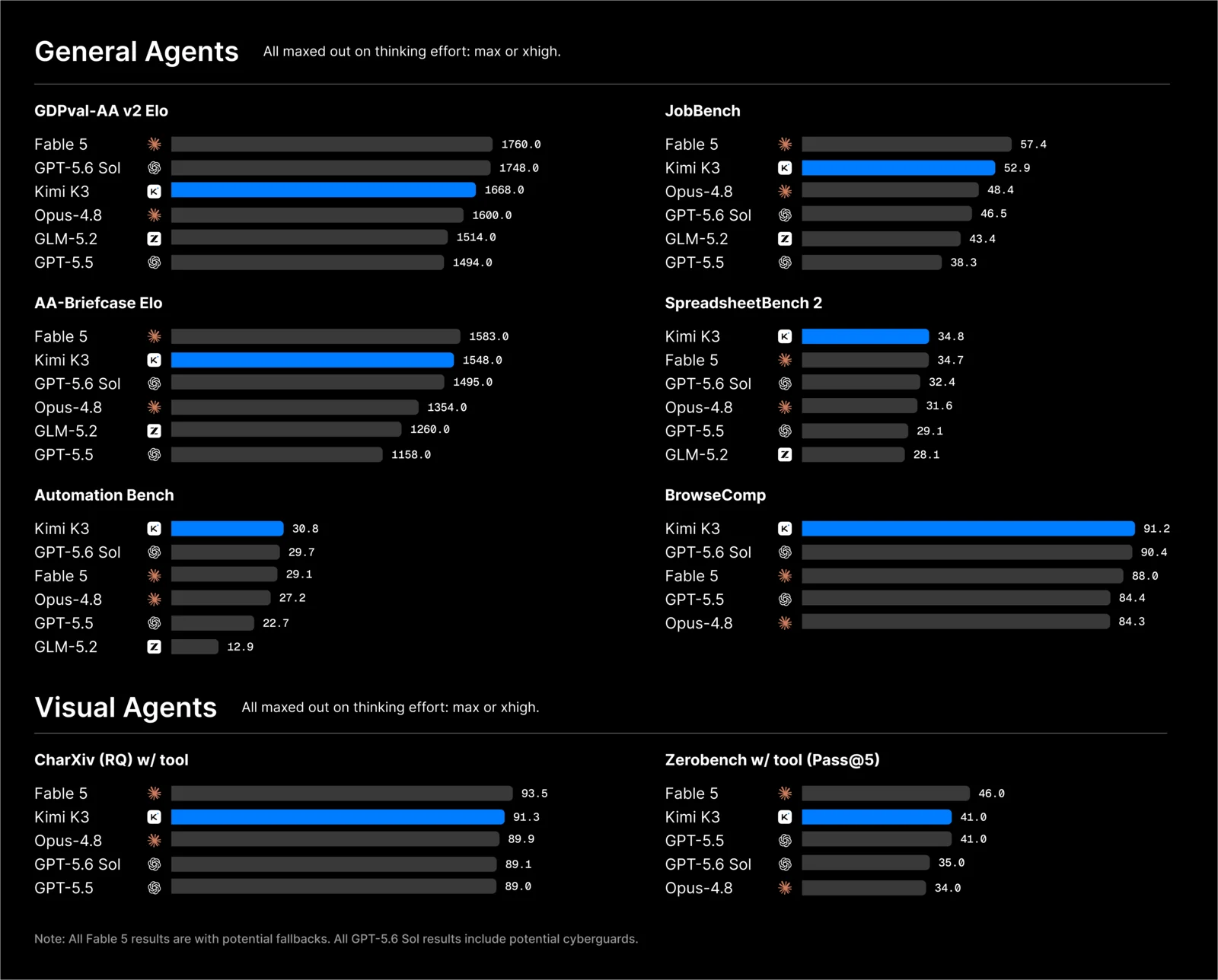
On real-world tasks spanning 44 occupations (GDPval-AA v2), K3 lands third: Claude Fable 5 and GPT-5.6 Sol lead, Claude Opus 4.8 trails. In exchange, it leads outright on web research and document reading.
Its weak spot surfaces on hard knowledge questions. On the brutal exam called HLE, roughly 10 points separate it from Claude Fable 5. It handles PhD-level science questions, then stumbles on the most extreme knowledge problems.
To sum up: K3 has not dethroned the closed giants. But it is the first open source model playing in their league, and that is a real threshold on its own.
How Do I Try It, and Is It Free? 💸
The easiest route is kimi.com or the Kimi mobile app (iOS included). The app lets you try the model free within limits, and heavy use needs a paid plan. If you write software, it is also available through Kimi Code and Kimi Work (v3.1.0+).
If you want it in your own app, API pricing runs like this (per million tokens):
| Item | Price |
|---|---|
| Input (new content) | $3.00 |
| Input (repeated content) | $0.30 |
| Output (what the model writes) | $15.00 |
That repeated content line matters. If you keep sending the same long document or code file, Moonshot remembers it and charges a tenth of the price. The company says this discount lands more than 90% of the time on coding work.
For comparison: there is no tiered pricing by context length. A monster request using the full million tokens bills at the same rate.
What do these numbers mean for your workload? Punch your input and output token counts into our LLM cost calculator to put Kimi side by side with GPT and Claude and see your monthly bill before it arrives.
For Developers: Getting Started in 5 Lines
The API is compatible with the OpenAI library. The code you wrote for ChatGPT connects to K3 with a two-line change:
from openai import OpenAI

client = OpenAI(
    api_key="YOUR_KEY",
    base_url="https://api.moonshot.ai/v1",   # this is the only real change
)

answer = client.chat.completions.create(
    model="kimi-k3",
    messages=[{"role": "user", "content": "Describe Kimi K3 in one sentence."}],
)

print(answer.choices[0].message.content)
Three gotchas worth knowing:
- The
thinkingparameter does nothing. Thinking is always on in K3; you tune the tier withreasoning_effort, andmaxis the only valid value for now. - Send the model’s reply back verbatim. In multi-turn chat, keep the entire message the API returns. Hold on to just the text and the model breaks.
- No web links for images. Send pictures as base64 or upload them to Moonshot first.
Details live in the official docs.
The Flaws Moonshot Admits Itself
Companies rarely publish their own model’s shortcomings. Moonshot did:
- Its memory is fragile. Drop the model into a conversation that started with another AI, or pass its thinking history back incompletely, and answer quality degrades badly.
- It is too forward. When your intent is unclear, it may make unexpected decisions on your behalf. In their words, it needs to “refrain from excessive improvisation.”
- The experience lags. Moonshot says it plainly: competitive as K3 is overall, it falls noticeably short of the feel that Claude Fable 5 and GPT-5.6 Sol deliver.
Independent testing also found K3 to be quite the talker: it burns far more words than its rivals doing the same job. Being cheap per token offsets part of that.
When Can I Download the Model?
Kimi K3 was announced as open source, but the files are not downloadable yet. Moonshot says full model weights will publish by July 27, 2026. The license and technical report land the same day. So as of today, K3 is a promised open source model.
Why does that matter? Because an open source model can be installed on your own machine or your company’s server. Your data never leaves, there is no monthly subscription, and if the company shuts the model down tomorrow, you still have it. Running a 2.8 trillion parameter model at home is of course out of reach, but for researchers and companies this means a genuine alternative to closed models.
Frequently Asked Questions
Question: When was Kimi K3 released? Answer: Moonshot AI announced Kimi K3 on July 16, 2026, and made it available the same day through the Kimi app and Kimi Code.
Question: Is Kimi K3 free? Answer: You can try it free within limits through the Kimi app and kimi.com. Heavy use and developer access are paid.
Question: Is Kimi K3 open source? Can I download it? Answer: It was announced as an open source model, but the files are not published yet. Moonshot says weights arrive by July 27, 2026. The earlier K2 family used a Modified MIT license. Technically it is an “open-weight” model: the model files ship, the training data does not.
Question: Is Kimi K3 better than ChatGPT and Claude? Answer: On coding and research tasks it is very close, and ahead on some tests. It trails on hard knowledge questions and on general feel. Since you can try it free, you can judge for yourself.
Question: How many parameters does Kimi K3 have? Answer: 2.8 trillion in total. But because only 16 of 896 experts fire for each word, it burns far less compute in practice.
Question: What is the difference between Kimi K3 and Kimi K2? Answer: K3’s context window is four times bigger (1 million tokens), it understands images and video, and its new architecture makes it roughly 2.5x more efficient than K2. Thinking mode is also always on now. If you are curious about the previous generation, take a look at our Kimi K2.5 review.
Stay healthy… 🙂