Meta shipped Muse Spark 1.3 on September 2, 2026: a closed multimodal reasoning model built for long-running agentic workflows, multi-agent setups and coding.
Two numbers made the headlines. It scores 75.4 on DeepSWE v1.1, edging past Claude Opus 5, and it hits 98.1% retrieval across a full million tokens of context. Both are real. Both come with a footnote, and the footnotes are what this post is about.
What Is Muse Spark 1.3? 🧠
Muse Spark is Meta Superintelligence Labs’ closed flagship series. Version 1.3 succeeds 1.2, and the pitch is not producing one good answer but carrying a long task all the way to the end.
The specs:
- Context window: 1,048,576 tokens (1M)
- Input modalities: text, image, audio and video
- Output: text only
- Weights: closed, not downloadable
- Access: Meta Model API and Muse Code
- Released: September 2, 2026
The headline gain over 1.2 is not a score, it is efficiency: the same work now takes roughly 20% fewer tool calls and 25% fewer tokens. On agent workloads that lands straight on the bill.
Muse Code is Meta’s own coding-agent harness. The model spends fewer turns and fewer tokens inside its native environment, which means part of the published performance belongs to the scaffolding rather than the weights.
Two Modes: xhigh and max ⚙️
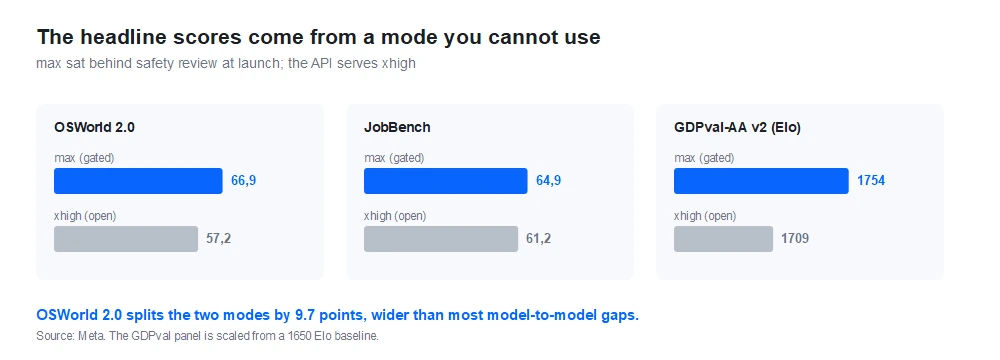
This matters. Muse Spark 1.3 has two reasoning modes, and only one was open at launch:
| Measure | max | xhigh | Gap |
|---|---|---|---|
| OSWorld 2.0 | 66.9 | 57.2 | 9.7 points |
| GDPval-AA v2 (Elo) | 1754 | 1709 | 45 points |
| JobBench | 64.9 | 61.2 | 3.7 points |
| Intelligence Index (AA) | 48 | 45 | 3 points |
| Output speed | 226 tokens/s | 176 tokens/s | max is faster |
| Available at launch | No | Yes | max is in safety review |
Most of the numbers that travelled came from max, and max sat behind safety review at launch. Connect to the API today and what you get is xhigh.
Meta is not hiding this, it is in the announcement itself:
AI at Meta: the Muse Spark 1.3 announcement, max mode and the open-weights plan
The thread continues: “max reasoning coming soon after we finish safety testing.” The setting that produces the model’s best scores is gated until that testing is done.
Benchmark Results 📊
Meta’s own scorecard:
| Benchmark | Muse Spark 1.3 | Claude Opus 5 | GPT-5.6 Sol |
|---|---|---|---|
| DeepSWE v1.1 | 75.4 | 74.0 | 72.7 |
| Terminal-Bench 2.1 | 88.8 | 86.7 | 88.8 |
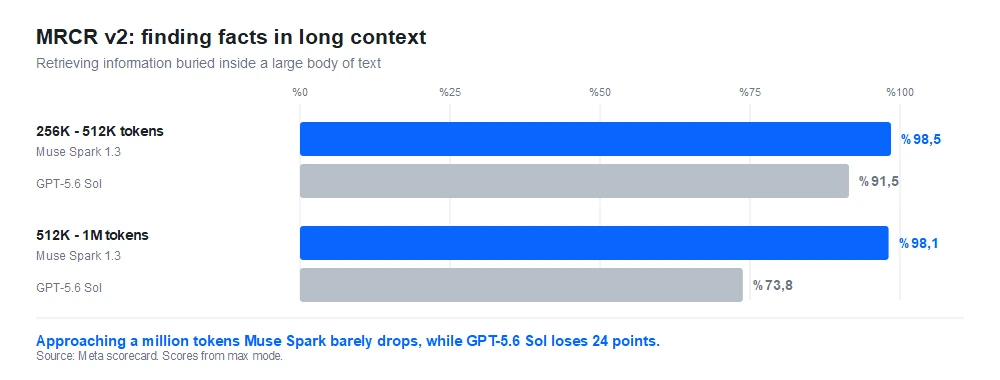
| MRCR v2 (256K-512K) | 98.5 | n/a | 91.5 |
| MRCR v2 (512K-1M) | 98.1 | n/a | 73.8 |
| SWE-Atlas Codebase QnA | 59.4 | n/a | n/a |
Two readings come out of this.
Long context is a blowout. MRCR v2 measures whether a model can find and use information buried inside a large body of text. Between 512K and 1M tokens Muse Spark scores 98.1% while GPT-5.6 Sol drops to 73.8%. Nothing else in this table has a 24 point gap. If you want a model that can actually use a million-token window rather than just accept one, this is the row that matters.
Coding is a coin flip. DeepSWE puts it 1.4 points ahead of Opus 5, and Terminal-Bench 2.1 is a dead tie with GPT-5.6 Sol. Both of those come from the gated max mode. Independent measurement is more restrained too: on the Artificial Analysis Intelligence Index the model sits at 24th of 644.
So “it beat Opus 5” is true for one row, not as a general claim.
Pricing: Two Endpoints, 12.5x Apart 💸
This is the genuinely interesting part. Meta sells the model through two separate endpoints:
| Item (per 1M tokens) | Contributor | Standard | Gap |
|---|---|---|---|
| Input | $0.10 | $1.25 | 12.5x |
| Output | $0.20 | $4.25 | 21.25x |
| Cache read | $0.002 | $0.15 | 75x |
| Your data | Meta may train on it | Stays private | The real price |
The Contributor tier is not a discount, it is a trade. In Meta’s own wording, it offers “heavily discounted token pricing in exchange for permission to use your prompts and completions to train future Meta models”.
So your prompts and the model’s answers become Meta training data. If you handle personal data, customer records or proprietary source code, this endpoint is closed to you. For an open-source side project, a personal experiment or a non-sensitive batch job, a 21x cut is a serious offer.
Even the standard tier sits on the cheap side of the market:
| Model | Input | Output |
|---|---|---|
| Muse Spark 1.3 (Contributor) | $0.10 | $0.20 |
| Gemini 3.8 Flash | $0.75 | $3.75 |
| Muse Spark 1.3 (standard) | $1.25 | $4.25 |
| Qwen3.8-Max | $2.00 | $6.00 |
| GPT-6 Astra | $10.00 | $50.00 |
| Claude Fable 5.1 | $10.00 | $50.00 |
Muse Spark’s standard tier is one eighth of the $10/$50 shelf where GPT-6 Astra and Claude Fable 5.1 both sit. On the Contributor tier the gap widens to a hundredfold. Both tiers are now in our LLM cost calculator if you want to run your own numbers.
What Does That Mean on a Monthly Bill? 🧮
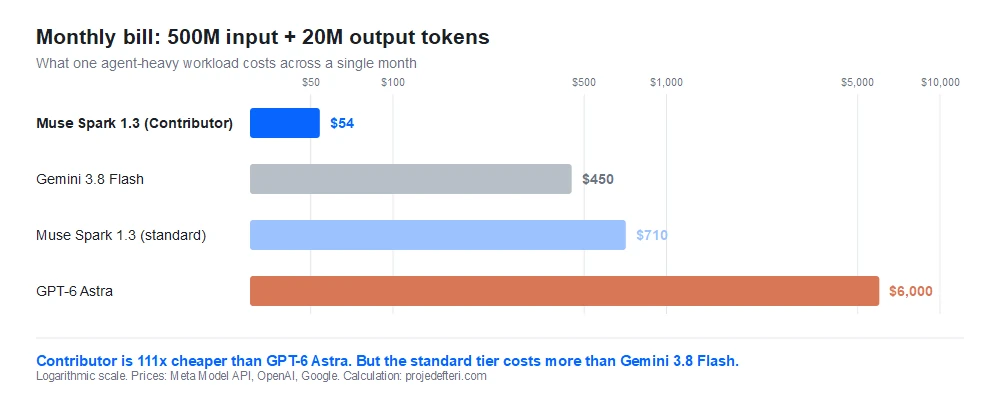
Make it concrete. Take an agent-heavy workload: 500M input tokens and 20M output tokens per month. Input dominates because the agent rereads the same context on every turn.
| Model / tier | Input (500M) | Output (20M) | Monthly total |
|---|---|---|---|
| Muse Spark 1.3 (Contributor) | $50 | $4 | $54 |
| Gemini 3.8 Flash | $375 | $75 | $450 |
| Muse Spark 1.3 (standard) | $625 | $85 | $710 |
| GPT-6 Astra | $5,000 | $1,000 | $6,000 |
Two conclusions.
First, the Contributor tier is in a different league entirely: the same workload costs 111 times more on GPT-6 Astra. That is no longer a discount, it is a different business model. Meta is not selling cheap tokens, it is buying training data and paying for it in rebate.
Second, and less discussed: Muse Spark’s standard tier is more expensive than Gemini 3.8 Flash. Picking Muse Spark as “the cheap option” on price alone is a mistake. What justifies the standard tier is not cost, it is the million-token retrieval score and four-modality input. Without those two, Flash-class models are cheaper.
What Changed From 1.2 to 1.3? 🔄
Meta is not promising a score jump in this release, it is promising efficiency. To finish the same task:
- roughly 20% fewer tool calls
- roughly 25% fewer tokens
On agent workloads that can be worth more than a score. If a task runs 40 turns and each turn makes a tool call, 20% fewer calls pulls both the bill and the wall-clock time down. The $710 monthly figure above would have been around $900 doing the same work on 1.2.
Meta’s other listed changes are harder to measure: the model now asks clarifying questions, keeps better track of the task map across long threads, and is better calibrated about its own limits, meaning it is less prone to pretending it can do something it cannot.
That last one matters in agent setups. A model that keeps attempting work it cannot do burns tokens and produces wrong output.
Are There Open Weights? 🔓
No. Muse Spark 1.3 is closed, with no downloadable weights and no Hugging Face repository. Meta has said an open-weights Muse Spark release is coming “soon”, but no date, variant or licence has been confirmed.
The Muse you can download and run today is Muse Glimmer: 30 billion parameters, Apache 2.0, distilled from Muse Spark. Architectural relatives, but Glimmer is small and local while Spark is large and API-bound.
The choice is simple: if data privacy forces you to run locally, Glimmer. If you need a million tokens of context and the top scores, Spark.
How to Use It 🔧
There are two channels:
- Meta Model API: direct API access. The standard endpoint serves xhigh mode; the Contributor endpoint serves the same model at the discounted rate.
- Muse Code: Meta’s own coding-agent interface, where the model spends fewer turns and fewer tokens.
Meta has not announced a free tier. The Contributor rate is cheap but not free, and you pay in data. The choice between endpoints is made at the API key level, so one account can route sensitive work to the standard endpoint and non-sensitive batch jobs to Contributor.
One warning: the max mode you see in benchmark tables is not on the API yet. Plan against max scores and the performance you actually get will be lower. If you are designing anything that relies on computer use, that 9.7 point OSWorld gap can be the difference between an agent that works and one that stalls.
There is a modality detail too: the model accepts audio and video as input but produces text only. Video summarisation and audio transcription are on the table; video or audio generation is not.
Who Is This Right For? 🎯
- Anyone working with very long context: the strongest case by far. A 24 point MRCR v2 lead above 512K tokens is not something a competitor closes with price.
- High-volume agent workloads: if you can accept the data trade, the Contributor tier’s 21x cut is the most aggressive offer on the market.
- Video and audio input: few models take all four modalities.
- Enterprises on confidential data: stay on the standard endpoint. $1.25/$4.25 is still an eighth of the frontier shelf.
- Everyday coding: no rush. The DeepSWE lead is 1.4 points and it came from the gated max mode.
- Running locally: not Spark, Muse Glimmer.
FAQ ❓
How much does Muse Spark 1.3 cost? There are two tiers. The standard endpoint is $1.25 per million input tokens and $4.25 per million output tokens. The Contributor endpoint is $0.10 input and $0.20 output, making it 12.5x cheaper on input, 21.25x on output and 75x on cache reads. The price of the Contributor tier is permission for Meta to use your prompts and completions to train future models.
What is the Muse Spark Contributor tier? It is a separate API endpoint serving the identical model at heavily discounted rates in exchange for Meta being allowed to train on the prompts you send and the completions you receive. Technically nothing about the model changes; only the data policy does.
Is Muse Spark 1.3 free? No. Meta has not announced a free tier. The Contributor rate is very cheap but still paid, and it requires you to accept that your data will be used for model training.
Is the Contributor tier safe to use? It depends entirely on your data. Meta may use prompts and completions sent through that endpoint to train future models. If you handle personal data, customer records, health data or contractually protected source code, stay on the standard endpoint.
What are the Muse Spark 1.3 benchmark results? On Meta’s scorecard: 75.4 on DeepSWE v1.1 against Claude Opus 5’s 74.0 and GPT-5.6 Sol’s 72.7; 88.8 on Terminal-Bench 2.1, tied with Sol; 98.5% on MRCR v2 between 256K and 512K tokens and 98.1% between 512K and 1M; 59.4 on SWE-Atlas Codebase QnA. These come from the max mode, which was gated at launch. On the Artificial Analysis Intelligence Index the model ranks 24th of 644.
What is the Muse Spark 1.3 context window? 1,048,576 tokens, exactly one million. On the MRCR v2 long-context retrieval test it scores 98.1% between 512K and 1M tokens, where GPT-5.6 Sol drops to 73.8%.
Does Muse Spark 1.3 have open weights or a Hugging Face repo? No. The model is closed and API-only, with no downloadable weights. Meta has said an open-weights Muse Spark release is coming soon, but no date, variant or licence has been confirmed. The Muse model you can download today is Muse Glimmer, 30 billion parameters under Apache 2.0.
What is the difference between Muse Spark 1.3 and Muse Glimmer? Muse Glimmer is a 30 billion parameter open-weight model under Apache 2.0, distilled from Muse Spark, that you can run on your own machine. Muse Spark 1.3 is the closed flagship: much larger, with a one million token context window, reachable only through the Meta Model API and Muse Code.
What is the difference between xhigh and max mode? max is the higher reasoning setting and most published benchmark figures come from it: 66.9 against 57.2 on OSWorld 2.0, 1754 against 1709 on GDPval-AA v2 Elo, 64.9 against 61.2 on JobBench. However max was gated behind safety review at launch, so the mode reachable through the API today is xhigh.
Conclusion
The real story of Muse Spark 1.3 is not the benchmark table, it is two footnotes: most of the headline scores come from a mode you cannot use yet, and the eye-catching price comes with your data as the payment.
Set those aside and something solid remains: a retrieval score at a million tokens that nobody comes close to, at an eighth of frontier pricing. If long context is your problem, Muse Spark 1.3 is currently the most sensible answer on the market. If you are picking it for coding, pick it knowing how thin the margin is.