
- Meta released its first frontier models, Muse Wonder and Muse Wonder Full, on October 12, 2026.
- Muse Wonder costs $4 input / $20 output per million tokens on the Meta Model API, with cached input at $0.20. That is exactly Claude Opus 5.5’s price.
- The stronger Wonder Full is not on the API. You only get it inside Muse Code, on the $50 and $200 monthly plans.
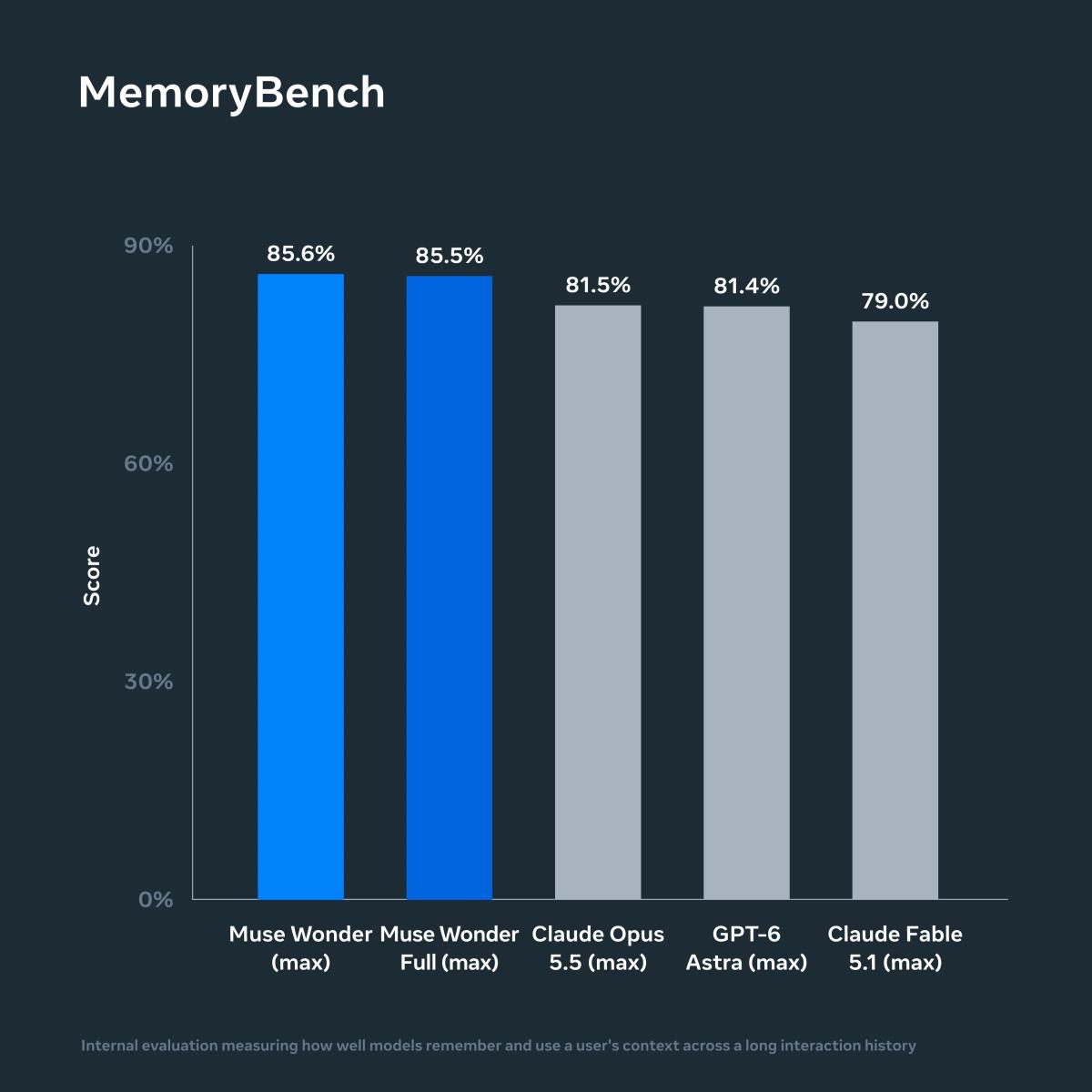
- It leads on memory and long-horizon coding (MemoryBench 85.6, DeepSWE 78.8, both ahead of Opus 5.5) but trails Opus 5.5 on the Artificial Analysis Intelligence Index.
Meta’s first frontier model costs exactly what Claude Opus 5.5 costs, down to the cached-input rate, and scores 6 points lower on the most widely cited independent index. What it offers in return is something none of its rivals do as well: remembering what matters across a long conversation.
Muse Wonder and Muse Wonder Full came out of Meta Superintelligence Labs on October 12, 2026. Until now Meta’s closed models were the Muse Spark line, built for speed and low cost. Wonder sits on larger base models, was trained at Meta’s gigawatt-scale Prometheus data center in Ohio, and is the company’s first real shot at the top of the leaderboard. The launch post drew 448 points on Hacker News.
Muse Wonder Pricing
| Model | Input | Cached input | Output |
|---|---|---|---|
| Muse Wonder | $4.00 | $0.20 | $20.00 |
| Claude Opus 5.5 | $4.00 | $0.20 | $20.00 |
| GPT-6 Astra | $10.00 | n/a | $50.00 |
| Muse Spark 1.3 | $1.25 | $0.15 | $4.25 |
The API model ID is muse-wonder-1.0. Two things stand out on the price sheet.
First, there is no Contributor tier. Muse Spark 1.3 can be had for $0.10/$0.20 if you let Meta train on your prompts; Wonder lists a single price only. Second, Wonder is 2.5x cheaper than GPT-6 Astra on both input and output, so against OpenAI’s flagship the pitch is cost. Against Opus 5.5 there is no price argument at all, which means the choice comes down to the benchmarks below.
You can plug your own token counts into our LLM cost calculator or the token counter , both of which now list Muse Wonder.
Muse Wonder vs Muse Wonder Full
The two models share a name but not a storefront:
| Spec | Muse Wonder | Muse Wonder Full |
|---|---|---|
| Meta Model API | Yes | No |
| Muse Code | Yes | Power ($50/mo) and Maximum ($200/mo) |
| Token price | $4 / $20 | Not sold per token |
| AA Intelligence Index | 52 | 56 |
| DeepSWE 1.1 | 78.8 | 79.0 |
| SWE-Marathon | 53.1 | 57.5 |
So the model you can wire into your own product is Muse Wonder. Most of the headline numbers belong to Wonder Full, and the only way to use that one is through Meta’s own coding agent, Muse Code. The Power plan gives 20x the usage of the entry Everyday plan; Maximum gives 80x.
Both models share the same spec sheet otherwise: a 1M-token context window, text, image, video and audio input, text-only output, and closed weights.
Benchmarks: Where It Wins and Where It Doesn’t
Meta ran everything at max reasoning effort against Claude Opus 5.5, GPT-6 Astra and Claude Fable 5.1:
| Benchmark | Wonder | Wonder Full | Opus 5.5 | GPT-6 Astra | Fable 5.1 |
|---|---|---|---|---|---|
| MemoryBench | 85.6 | 85.5 | 81.5 | 81.4 | 79.0 |
| DeepSWE 1.1 | 78.8 | 79.0 | 74.2 | 74.1 | 67.4 |
| SWE-Marathon | 53.1 | 57.5 | 46.3 | 42.5 | 45.6 |
| Personal Superintelligence Index | 54.3 | 59.1 | 55.2 | 54.5 | 49.9 |
| Harvey LAB-AA (legal) | 10.0 | 13.1 | 4.2 | 8.6 | 6.4 |
| Terminal-Bench 4.0 | 52.0 | 57.1 | 59.6 | 59.1 | 52.0 |
| ProgramBench | 50.0 | 59.0 | 70.5 | 52.5 | 55.5 |
| OSWorld V2.1 | 72.6 | 78.4 | 81.8 | 75.8 | 80.7 |
| HealthBench Pro | 60.5 | 62.3 | 65.6 | 65.3 | 62.1 |
| AA Intelligence Index | 52 | 56 | 58 | 53 | 53 |
Memory is the clear win. MemoryBench checks whether a model can pull the right detail out of a 64K to 100K-token conversation full of distractors and facts that get updated later on. Muse Wonder beats every rival by more than 4 points. For a model sold as the engine of a personal assistant, this is the number that matters most.
Long-horizon coding yes, from-scratch coding no. On DeepSWE, Wonder is 4.6 points ahead of Opus 5.5. On ProgramBench, which asks the model to rebuild a whole program in a clean room, Opus 5.5 scores 70.5 and Wonder 50.0. Opus and Astra also lead on Terminal-Bench. One caveat on SWE-Marathon from Meta’s own model card: the rivals’ scores there come from Codex and Claude Code, so it is not a controlled same-harness comparison.
Opus 5.5 still has the best general score. On the Artificial Analysis Intelligence Index, Opus 5.5 leads with 58 and Wonder Full is second with 56. The API model, Muse Wonder, sits at 52: one point below both GPT-6 Astra and Fable 5.1.
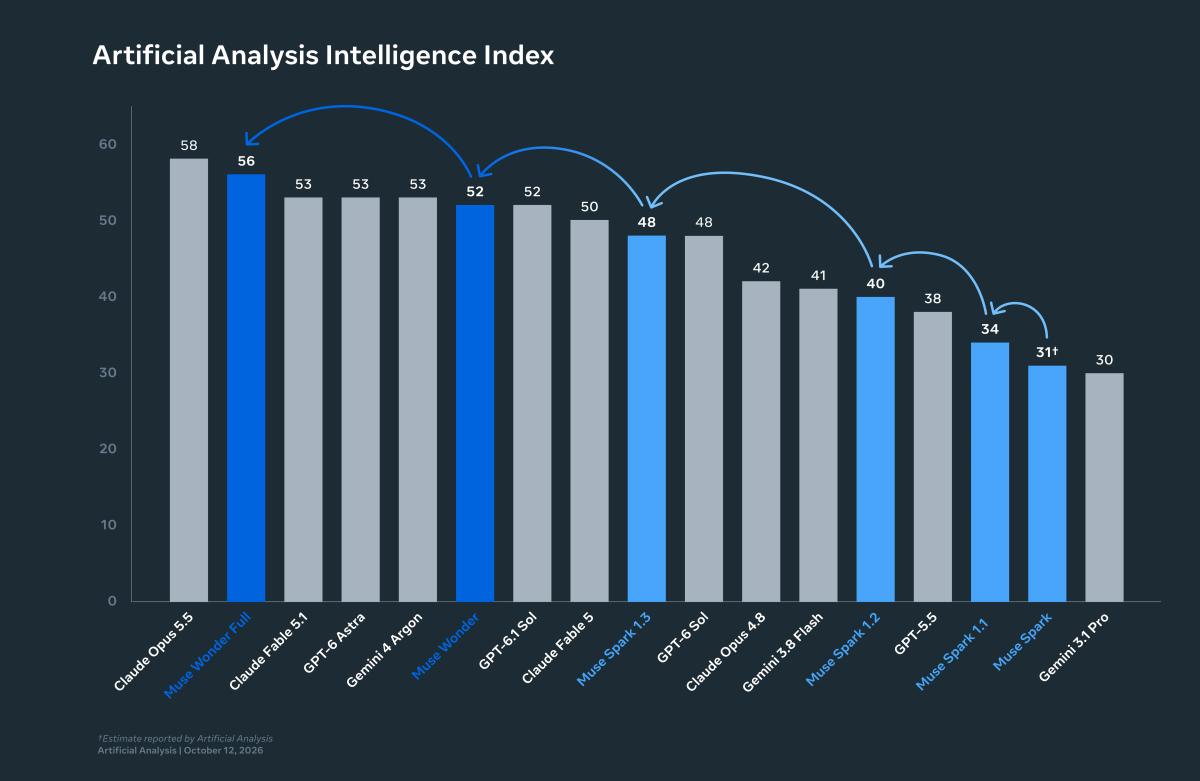
The chart also shows how far Meta has come in a year: the first Muse Spark scored an estimated 31, Wonder Full scores 56.
How to Use Muse Wonder
There is no free tier. You have three routes:
- Meta Model API: use the
muse-wonder-1.0model ID. The API is OpenAI SDK compatible, so an existing OpenAI client only needs a new base URL and key. There is also a playground on dev.meta.ai. - Muse Code: Meta’s multi-agent coding tool for the terminal. Wonder is available there; Wonder Full needs the Power ($50/month) or Maximum ($200/month) plan.
- The Muse app: “soon”, subscribers first. No date for free users. Our Meta Muse guide covers what the app does today.
Is Muse Wonder open source? No. The weights are closed and there is no Hugging Face repo. The Muse model you can run on your own machine is still the 30B Muse Glimmer .
Safety Notes from the Model Card
Two details in Meta’s model card are worth knowing. Meta does not rule out that the unmitigated model reaches its “high risk” threshold for chemical and biological misuse, so it ships with extra safety training and system-level classifiers. And on the ExploitGym cyber benchmark, Wonder Full captured 92 flags, but only 21 through the intended vulnerability; the other 71 came from holes the test designers had not planned for.
The listed limitations are plain: visual and spatial reasoning, especially 3D, is weak, and the model is not meant for users under 18.
Should You Use It?
Muse Wonder proves Meta is now in the frontier race, but “beats Opus 5.5” is not the right headline. At the same price, Opus 5.5 leads on general intelligence, and the model the API actually sells is Wonder, not Wonder Full.
There is a good case for picking it, though. If you are building a personal assistant that has to hold context over weeks, or a coding agent that runs for hours, its MemoryBench and DeepSWE scores are the best available right now. For short, one-shot coding work, the same money buys Opus 5.5, which is the safer choice.
FAQ
How much does Muse Wonder cost? $4 per million input tokens, $0.20 per million cached input tokens and $20 per million output tokens on the Meta Model API. That is identical to Claude Opus 5.5 and 2.5x cheaper than GPT-6 Astra.
What is the difference between Muse Wonder and Muse Wonder Full? Wonder Full is the stronger model (56 vs 52 on the Artificial Analysis Intelligence Index), but it is not on the API. It is only available inside Muse Code on the $50/month Power and $200/month Maximum plans. Muse Wonder is the one you can call through the API.
Is Muse Wonder free? No. Meta did not announce a free tier. It is coming to the Muse app “soon”, but subscribers get it first.
Is Muse Wonder better than Claude Opus 5.5? It depends on the task. Muse Wonder leads on memory (MemoryBench 85.6 vs 81.5) and long-horizon coding (DeepSWE 78.8 vs 74.2). Opus 5.5 leads on the Artificial Analysis Intelligence Index (58 vs 52), ProgramBench (70.5 vs 50.0) and OSWorld computer use. Both cost the same.
Is Muse Wonder open source? No. The weights are closed and the model is only available through the Meta Model API and Muse Code. Meta’s open-weights model is Muse Glimmer, a 30B model under Apache 2.0.
What is Muse Wonder’s context window? 1 million tokens. It takes text, image, video and audio as input and produces text only.