Project, Technology, Knowledge, and Blogs
Don’t forget to follow us on Instagram! 🤗
Does Claude Watermark Text? How It Works
Summary: Claude's Watermark in 30 Seconds Claude models released on or after August 2, 2026 embed an imperceptible mark in the text they generate. Older models are being retrofitted. The mark lives in the text itself. It survives copy and paste, and can survive light editing. Files get a separate mechanism: .svg, .png and .jpg outputs carry signed provenance metadata following the C2PA standard. Coverage is broad: the API, Claude apps, Claude Code, Cowork, Claude Tag, plus access through AWS, Google Cloud and Microsoft Foundry, worldwide. A detected mark means the content may have been processed by Claude. The absence of a mark proves nothing about whether text was AI-generated. Detection tooling and technical documentation are not published yet. Today, no third party can actually verify a mark. Watermarking an image is easy. You nudge millions of pixel values by amounts no eye can catch, and you are done. Watermarking text is a different problem entirely. There are no pixels, only words, and you cannot change a word “slightly”. It is either that word or a different one. ...
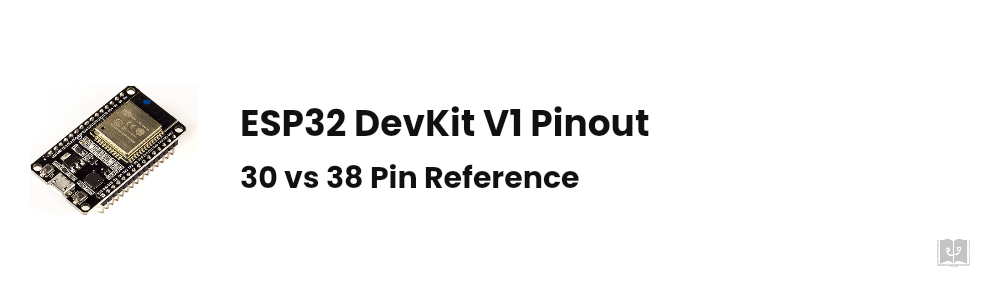
ESP32 DevKit V1 Pinout: 30 vs 38 Pin Reference
Summary: ESP32 Pinout in 30 Seconds The ESP32 is Espressif’s dual-core Xtensa LX6 MCU running at up to 240 MHz with Wi-Fi and Bluetooth. The chip has 34 GPIOs; boards break out either 30 or 38 pins. The 30 vs 38 pin difference is not just pin count: six of the extra pins on the 38-pin board are wired to the internal flash and cannot be used. GPIO6 through GPIO11 belong to the flash chip. Connect anything there and the board will not boot. GPIO34, 35, 36 and 39 are input only. They cannot drive an output and have no internal pull-up or pull-down. GPIO0, 2, 5, 12 and 15 are strapping pins. Hold one at the wrong level during boot and the board either refuses to start or hangs in flashing mode. ADC2 does not work while Wi-Fi is on. Wire analog sensors to the ADC1 pins, GPIO32 to GPIO39. The board runs on 3.3 V logic and is not 5 V tolerant. Never wire a 5 V sensor output straight to a GPIO. The ESP32 is cheap, fast, and ships with Wi-Fi and Bluetooth built in. It also has one habit that drives beginners up the wall: the board says 38 pins, and you cannot use all of them. Wire a relay to one pin and the board stops booting. Wire a sensor to another and the reading turns to noise the moment Wi-Fi comes up. Wire an LED to a third and it flickers once on every reset. ...
Gemini 3.7 Flash: Benchmarks, Pricing, Specs
Summary: Gemini 3.7 Flash in 30 Seconds Gemini 3.7 Flash landed on August 13, 2026, only three weeks after 3.6 Flash. Introductory pricing is $0.75 in / $3.75 out per 1M tokens: half of 3.6 Flash’s standard rate. The promo ends December 31, 2026. Coding jumped hard: FrontierCode 1.1 went from 34.4% to 43.6%, DeepSWE v1.1 from 48.6% to 65.3%. Context window is 1,048,576 tokens with a 65,536 token output cap. It takes text, images, video, audio and PDF. It is not the smartest model on the board: 56 on the Artificial Analysis index, one point behind GPT-5.6 Terra and Muse Spark 1.2, at roughly a third of their price. Google’s Flash line has never been about winning the intelligence crown. It is the model you run at volume: cheap enough to call thousands of times a day, fast enough to sit inside a product. Gemini 3.7 Flash stretches that definition. ...
DeepSeek V4 Pro 0813: Price and Benchmarks
Summary: DeepSeek V4 Pro in 30 Seconds DeepSeek V4 Pro 0813 went generally available on August 13, 2026. No press release, no blog post, just one line in a changelog. 1.7 trillion parameters, mixture-of-experts architecture, 1M token context, 384K token output ceiling. The weights are on Hugging Face under the MIT license. You can download them, modify them and ship them in a commercial product. Official scores are bold: 87.9 on Terminal Bench 2.1, 62.7 on DeepSWE. Independent testing is more restrained: 53 on the Artificial Analysis Intelligence Index. Pricing is $0.435 in and $0.87 out per million tokens. From August 16 the off-peak rate is half of that. The catch: its smaller sibling V4 Flash scores 52 on the same index at one third of the price. You are paying triple for one point. Model launches have settled into a ritual: a teaser video, a wall of benchmark charts, an excited founder post. DeepSeek skipped all of it. DeepSeek V4 Pro 0813 went generally available on August 13, 2026 with no announcement at all. One line landed in the API changelog and the weights appeared on Hugging Face. ...
Grok 4.6 Is Here! Benchmarks, Price and What Changed
Summary: Grok 4.6 in 30 Seconds Grok 4.6 is SpaceXAI’s new flagship model, announced on August 12, 2026. It is a post-training upgrade on the Grok 4.5 base, not a new foundation model. It scores 61 on the Artificial Analysis Intelligence Index: five points above Grok 4.5 from a month ago, level with GPT-5.6 Sol, two points behind Claude Opus 5. Pricing did not move: $2 per 1M input tokens and $6 per 1M output. Roughly half what rivals charge. A new reasoning tier arrived: xhigh. The model also checks and verifies its own work far more often. The context window is 500K tokens, but any request above 200K doubles the price of the whole call. In the AI race, a month is a long time. In early July we were writing about Grok 4.5. Five weeks later SpaceXAI announced Grok 4.6 and put the model straight back into the frontier conversation. ...